
Review the key concepts, formulae, and examples before starting your quiz.
🔑Concepts
3D shapes are solid objects that have three dimensions: length, width, and height. The flat surfaces are called faces, the lines where faces meet are edges, and the corners where edges meet are vertices.
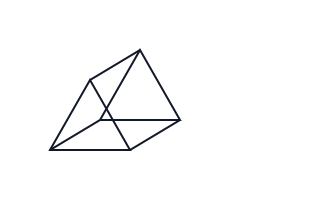
A Prism is a 3D shape with the same cross-section all the way through. It has two identical ends (bases) connected by rectangular flat faces. Examples include rectangular prisms (cuboids) and triangular prisms.
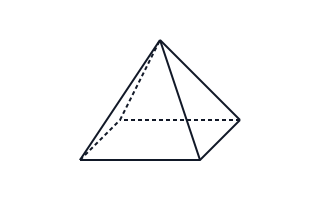
A Pyramid has a base that is a polygon and triangular sides that meet at a single point at the top called the apex. The name of the pyramid comes from the shape of its base (e.g., Square-based pyramid).
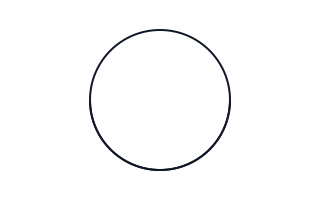
A Sphere is a perfectly round 3D shape, like a ball. Every point on its surface is the same distance from the center. It has 1 curved surface, 0 edges, and 0 vertices.
📐Formulae
(Euler's Formula for polyhedra)
💡Examples
Problem 1:
Identify the 3D shape that has 1 square base and 4 triangular faces that meet at a point.
Solution:
Square-based Pyramid
Explanation:
A pyramid is named after its base. Since the base is a square and the sides are triangles meeting at an apex, it is a square-based pyramid.
Problem 2:
How many faces, edges, and vertices does a triangular prism have?
Solution:
5 faces, 9 edges, and 6 vertices.
Explanation:
A triangular prism has 2 triangular faces (the ends) and 3 rectangular faces. It has 3 edges around each triangle plus 3 connecting edges (). It has 3 vertices on each triangular face ().
Problem 3:
Which 3D shape has no flat faces, no edges, and no vertices?
Solution:
Sphere
Explanation:
A sphere is a perfectly round solid. Because it is completely curved, it does not have any flat surfaces (faces), sharp lines (edges), or corners (vertices).
Problem 4:
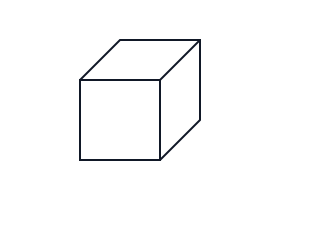
Identify the 3D shape shown in the diagram and state the number of faces, edges, and vertices it has.
Solution:
Shape: Square Prism (Cube) Faces: Edges: Vertices:
Explanation:
The diagram shows a cube. It has identical square faces. There are edges on the top, on the bottom, and vertical edges ( total). There are corners on the top and on the bottom ( total).
Problem 5:
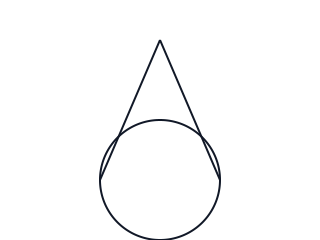
Identify this 3D shape which has a circular base that tapers to a single point.
Solution:
Shape: Cone
Explanation:
A cone has flat circular face (the base) and curved surface that meets at a point called the apex. It has circular edge where the base meets the curved surface.