
Review the key concepts, formulae, and examples before starting your quiz.
🔑Concepts
A right angle is the corner of a square. It represents a turn or one quarter turn.
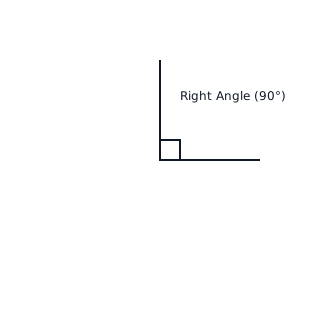
A half turn is equal to two right angles and forms a straight line ().
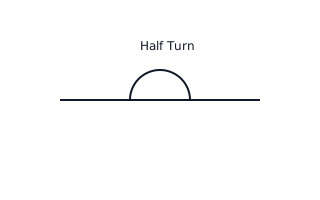
A full turn is equal to four right angles, returning to the original position ().
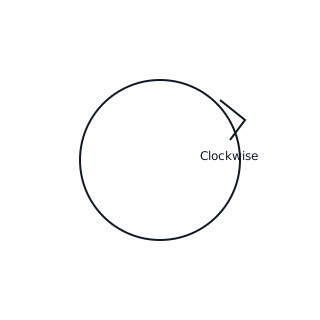
Turns can be clockwise (following the direction of clock hands) or anti-clockwise (the opposite direction).
📐Formulae
💡Examples
Problem 1:
How many right angles are there inside a standard rectangle?
Solution:
4 right angles
Explanation:
A rectangle has four corners, and each corner is a perfect 'L' shape or a square corner, which measures .
Problem 2:
If Sarah is facing North and makes a half turn, which direction is she facing now?
Solution:
South
Explanation:
A half turn is equal to two right angles. Moving two right angles from North (whether clockwise or anti-clockwise) points you in the opposite direction, which is South.
Problem 3:
Identify if the angle formed by the hands of a clock at 1:00 is 'greater than', 'less than', or 'equal to' a right angle.
Solution:
Less than a right angle
Explanation:
At 3:00, the hands form a perfect right angle (). At 1:00, the gap between the hands is much smaller than the 'L' shape of a right angle.
Problem 4:
A robot makes 3 quarter turns clockwise. How many right angles has it turned through?
Solution:
3 right angles
Explanation:
Since each quarter turn is equal to 1 right angle, 3 quarter turns equals right angles.
Problem 5:
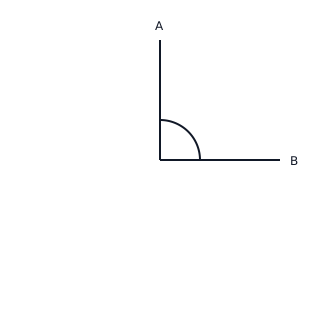
Determine the type of turn required to move the arrow from pointing at the letter A to pointing at the letter B in the diagram.
Solution:
One quarter turn clockwise (or 1 right angle).
Explanation:
The arrow moves from North (A) to East (B). This is a movement in the direction of clock hands, which is one quarter turn clockwise.
Problem 6:
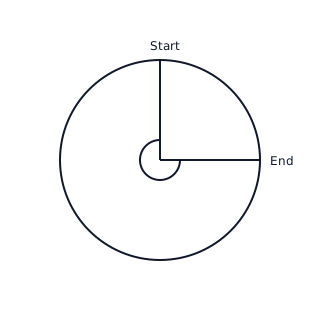
If a dial starts at 0 and moves through 3 right angles anti-clockwise, where will it point?
Solution:
It will point to the '9' position (West).
Explanation:
Each right angle is a quarter turn. Three right angles anti-clockwise is a turn. Starting from the top (12/0), one turn lands at 9, two turns at 6, and three turns anti-clockwise lands at the 3 o'clock position if moving clockwise, but because we are moving anti-clockwise: 1st turn = 9, 2nd turn = 6, 3rd turn = 3. Wait, the calculation is: anti-clockwise from North is East.