
Review the key concepts, formulae, and examples before starting your quiz.
🔑Concepts
A Point shows a fixed position and is represented by a small dot. It has no length, breadth, or thickness. Points are usually named with capital letters like , , or .

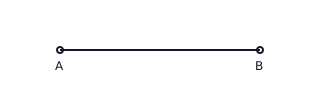
A Line Segment is a part of a line that has two fixed endpoints. It has a definite length and can be measured. For example, the edge of a ruler or a pencil is a line segment.
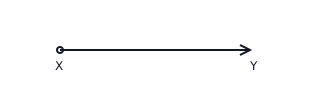
A Ray starts at a fixed point (initial point) and goes on forever in one direction. An arrow is used to show it is endless. Examples include a beam of light from a torch or rays from the Sun.
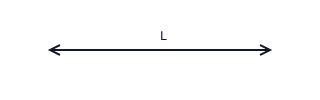
A Line has no endpoints. It extends endlessly in both directions. Since it has no ends, it does not have a fixed length and cannot be measured on paper.
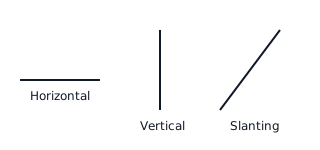
Lines can be Horizontal (sleeping lines), Vertical (standing lines), or Slanting (oblique lines).
📐Formulae
Line Segment
Ray
Line
Length of Segment
💡Examples
Problem 1:
Identify the type of line represented by a sunbeam coming from the Sun.
Solution:
- The sunbeam starts at a fixed point (the Sun). 2. It travels infinitely in one direction toward the Earth. 3. A figure with one endpoint that extends infinitely in one direction is called a Ray.
Explanation:
Since the light has a starting point but no ending point in space, it is a Ray, denoted as where is the Sun.
Problem 2:
How many line segments are used to form a simple triangle?
Solution:
- A triangle is a closed shape made of straight sides. 2. Each side connects two corners (vertices). 3. There are 3 sides in a triangle, and each side is a line segment. 4. Total line segments = .
Explanation:
A triangle consists of three connected line segments, such as , , and .
Problem 3:
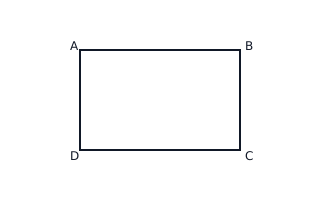
Look at the rectangle shown below. Identify all the horizontal and vertical line segments used to form it.
Solution:
Horizontal segments: and . Vertical segments: and .
Explanation:
In a standard rectangle, the top and bottom edges are horizontal (sleeping), while the left and right sides are vertical (standing).
Problem 4:
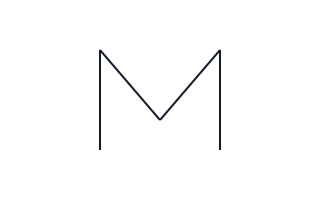
Count the number of slanting line segments in the letter 'M' shown below.
Solution:
There are 2 slanting line segments.
Explanation:
The letter 'M' is made of two vertical lines on the outside and two slanting lines that meet in the middle.