
Review the key concepts, formulae, and examples before starting your quiz.
🔑Concepts
3D solids are three-dimensional shapes that have length, width, and height. The flat surfaces are called Faces, the lines where two faces meet are Edges, and the corner points where edges meet are Vertices.
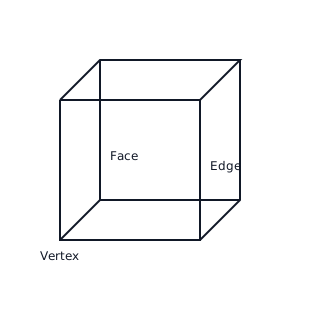
A Cube and a Cuboid both have faces, edges, and vertices. In a cube, all faces are identical squares, while in a cuboid, the faces are usually rectangles.
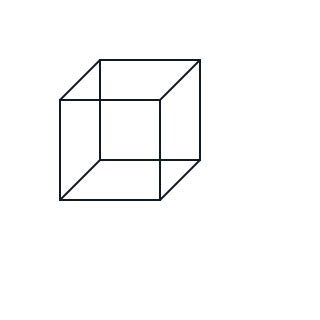
A Cylinder consists of circular flat faces and curved surface. It has curved edges and vertices.
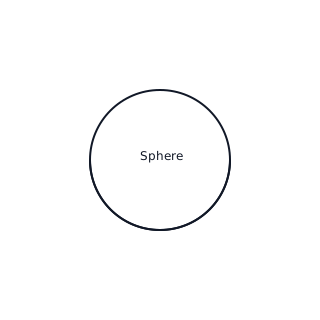
A Cone has flat circular face, curved surface, curved edge, and vertex at the top (the apex). A Sphere is perfectly round with only curved surface, no edges, and no vertices.
📐Formulae
Total Faces of a Cube or Cuboid =
Total Edges of a Cube or Cuboid =
Total Vertices of a Cube or Cuboid =
Faces of a Cylinder =
Vertices of a Cone = (The Apex)
Properties of a Sphere:
💡Examples
Problem 1:
Identify the 3D solid that has rectangular faces, edges, and vertices. Give one real-life example of this shape.
Solution:
- Look at the properties: rectangular faces indicate a prism-like structure.
- Since the faces are rectangles, the shape is a Cuboid.
- Verify edges: .
- Verify vertices: .
- Real-life example: A brick or a pencil box.
Explanation:
By checking the number of faces and their shape (rectangles), we can distinguish between a cube (square faces) and a cuboid (rectangular faces).
Problem 2:
Rohan has a solid that has flat faces and curved surface. How many edges does this solid have, and what is the name of the shape?
Solution:
- A solid with flat circular faces and curved surface is a Cylinder.
- The flat faces meet the curved surface at the top and bottom.
- Each meeting point forms a curved edge.
- Therefore, the number of edges is .
Explanation:
A cylinder is unique because it combines flat circular ends with a curved middle, resulting in exactly curved edges.
Problem 3:
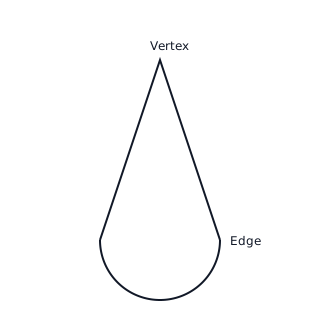
Look at the object shown below (a party hat). Identify its shape and state the number of vertices and edges it has.
Solution:
Explanation:
A party hat is shaped like a cone. It has one sharp point at the top called a vertex. It has one circular edge where the curved surface meets the flat circular base.
Problem 4:
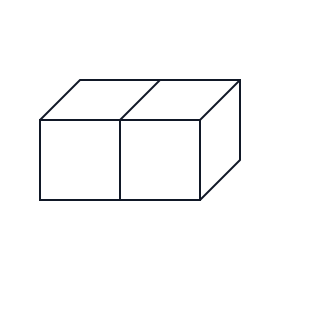
A wooden block has identical square faces. If you place two such blocks side-by-side as shown, what is the resulting shape and how many vertices does the new shape have?
Solution:
Explanation:
When two cubes are joined together, they form a longer shape called a cuboid. Although it is longer, the structure of a cuboid still has corners (vertices).