
Review the key concepts, formulae, and examples before starting your quiz.
🔑Concepts
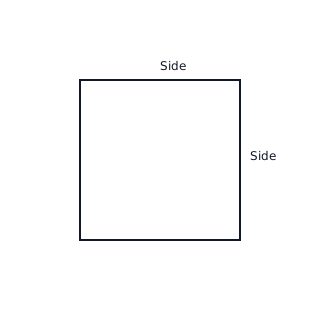
A Square is a closed 2D shape with four equal sides and four corners. All its sides are the same length.
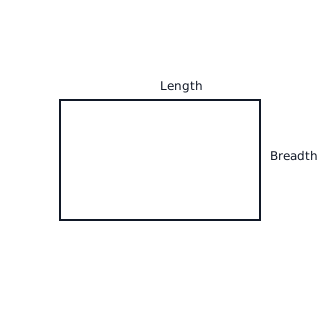
A Rectangle has four sides and four corners. Its opposite sides are equal in length. The longer side is the length and the shorter side is the breadth.
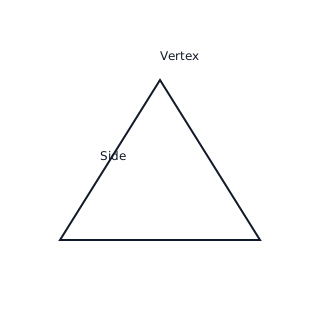
A Triangle is a 2D shape with three sides and three corners (vertices).
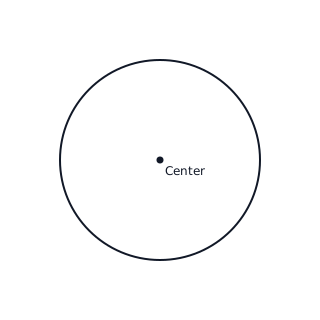
A Circle is a perfectly round shape with no corners or straight sides. Every point on its boundary is at the same distance from its center.
📐Formulae
💡Examples
Problem 1:
Find the perimeter of a rectangle whose length is and breadth is .
Solution:
Step 1: Identify the given values: and . Step 2: Use the formula: . Step 3: Substitute the values: . Step 4: Add the numbers inside the brackets: . Step 5: Multiply the numbers: . Final Answer: The perimeter is .
Explanation:
To find the perimeter of a rectangle, we add the length and breadth together and then double the result because there are two lengths and two breadths in every rectangle.
Problem 2:
A square garden has a side of . Calculate the total length of the fence needed to cover its boundary.
Solution:
Step 1: Identify that the length of the fence is the same as the perimeter of the square. Step 2: Use the formula: . Step 3: Substitute the value of the side: . Step 4: Calculate the product: . Final Answer: The total length of the fence needed is .
Explanation:
Since all four sides of a square are equal, the total boundary (perimeter) is found by multiplying the length of one side by .
Problem 3:
Calculate the perimeter of a triangle whose sides measure , , and .
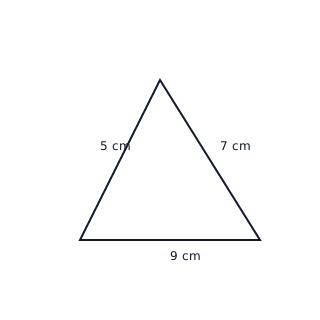
Solution:
Perimeter of Triangle =
Perimeter =
Explanation:
To find the perimeter of a triangle, we add the lengths of all its three sides together.
Problem 4:
Find the length of the boundary of a square photo frame if one of its sides is .
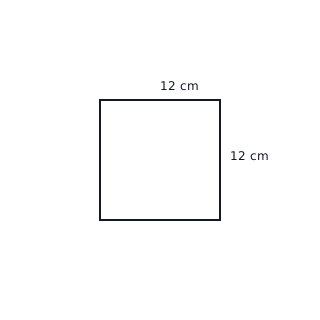
Solution:
Boundary of a square (Perimeter) = Perimeter = Perimeter =
Explanation:
Since all four sides of a square are equal, we multiply the length of one side by 4 to get the total boundary length.