krit.club logo

Vectors and Transformations - Vector Addition, Subtraction, and Scaling

Grade 12A Level

Review the key concepts, formulae, and examples before starting your quiz.

🔑Concepts

•

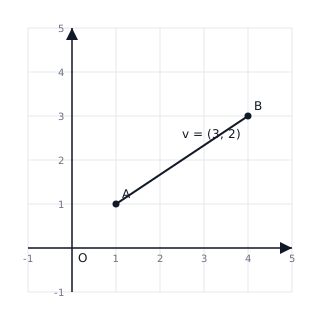
A vector is a quantity with both magnitude and direction, often represented as a column vector (xy)\begin{pmatrix} x \\ y \end{pmatrix}, where xx is the horizontal displacement and yy is the vertical displacement.

A vector AB starting at (1,1) and ending at (4,3) showing a translation of 3 units right and 2 units up.
•

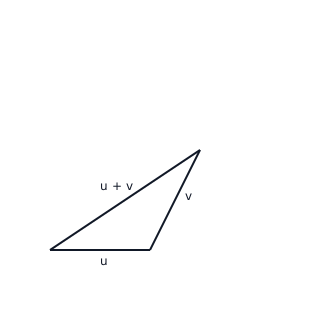
Vector addition follows the triangle law or parallelogram law. To add u+v\mathbf{u} + \mathbf{v}, place the tail of v\mathbf{v} at the head of u\mathbf{u}. The resultant vector is the line from the tail of u\mathbf{u} to the head of v\mathbf{v}.

Triangle law of vector addition showing vectors u and v forming the third side u+v.
•

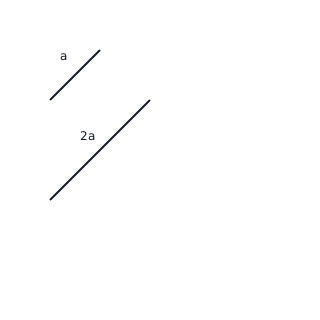
Scalar scaling changes the magnitude of a vector but not its direction (unless the scalar is negative). If a=kb\mathbf{a} = k\mathbf{b}, then the vectors a\mathbf{a} and b\mathbf{b} are parallel.

Two parallel vectors where one is twice the length of the other.
•

Vector subtraction u−v\mathbf{u} - \mathbf{v} is equivalent to adding the negative of a vector: u+(−v)\mathbf{u} + (-\mathbf{v}). Geometrically, this represents the displacement from the head of v\mathbf{v} to the head of u\mathbf{u} when both start at the same origin.

📐Formulae

Addition: (x1y1)+(x2y2)=(x1+x2y1+y2)\begin{pmatrix} x_1 \\ y_1 \end{pmatrix} + \begin{pmatrix} x_2 \\ y_2 \end{pmatrix} = \begin{pmatrix} x_1 + x_2 \\ y_1 + y_2 \end{pmatrix}

Subtraction: (x1y1)−(x2y2)=(x1−x2y1−y2)\begin{pmatrix} x_1 \\ y_1 \end{pmatrix} - \begin{pmatrix} x_2 \\ y_2 \end{pmatrix} = \begin{pmatrix} x_1 - x_2 \\ y_1 - y_2 \end{pmatrix}

Scalar Scaling: k(xy)=(kxky)k \begin{pmatrix} x \\ y \end{pmatrix} = \begin{pmatrix} kx \\ ky \end{pmatrix}

Magnitude: ∣a∣=x2+y2|\mathbf{a}| = \sqrt{x^2 + y^2}

Displacement between two points: AB⃗=OB⃗−OA⃗=(xB−xAyB−yA)\vec{AB} = \vec{OB} - \vec{OA} = \begin{pmatrix} x_B - x_A \\ y_B - y_A \end{pmatrix}

💡Examples

Problem 1:

Given vectors a=(3−2)\mathbf{a} = \begin{pmatrix} 3 \\ -2 \end{pmatrix} and b=(−14)\mathbf{b} = \begin{pmatrix} -1 \\ 4 \end{pmatrix}, calculate the resultant vector c=2a+3b\mathbf{c} = 2\mathbf{a} + 3\mathbf{b}.

Solution:

c=2(3−2)+3(−14)=(6−4)+(−312)=(6+(−3)−4+12)=(38)\mathbf{c} = 2\begin{pmatrix} 3 \\ -2 \end{pmatrix} + 3\begin{pmatrix} -1 \\ 4 \end{pmatrix} = \begin{pmatrix} 6 \\ -4 \end{pmatrix} + \begin{pmatrix} -3 \\ 12 \end{pmatrix} = \begin{pmatrix} 6 + (-3) \\ -4 + 12 \end{pmatrix} = \begin{pmatrix} 3 \\ 8 \end{pmatrix}

Explanation:

First, scale each vector by its respective scalar (2 and 3) by multiplying each component. Then, add the resulting xx components and yy components together.

Problem 2:

In triangle OABOAB, OA⃗=a\vec{OA} = \mathbf{a} and OB⃗=b\vec{OB} = \mathbf{b}. Point MM is the midpoint of ABAB. Find OM⃗\vec{OM} in terms of a\mathbf{a} and b\mathbf{b}.

Solution:

AB⃗=OB⃗−OA⃗=b−a\vec{AB} = \vec{OB} - \vec{OA} = \mathbf{b} - \mathbf{a}. Since MM is the midpoint, AM⃗=12AB⃗=12(b−a)\vec{AM} = \frac{1}{2}\vec{AB} = \frac{1}{2}(\mathbf{b} - \mathbf{a}). Therefore, OM⃗=OA⃗+AM⃗=a+12(b−a)=12a+12b\vec{OM} = \vec{OA} + \vec{AM} = \mathbf{a} + \frac{1}{2}(\mathbf{b} - \mathbf{a}) = \frac{1}{2}\mathbf{a} + \frac{1}{2}\mathbf{b}.

Explanation:

To find OM⃗\vec{OM}, we find the displacement vector AB⃗\vec{AB} first. Then we move from the origin to AA, and then halfway along the vector AB⃗\vec{AB} to reach MM.

Problem 3:

Determine if the vectors u=(4−6)\mathbf{u} = \begin{pmatrix} 4 \\ -6 \end{pmatrix} and v=(−69)\mathbf{v} = \begin{pmatrix} -6 \\ 9 \end{pmatrix} are parallel.

Solution:

Check if v=ku\mathbf{v} = k\mathbf{u}. Comparing xx-components: −6=4k  ⟹  k=−1.5-6 = 4k \implies k = -1.5. Comparing yy-components: 9=−6k  ⟹  k=−1.59 = -6k \implies k = -1.5. Since kk is consistent, v=−1.5u\mathbf{v} = -1.5\mathbf{u}.

Explanation:

Vectors are parallel if one can be expressed as a scalar multiple of the other. Since both components share the same ratio (−1.5-1.5), the vectors are parallel and point in opposite directions.

Problem 4:

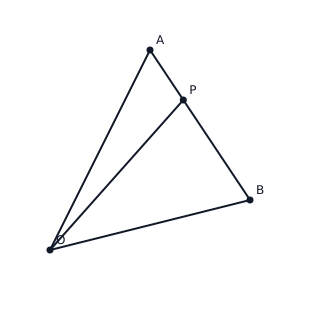
In the diagram, OO is the origin. OA⃗=a\vec{OA} = \mathbf{a} and OB⃗=b\vec{OB} = \mathbf{b}. Point PP lies on ABAB such that AP:PB=2:1AP:PB = 2:1. Find OP⃗\vec{OP} in terms of a\mathbf{a} and b\mathbf{b}.

Triangle OAB with point P on AB dividing it in ratio 2:1.

Solution:

AB⃗=OB⃗−OA⃗=b−a\vec{AB} = \vec{OB} - \vec{OA} = \mathbf{b} - \mathbf{a} AP⃗=23AB⃗=23(b−a)\vec{AP} = \frac{2}{3}\vec{AB} = \frac{2}{3}(\mathbf{b} - \mathbf{a}) OP⃗=OA⃗+AP⃗=a+23(b−a)\vec{OP} = \vec{OA} + \vec{AP} = \mathbf{a} + \frac{2}{3}(\mathbf{b} - \mathbf{a}) OP⃗=a+23b−23a=13a+23b\vec{OP} = \mathbf{a} + \frac{2}{3}\mathbf{b} - \frac{2}{3}\mathbf{a} = \frac{1}{3}\mathbf{a} + \frac{2}{3}\mathbf{b}

Explanation:

We first find the vector AB⃗\vec{AB} using subtraction. Since PP divides the line in ratio 2:12:1, it is 23\frac{2}{3} of the way along the vector AB⃗\vec{AB}. We then use path addition from OO through AA to PP.

Problem 5:

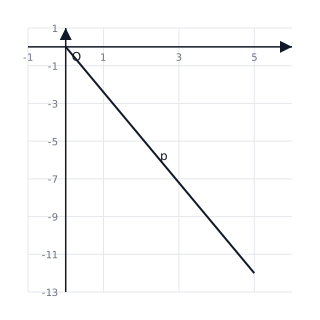
Given vector p=(5−12)\mathbf{p} = \begin{pmatrix} 5 \\ -12 \end{pmatrix}, find the unit vector in the direction of p\mathbf{p}.

A vector pointing from the origin to (5, -12) showing its components.

Solution:

∣p∣=52+(−12)2=25+144=169=13|\mathbf{p}| = \sqrt{5^2 + (-12)^2} = \sqrt{25 + 144} = \sqrt{169} = 13 p^=113(5−12)=(513−1213)\hat{\mathbf{p}} = \frac{1}{13} \begin{pmatrix} 5 \\ -12 \end{pmatrix} = \begin{pmatrix} \frac{5}{13} \\ -\frac{12}{13} \end{pmatrix}

Explanation:

A unit vector is found by scaling the original vector by the reciprocal of its magnitude. This preserves the direction while setting the length to 1 unit.