
Review the key concepts, formulae, and examples before starting your quiz.
🔑Concepts
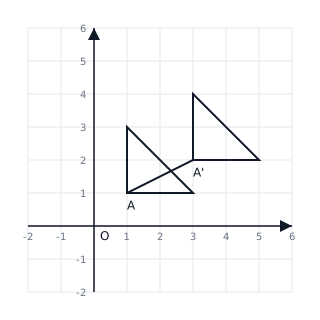
A translation moves every point of a shape the same distance in the same direction. It is described by a column vector , where represents horizontal movement (right is positive) and represents vertical movement (up is positive).
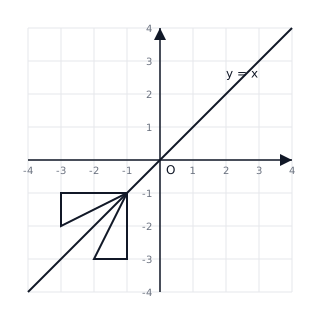
Reflections flip a shape over a mirror line. Points on the mirror line remain invariant. Every point of the image is at the same perpendicular distance from the mirror line as the original point but on the opposite side.
Rotations turn a shape around a fixed point called the center of rotation. A rotation is defined by the center, the angle, and the direction (clockwise or anti-clockwise). For origin rotations, specific matrices are used.
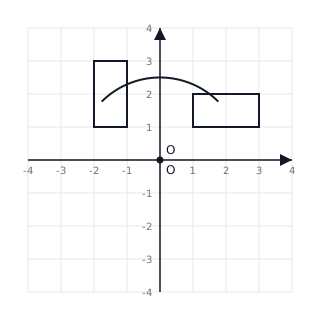
An invariant point is a point that does not change its position under a transformation. For reflections, all points on the mirror line are invariant. For rotations, only the center of rotation is invariant.
📐Formulae
Magnitude of a vector:
Translation mapping:
Reflection in x-axis:
Reflection in y-axis:
Reflection in :
Rotation Anti-clockwise about :
Rotation about :
Rotation Anti-clockwise (or Clockwise):
💡Examples
Problem 1:
A triangle with vertices , , and is translated by the vector . Find the coordinates of the image .
Solution:
, ,
Explanation:
To translate a point, add the -component of the vector to the -coordinate and the -component of the vector to the -coordinate of the point.
Problem 2:
Reflect the point in the line .
Solution:
Explanation:
When reflecting in the line , the and coordinates are swapped. Using matrix multiplication: .
Problem 3:
Rotate the point clockwise about the origin .
Solution:
Explanation:
A clockwise rotation is equivalent to a anti-clockwise rotation. Applying the matrix results in .
Problem 4:
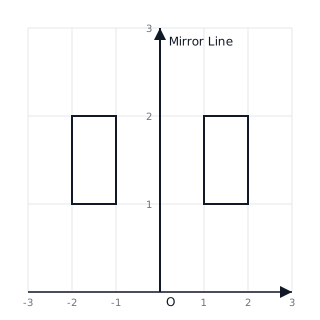
Reflect the square with vertices , , , and in the -axis. Find the new coordinates.
Solution:
The transformation for reflection in the -axis is . Applying this to each vertex: The image is a square on the left side of the -axis.
Explanation:
Reflection in the -axis negates the x-coordinate while the y-coordinate remains unchanged. The distance of each point from the -axis remains the same.
Problem 5:
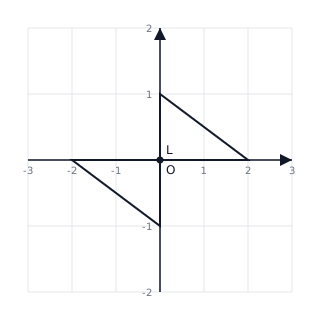
A triangle with vertices , , and is rotated about the origin. Determine the coordinates of the image .
Solution:
The transformation for a rotation about the origin is . The point is at the origin (center of rotation), so it is an invariant point.
Explanation:
In a rotation about , both the and coordinates change sign. This is equivalent to reflecting the shape in both the and axes.