
Review the key concepts, formulae, and examples before starting your quiz.
🔑Concepts
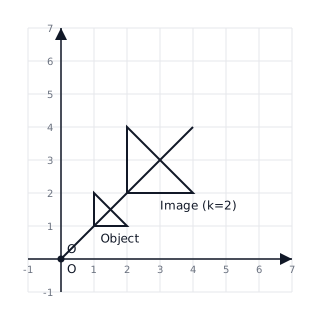
An enlargement is a transformation that changes the size of an object while preserving its shape and orientation. It is defined by a center of enlargement and a scale factor . If , the object expands; if , it shrinks; if is negative, the image is inverted and appears on the opposite side of the center.
A shear transformation shifts points parallel to a fixed line called the invariant line. The distance a point moves is proportional to its distance from that line. For an -axis invariant shear, points map to , meaning the -coordinate remains unchanged while the -coordinate shifts based on the shear factor .
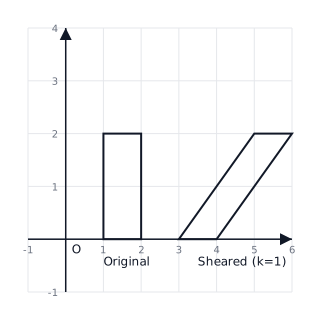
The determinant of the transformation matrix tells us how the area changes. For an enlargement with scale factor , the area increases by because . For a shear, the area remains invariant because .
Negative scale factors in enlargement result in a point reflection through the center. A scale factor of is equivalent to a rotation of about the center of enlargement.
📐Formulae
Enlargement Matrix (Center at origin):
Shear Matrix (-axis invariant): , where is the shear factor.
Shear Matrix (-axis invariant): , where is the shear factor.
Area of Image:
Vector Mapping:
💡Examples
Problem 1:
Find the image of the point under an enlargement with center and scale factor .
Solution:
. The image is .
Explanation:
Since the center is the origin, we multiply the coordinate vector by the enlargement matrix. The negative scale factor reflects the point through the origin and triples its distance.
Problem 2:
A shear maps the point to while the -axis remains invariant. Determine the transformation matrix.
Solution:
For an -axis invariant shear, the matrix is . Applying this to : . Given the image is , . Matrix is .
Explanation:
Because the -axis is invariant, the -coordinate remains unchanged. The 'shear factor' represents how much the -coordinate shifts per unit of .
Problem 3:
Triangle has an area of . It undergoes an enlargement with scale factor followed by a shear. What is the area of the final image?
Solution:
Area after enlargement: . Area after shear: A shear has a determinant of (e.g., ), so it preserves area. Final area .
Explanation:
Enlargement scales area by . Shear does not change the area of a shape, only its displacement/tilt.
Problem 4:
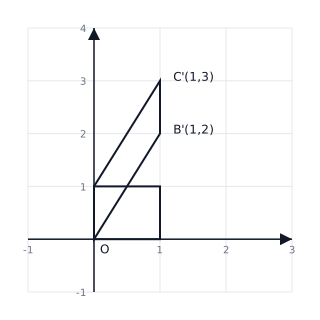
A square with vertices , , , and is transformed by a shear with the -axis invariant and a shear factor . Determine the coordinates of the image and draw the resulting shape.
Solution:
The transformation matrix for a shear with the -axis invariant is . Given , the matrix is . To find , we multiply: . The coordinates of the image vertices are , , , and .
Explanation:
In a -axis invariant shear, the -coordinates stay the same while the -coordinates change by times the -distance. Since is at , its -coordinate increases by , moving from to .
Problem 5:
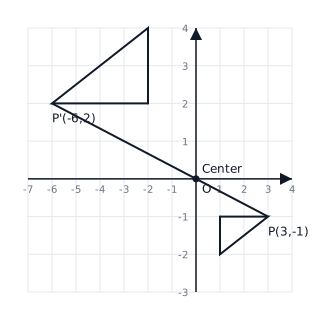
A triangle with area undergoes an enlargement with center and scale factor . Find the area of the image and the coordinates of the image of vertex .
Solution:
- Area of Image: The area scale factor is . . 2. Coordinates of : Using the matrix : . The image is at .
Explanation:
A negative scale factor enlarges the object and rotates it about the center. The area is always positive as it depends on .