
Review the key concepts, formulae, and examples before starting your quiz.
🔑Concepts
The magnitude of a vector represents the scalar length of the vector arrow. Geometrically, it is the hypotenuse of a right-angled triangle where the horizontal component () and vertical component () are the legs.
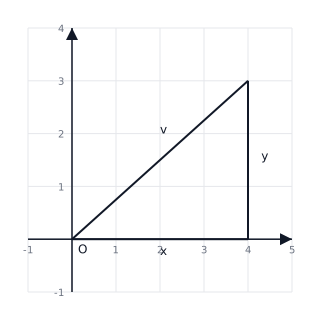
The notation for magnitude uses vertical bars, written as or . It is always a non-negative real number, as distances cannot be negative.
To calculate the magnitude, we apply the Pythagorean theorem: . Squaring the components ensures that negative directions (left or down) still contribute positively to the total length.
A unit vector is a vector with a magnitude of exactly 1. If a vector has magnitude , the vector is a unit vector in the same direction.
📐Formulae
for a 2D vector
for points and
for a 3D vector
💡Examples
Problem 1:
Calculate the magnitude of the vector .
Solution:
Explanation:
Identify the and components (5 and -12). Square both components, sum them, and take the square root. Note that squaring a negative number results in a positive value.
Problem 2:
Find the magnitude of the vector where is and is .
Solution:
. .
Explanation:
First, find the vector by subtracting the coordinates of the initial point from the terminal point . Then, apply the magnitude formula to the resulting components.
Problem 3:
If vector and , find the possible values of .
Solution:
.
Explanation:
Set up an equation using the magnitude formula. Square both sides to remove the radical, solve for , and remember to include both the positive and negative roots.
Problem 4:
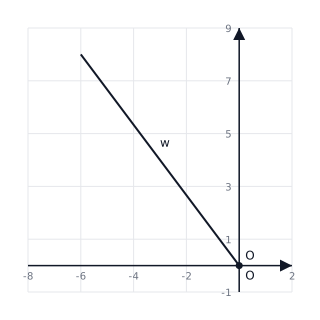
Calculate the magnitude of the vector .
Solution:
Explanation:
Substitute the -component (-6) and -component (8) into the magnitude formula. Square both terms, add them, and find the square root of the sum.
Problem 5:
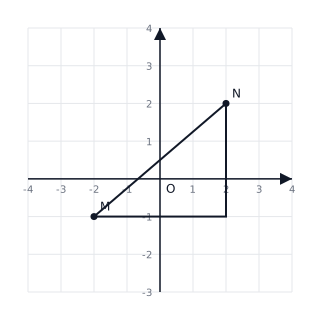
Given points and , find the magnitude of the displacement vector .
Solution:
Explanation:
First, find the column vector by subtracting the coordinates of the starting point from the ending point . Then apply the magnitude formula to the resulting components.