
Review the key concepts, formulae, and examples before starting your quiz.
🔑Concepts
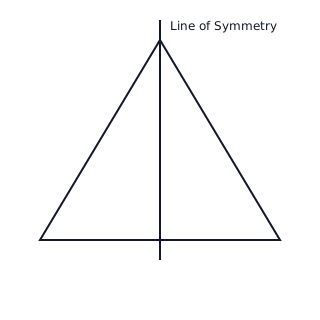
Line Symmetry (Reflectional Symmetry) occurs when a 2D shape can be folded along a line so that the two halves match exactly. For a regular polygon with sides, there are always lines of symmetry.
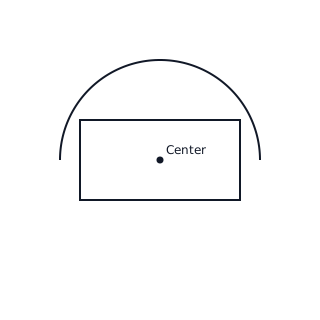
Rotational Symmetry describes how many times a shape fits onto itself during a full turn. This count is called the 'order'. The center of rotation is the fixed point around which the shape turns.
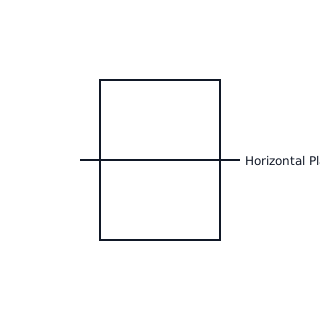
Planes of Symmetry are the 3D equivalent of lines of symmetry. A plane divides a 3D solid into two mirror-image halves. A sphere has infinite planes of symmetry, while a cylinder has one horizontal plane and infinite vertical planes.
Point Symmetry (Order 2 Rotational Symmetry) exists when a shape looks the same when rotated . Every point on the shape has a matching point relative to the center.
📐Formulae
💡Examples
Problem 1:
Determine the number of lines of symmetry and the order of rotational symmetry for a regular octagon.
Solution:
Lines of symmetry: 8; Order of rotational symmetry: 8.
Explanation:
For any regular polygon with sides, the number of lines of symmetry is equal to , and the order of rotational symmetry is also equal to . Since an octagon has 8 sides, both values are 8.
Problem 2:
Identify the number of planes of symmetry in a square-based pyramid where all triangular faces are isosceles.
Solution:
4 planes of symmetry.
Explanation:
Two planes pass through the vertices of the square base (diagonals) and the apex. Two planes pass through the midpoints of the opposite sides of the square base and the apex.
Problem 3:
A shape has a rotational symmetry of order 5. Calculate the smallest angle through which the shape must be rotated to coincide with its original position.
Solution:
Explanation:
Using the formula , where is the order of symmetry: .
Problem 4:
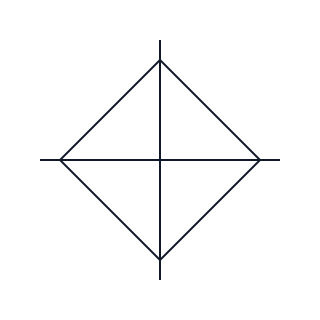
Identify the number of lines of symmetry and the order of rotational symmetry for the rhombus shown, where all sides are equal but interior angles are not .
Solution:
- Lines of Symmetry: A rhombus has 2 lines of symmetry (the diagonals).
- Rotational Symmetry: The shape repeats its appearance twice in a full circle ( and ), so the order is 2.
Explanation:
Unlike a square, a rhombus does not have lines of symmetry through the midpoints of its sides, only through its vertices (diagonals). Because it is not a regular polygon, its order of symmetry is less than the number of sides.
Problem 5:
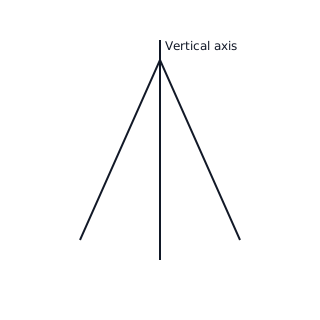
A right circular cone has a base radius of and height . Describe the planes of symmetry for this 3D solid.
Solution:
A right circular cone has infinite planes of symmetry. Every plane that passes through the vertex and the center of the circular base is a plane of symmetry.
Explanation:
Because the base is a circle, any diameter can form the base of a symmetry plane. However, unlike a cylinder, there is no horizontal plane of symmetry because the top (vertex) and bottom (circular base) are different.