
Review the key concepts, formulae, and examples before starting your quiz.
🔑Concepts
Two shapes are congruent if they are identical in shape and size. This means all corresponding sides are equal (, , ) and all corresponding angles are equal. Congruence is a special case of similarity where the scale factor .
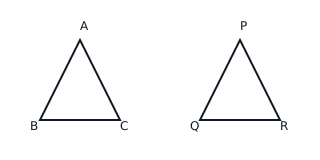
Two shapes are similar if they are the same shape but different sizes. All corresponding angles are equal, and the lengths of corresponding sides are proportional by a scale factor . For any two similar figures, the ratio of their lengths is , the ratio of their areas is , and the ratio of their volumes is .
Similarity in triangles occurs if: 1. Two angles are the same (), 2. Three sides are in the same proportion ( similarity), or 3. Two sides are in proportion and the included angle is equal ( similarity). Parallel lines often create similar triangles through corresponding or alternate angles.
For 3D objects, if the linear scale factor from solid A to solid B is , then the ratio of their surface areas is and the ratio of their volumes is .
📐Formulae
💡Examples
Problem 1:
Two mathematically similar cylinders have heights of 5 cm and 10 cm. If the surface area of the smaller cylinder is 40 cm², find the surface area of the larger cylinder.
Solution:
. . .
Explanation:
First, find the linear scale factor (k) by dividing the corresponding heights. Since we are looking for area, square the scale factor to find the area scale factor, then multiply the original area by this factor.
Problem 2:
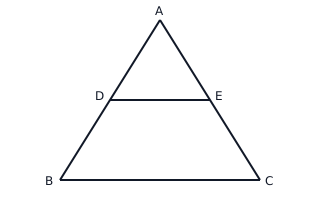
In triangle ABC, a line DE is drawn parallel to BC such that D is on AB and E is on AC. If AD = 3cm, DB = 6cm, and BC = 12cm, find the length of DE.
Solution:
. . . .
Explanation:
Because DE is parallel to BC, and (corresponding angles). By AA criteria, the triangles are similar. We use the ratio of the small side to the full side of the large triangle to find the scale factor.
Problem 3:
Two similar solid spheres have volumes in the ratio 27:64. If the radius of the larger sphere is 20 cm, calculate the radius of the smaller sphere.
Solution:
. .
Explanation:
The volume ratio is the cube of the linear scale factor. Take the cube root of the volume ratio to find the linear scale factor (k). Multiply the larger radius by k to find the smaller radius.
Problem 4:
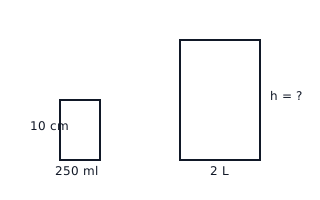
Two similar containers have capacities of ml and liters. If the height of the smaller container is cm, calculate the height of the larger container.
Solution:
- Convert volumes to the same units: ml, ml.
- Find the volume scale factor: .
- Find the linear scale factor: .
- Calculate the height of the larger container: cm.
Explanation:
Since the containers are mathematically similar, the ratio of their volumes is the cube of the ratio of their heights. By finding the cube root of the volume ratio, we find the linear scale factor , which is then applied to the known height.
Problem 5:
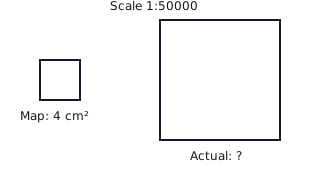
A map has a scale of . A forest on the map has an area of . Calculate the actual area of the forest in .
Solution:
- Linear scale factor .
- Area scale factor .
- Actual area in : .
- Convert to : .
- Convert to : .
Explanation:
Map scales are linear ratios. To find the area ratio, we must square the linear ratio. After calculating the actual area in square centimeters, we convert it to square kilometers using the factors for and for .