
Review the key concepts, formulae, and examples before starting your quiz.
🔑Concepts
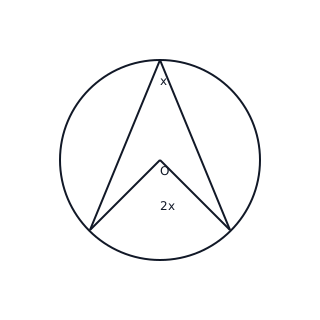
The angle subtended by an arc at the center is twice the angle subtended by the same arc at the circumference. If the angle at the circumference is , the angle at the center is .
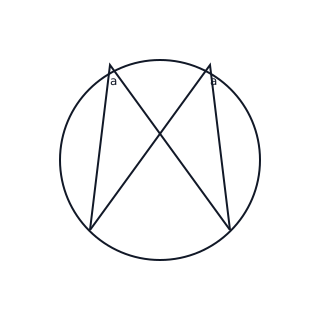
Angles in the same segment of a circle are equal. This means angles subtended by the same arc at the circumference are identical.
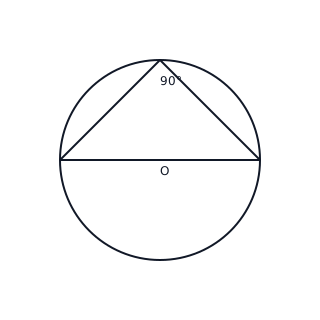
The angle in a semi-circle is always a right angle (). Any triangle formed using the diameter as one side and a third point on the circumference is a right-angled triangle.
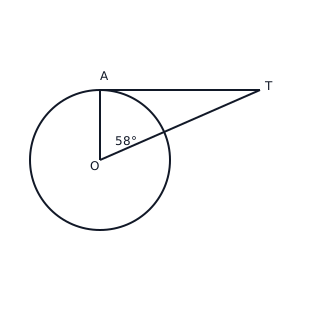
A tangent to a circle is perpendicular to the radius at the point of contact. The angle between the tangent and radius is .
Opposite angles in a cyclic quadrilateral sum to . If the quadrilateral's vertices all lie on the circle, then and .
📐Formulae
💡Examples
Problem 1:
Points A, B, and C lie on the circumference of a circle with center O. If angle BOC = 130°, find the size of angle BAC.
Solution:
65°
Explanation:
By the Angle at the Center Theorem, the angle subtended by an arc at the center (BOC) is twice the angle subtended at the circumference (BAC). Therefore, .
Problem 2:
In a cyclic quadrilateral PQRS, the angle PQR = 115°. Calculate the size of angle PSR.
Solution:
65°
Explanation:
Opposite angles of a cyclic quadrilateral are supplementary (sum to 180°). Thus, .
Problem 3:
A tangent is drawn from a point T to a circle at point A. If O is the center of the circle, angle OAT is 90°, and angle OTA is 35°, find angle AOT.
Solution:
55°
Explanation:
The radius OA and tangent TA meet at 90°. In the triangle OAT, the sum of angles is 180°. Therefore, .
Problem 4:
A chord AB is drawn in a circle. A tangent is drawn at point A. If the angle between the tangent and chord AB is 42°, what is the angle subtended by chord AB in the alternate segment?
Solution:
42°
Explanation:
According to the Alternate Segment Theorem, the angle between a tangent and a chord is equal to the angle subtended by the chord in the alternate segment.
Problem 5:
In the circle with center , points and lie on the circumference. The tangent at point meets the line extended at point . If , calculate the size of .
Solution:
Explanation:
Since is a tangent to the circle at point , the angle between the radius and the tangent is . We then use the sum of angles in a triangle to find the remaining angle.
Problem 6:
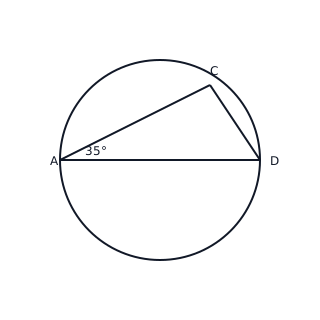
A circle has a diameter . Point and lie on the circumference such that is a quadrilateral. If , find .
Solution:
Explanation:
By the circle theorem 'Angle in a semi-circle is 90 degrees', any angle subtended by the diameter at the circumference is a right angle. Since is the diameter, must be .