
Review the key concepts, formulae, and examples before starting your quiz.
🔑Concepts
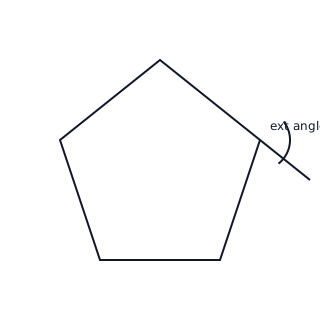
The sum of the exterior angles of any convex polygon is always . For a regular polygon with sides, each exterior angle is calculated as .
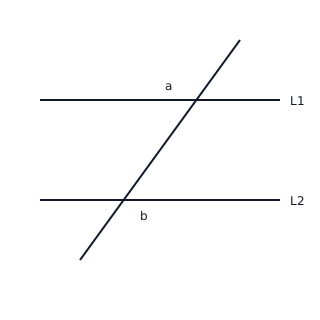
When a transversal intersects two parallel lines, several angle relationships are formed: Corresponding angles are equal (F-shape), Alternate angles are equal (Z-shape), and Co-interior angles sum to (C-shape).
Interior and exterior angles at any vertex of a polygon are supplementary, meaning they add up to . This is because they lie on a straight line.
The sum of interior angles of a polygon depends on the number of triangles it can be divided into from one vertex, which is . Hence, the sum is .
📐Formulae
Sum of interior angles =
Each interior angle (regular polygon) =
Sum of exterior angles =
Each exterior angle (regular polygon) =
Number of sides (n) =
Interior Angle + Exterior Angle =
💡Examples
Problem 1:
A regular polygon has an interior angle of . Calculate the number of sides (n) of this polygon.
Solution:
. .
Explanation:
First, find the exterior angle using the supplementary rule (Interior + Exterior = 180°). Then, use the property that the sum of exterior angles is 360° divided by the measure of one exterior angle to find the number of sides.
Problem 2:
In a pentagon, four of the interior angles are and . Find the size of the fifth angle.
Solution:
Sum = . Fifth angle = .
Explanation:
Calculate the total sum of interior angles for a pentagon (n=5). Subtract the sum of the known four angles from the total sum to find the remaining angle.
Problem 3:
Line and are parallel. A transversal cuts them. If a pair of co-interior angles are represented by and , find the value of .
Solution:
.
Explanation:
Co-interior angles between parallel lines are supplementary, meaning they add up to 180°. Set up an algebraic equation summing the two expressions to 180 and solve for x.
Problem 4:
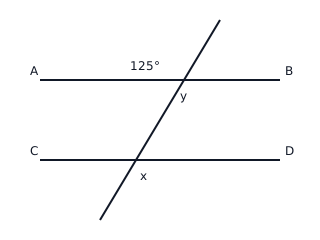
In the diagram provided, is parallel to . Given that , find the value of the angle and the angle .
Solution:
(Vertically opposite angles) Since , is not the direct path. Instead, use alternate interior angles: Since and are on a straight line:
Explanation:
We identify as vertically opposite to the given angle. Then we use the property that alternate interior angles are equal to find the relationship between the given angle and the angles on the parallel line .
Problem 5:
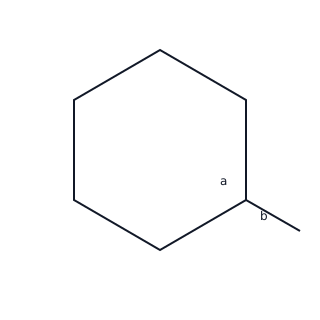
The diagram shows a regular hexagon. Calculate the size of the interior angle marked and the exterior angle marked .
Solution:
For a regular hexagon, . Sum of interior angles = Each interior angle = Each exterior angle = Alternatively, .
Explanation:
We use the formula for the sum of interior angles of a polygon and divide by the number of sides for a regular polygon. The exterior angle is then found using the supplementary rule.