
Review the key concepts, formulae, and examples before starting your quiz.
🔑Concepts
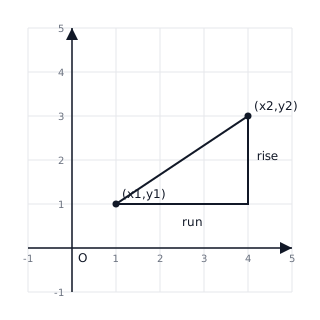
The gradient of a line measures its steepness. For a line passing through and , the gradient is given by .
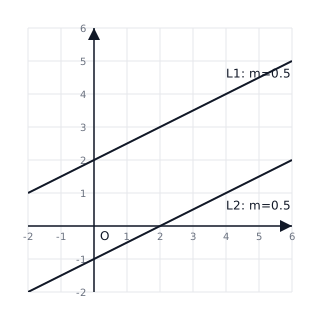
Parallel lines have the same gradient. If two lines and are parallel, then . They will never intersect and maintain a constant distance from each other.
Perpendicular lines intersect at a right angle (). The product of their gradients is , which means or .
The equation of a line can be written in slope-intercept form or point-slope form . The constant represents the -intercept where the line crosses the -axis.
📐Formulae
Parallel:
Perpendicular:
💡Examples
Problem 1:
Find the equation of the line that passes through the point and is parallel to the line .
Solution:
Explanation:
Since the lines are parallel, they share the same gradient. The gradient of the given line is . Using the point-gradient formula with point , we get: .
Problem 2:
Find the equation of the line perpendicular to that passes through the point .
Solution:
Explanation:
First, find the gradient of the given line by rearranging to : . The gradient . The perpendicular gradient is the negative reciprocal: . Since the line passes through , the y-intercept . Thus, .
Problem 3:
The line passes through and . The line is perpendicular to and passes through . Determine where crosses the x-axis.
Solution:
x = 5.75
Explanation:
- Find gradient of : . 2. Find gradient of : . 3. Equation of : . 4. X-axis crossing (where ): .
Problem 4:
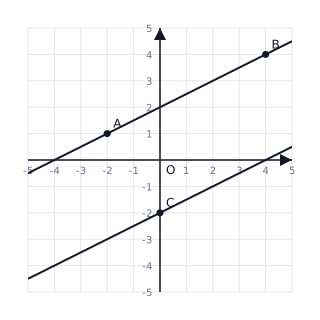
A line passes through the points and . Another line is parallel to and passes through the point . Find the equation of line in the form .
Solution:
- Calculate the gradient () of line using and :
- Since is parallel to , its gradient () is the same:
- Use the point-gradient form with :
- Rearrange into the form : Multiply by 2 to clear decimals:
Explanation:
Parallel lines share the same gradient. We first find the gradient of the reference line using two points, then apply that same gradient to the target point to form the new equation.
Problem 5:
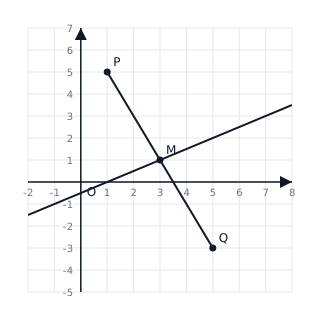
Find the equation of the line which is the perpendicular bisector of the line segment joining and .
Solution:
- Find the midpoint of :
- Find the gradient () of line segment :
- Determine the perpendicular gradient ():
- Find the equation using and : or
Explanation:
A perpendicular bisector must pass through the midpoint of the segment and have a gradient that is the negative reciprocal of the segment's gradient.