krit.club logo

Coordinate Geometry - Equations of Circles

Grade 12A Level

Review the key concepts, formulae, and examples before starting your quiz.

🔑Concepts

•

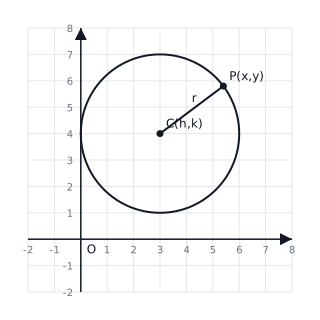
The standard equation of a circle is derived from the Pythagorean theorem, where rr is the constant distance (radius) from the center (h,k)(h, k) to any point (x,y)(x, y) on the circumference.

A circle on a coordinate plane with center (h, k) and a point (x, y) on the circumference connected by radius r.
•

The general form x2+y2+2gx+2fy+c=0x^2 + y^2 + 2gx + 2fy + c = 0 can be converted to standard form by completing the square for both xx and yy variables, revealing the center (−g,−f)(-g, -f).

•

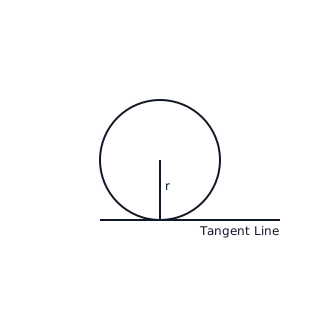
A line is tangent to a circle if the perpendicular distance from the center of the circle to the line is exactly equal to the radius rr.

A circle with a vertical line representing the radius meeting a horizontal tangent line at a 90 degree angle.
•

If a circle passes through two points, the center of the circle must lie on the perpendicular bisector of the chord connecting those two points.

📐Formulae

Standard Equation: (x−h)2+(y−k)2=r2(x - h)^2 + (y - k)^2 = r^2

General Equation: x2+y2+2gx+2fy+c=0x^2 + y^2 + 2gx + 2fy + c = 0

Center (General Form): (−g,−f)(-g, -f)

Radius (General Form): r=g2+f2−cr = \sqrt{g^2 + f^2 - c}

Distance Formula: d=(x2−x1)2+(y2−y1)2d = \sqrt{(x_2 - x_1)^2 + (y_2 - y_1)^2}

Midpoint Formula: M=(x1+x22,y1+y22)M = \left( \frac{x_1 + x_2}{2}, \frac{y_1 + y_2}{2} \right)

💡Examples

Problem 1:

Find the center and radius of the circle given by the equation x2+y2−4x+10y−7=0x^2 + y^2 - 4x + 10y - 7 = 0.

Solution:

Center: (2,−5)(2, -5), Radius: 66

Explanation:

  1. Group x and y terms: (x2−4x)+(y2+10y)=7(x^2 - 4x) + (y^2 + 10y) = 7. 2. Complete the square: (x−2)2−4+(y+5)2−25=7(x - 2)^2 - 4 + (y + 5)^2 - 25 = 7. 3. Simplify: (x−2)2+(y+5)2=7+4+25⇒(x−2)2+(y+5)2=36(x - 2)^2 + (y + 5)^2 = 7 + 4 + 25 \Rightarrow (x - 2)^2 + (y + 5)^2 = 36. 4. Compare with (x−h)2+(y−k)2=r2(x-h)^2 + (y-k)^2 = r^2 to find center (2,−5)(2, -5) and r=36=6r = \sqrt{36} = 6.

Problem 2:

Find the equation of the tangent to the circle (x−3)2+(y+1)2=25(x - 3)^2 + (y + 1)^2 = 25 at the point (7,2)(7, 2).

Solution:

4x + 3y - 34 = 0

Explanation:

  1. The center of the circle is C(3,−1)C(3, -1). 2. Find the gradient of the radius (mrm_r) connecting C(3,−1)C(3, -1) and P(7,2)P(7, 2): mr=2−(−1)7−3=34m_r = \frac{2 - (-1)}{7 - 3} = \frac{3}{4}. 3. The tangent is perpendicular to the radius, so its gradient (mtm_t) is −43-\frac{4}{3}. 4. Use the point-slope form: y−2=−43(x−7)y - 2 = -\frac{4}{3}(x - 7). 5. Multiply by 3 and rearrange: 3y−6=−4x+28⇒4x+3y−34=03y - 6 = -4x + 28 \Rightarrow 4x + 3y - 34 = 0.

Problem 3:

Determine if the line y=x+10y = x + 10 intersects the circle x2+y2=25x^2 + y^2 = 25.

Solution:

No intersection.

Explanation:

  1. Substitute y=x+10y = x + 10 into the circle equation: x2+(x+10)2=25x^2 + (x + 10)^2 = 25. 2. Expand: x2+x2+20x+100=25⇒2x2+20x+75=0x^2 + x^2 + 20x + 100 = 25 \Rightarrow 2x^2 + 20x + 75 = 0. 3. Calculate the discriminant (D=b2−4acD = b^2 - 4ac): 202−4(2)(75)=400−600=−20020^2 - 4(2)(75) = 400 - 600 = -200. 4. Since D<0D < 0, there are no real solutions, meaning the line does not intersect the circle.

Problem 4:

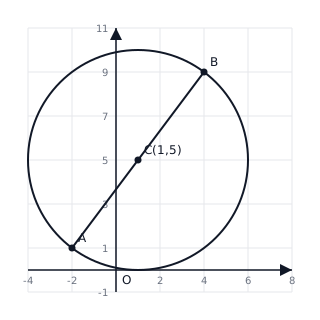
Find the equation of the circle that has a diameter with endpoints A(−2,1)A(-2, 1) and B(4,9)B(4, 9).

A circle with diameter line segment connecting points A(-2,1) and B(4,9) through center C(1,5).

Solution:

  1. Find the center (midpoint of ABAB): M=(−2+42,1+92)=(1,5)M = \left( \frac{-2 + 4}{2}, \frac{1 + 9}{2} \right) = (1, 5)
  2. Find the radius (distance from center to AA): r2=(1−(−2))2+(5−1)2=32+42=9+16=25r^2 = (1 - (-2))^2 + (5 - 1)^2 = 3^2 + 4^2 = 9 + 16 = 25 r=5r = 5
  3. Write the equation: (x−1)2+(y−5)2=25(x - 1)^2 + (y - 5)^2 = 25

Explanation:

Since the segment ABAB is a diameter, its midpoint must be the center of the circle, and the distance from the center to either endpoint is the radius.

Problem 5:

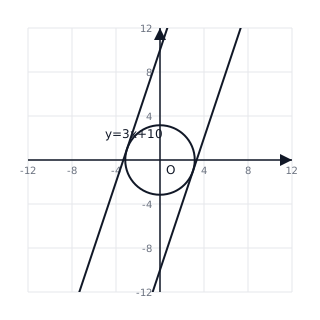
Determine the value of kk such that the line y=3x+ky = 3x + k is tangent to the circle x2+y2=10x^2 + y^2 = 10.

A circle centered at the origin with two parallel tangent lines y=3x+10 and y=3x-10.

Solution:

  1. Substitute y=3x+ky = 3x + k into the circle equation: x2+(3x+k)2=10x^2 + (3x + k)^2 = 10 x2+9x2+6kx+k2=10x^2 + 9x^2 + 6kx + k^2 = 10 10x2+6kx+(k2−10)=010x^2 + 6kx + (k^2 - 10) = 0
  2. For tangency, the discriminant DD must be zero (b2−4ac=0b^2 - 4ac = 0): (6k)2−4(10)(k2−10)=0(6k)^2 - 4(10)(k^2 - 10) = 0 36k2−40k2+400=036k^2 - 40k^2 + 400 = 0 −4k2=−400-4k^2 = -400 k2=100  ⟹  k=±10k^2 = 100 \implies k = \pm 10

Explanation:

A line is tangent to a curve when they intersect at exactly one point. In algebraic terms, the resulting quadratic equation from the substitution must have a discriminant of zero.