
Review the key concepts, formulae, and examples before starting your quiz.
🔑Concepts
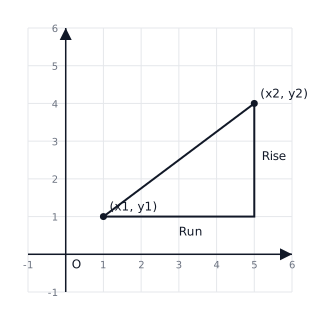
The gradient (or slope) measures the steepness of a line segment. For any two points and , it is the ratio of the 'rise' (vertical change) over the 'run' (horizontal change). A positive gradient slopes upwards from left to right, while a negative gradient slopes downwards.
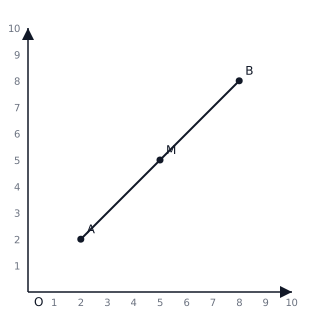
The midpoint is the exact center point of a line segment connecting and . It is calculated by taking the average of the -coordinates and the average of the -coordinates, effectively finding the 'middle' of the horizontal and vertical spans.
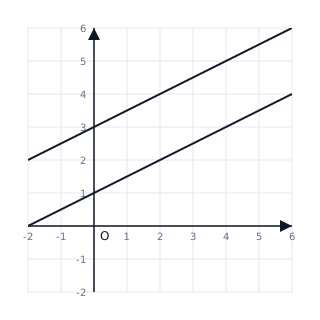
Two lines are parallel if they have the same gradient (). They will never intersect, regardless of how far they are extended.
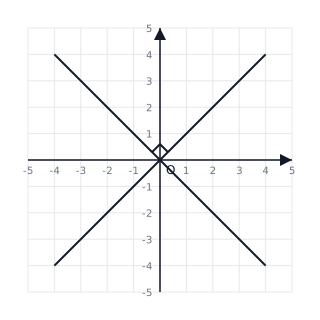
Two lines are perpendicular if they intersect at a right angle (). The product of their gradients is (i.e., ).
📐Formulae
Gradient:
Midpoint:
Perpendicular Gradient:
💡Examples
Problem 1:
Find the gradient and the midpoint of the line segment connecting the points and .
Solution:
Gradient . Midpoint .
Explanation:
Apply the gradient formula by subtracting the y-coordinates and x-coordinates. For the midpoint, calculate the average of the x-values and the average of the y-values.
Problem 2:
The midpoint of a line is . If the coordinates of are , find the coordinates of point .
Solution:
. . Point .
Explanation:
Use the midpoint formula as an equation where the midpoint is known. Solve for the unknown coordinates and individually.
Problem 3:
Given line passes through and . Find the gradient of a line that is perpendicular to .
Solution:
Gradient of . Since , .
Explanation:
First, calculate the gradient of the first line using the two given points. Then, apply the perpendicular gradient rule: take the negative reciprocal of .
Problem 4:
Find the gradient of the line segment joining the points and . Use this to determine if the line is perpendicular to a line with gradient .
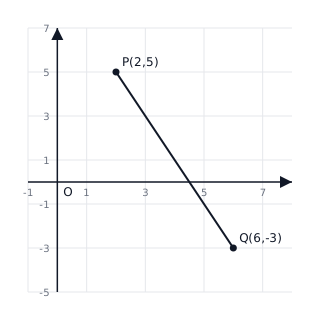
Solution:
- Identify coordinates: and .
- Calculate gradient :
- Check perpendicularity: For a line with gradient , the product is .
- Since , the lines are not perpendicular.
Explanation:
We first calculate the gradient using the formula. To check if it is perpendicular to another line, we multiply the two gradients; if the result is not , they are not perpendicular.
Problem 5:
Point has coordinates and point has coordinates . Find the coordinates of the midpoint and show its position on a coordinate plane.
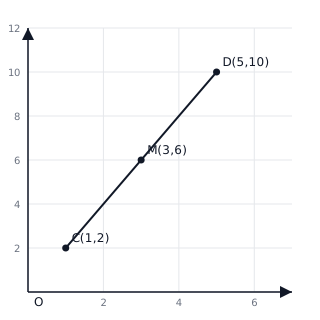
Solution:
- Identify coordinates: and .
- Apply midpoint formula for :
- Apply midpoint formula for :
- The midpoint is .
Explanation:
The midpoint is found by averaging the horizontal positions and the vertical positions of the endpoints.