
Review the key concepts, formulae, and examples before starting your quiz.
🔑Concepts
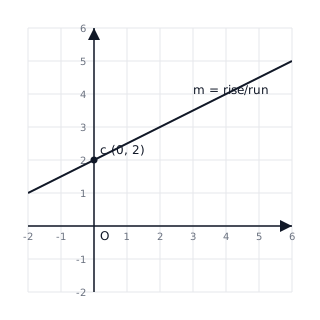
The equation of a straight line is represented as , where is the gradient (slope) and is the -intercept (the point where the line crosses the vertical axis).
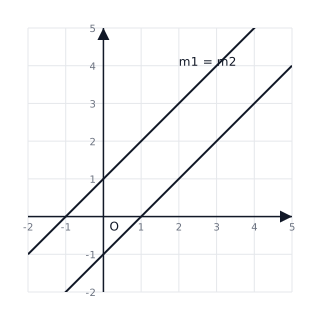
Parallel lines have identical gradients (). This means they will never intersect, regardless of their -intercepts.
Perpendicular lines meet at a angle. Their gradients are negative reciprocals of each other, satisfying the condition .
Horizontal lines have a gradient of and are written as . Vertical lines have an undefined gradient and are written as .
📐Formulae
Gradient formula:
Equation of a straight line (Slope-intercept form):
Point-gradient form:
Midpoint of a line segment:
Distance between two points:
Perpendicular gradient:
💡Examples
Problem 1:
Find the equation of the line passing through the points and .
Solution:
. Using : . Equation: .
Explanation:
First, calculate the gradient using the two-point formula. Then, substitute one point and the gradient into the slope-intercept form to solve for the y-intercept (c).
Problem 2:
Find the equation of the line perpendicular to that passes through the point .
Solution:
Gradient of given line . Perpendicular gradient . Using : .
Explanation:
Perpendicular lines have negative reciprocal gradients. After finding the new gradient, use the point-slope formula with the given coordinate.
Problem 3:
A line segment has endpoints and . Find the equation of the perpendicular bisector of .
Solution:
Midpoint . Gradient . Perpendicular gradient . Equation: .
Explanation:
The perpendicular bisector passes through the midpoint of the segment at a right angle. Find the midpoint, the gradient of the segment, the perpendicular gradient, and then the equation.
Problem 4:
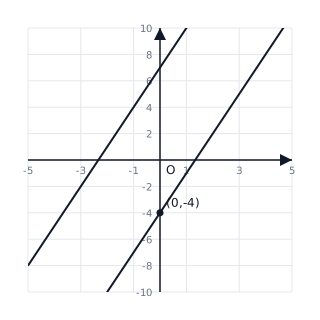
Find the equation of the line that passes through the point and is parallel to the line . Give your answer in the form .
Solution:
Explanation:
Since the line is parallel to , it must share the same gradient (). The point lies on the -axis, identifying as the -intercept ().
Problem 5:
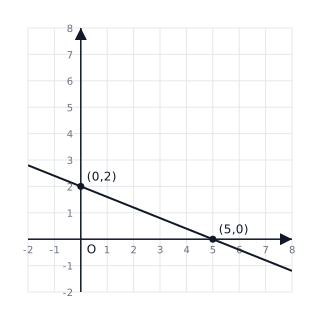
A line crosses the -axis at and the -axis at . Find the equation of line .
Solution:
Explanation:
To find the equation, we first calculate the gradient using the change in over the change in . Since the line crosses the -axis at 2, we can directly identify as 2.