krit.club logo

Integrals - Integration using trigonometric identities

Grade 12CBSE

Review the key concepts, formulae, and examples before starting your quiz.

🔑Concepts

•

The fundamental goal of using trigonometric identities in integration is to decompose products or powers of trigonometric functions into linear sums of sines and cosines. This process simplifies the integral into basic forms that can be integrated directly using the rule ∫cos⁡(mx) dx=sin⁡(mx)m+C\int \cos(mx) \, dx = \frac{\sin(mx)}{m} + C.

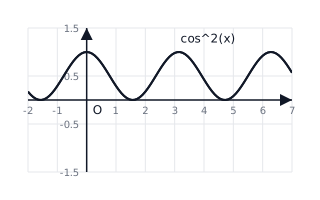
Graph showing the transformation of cos squared x into a shifted and scaled cosine wave using trigonometric identities.
•

When integrating products like sin⁡mxcos⁡nx\sin mx \cos nx, use the product-to-sum identities. These identities essentially treat the integrand as a superposition of two different frequencies, allowing for term-by-term integration.

•

For higher powers like sin⁡3x\sin^3 x or cos⁡3x\cos^3 x, identities for sin⁡3x\sin 3x and cos⁡3x\cos 3x are preferred over substitution when a purely trigonometric path is required. This converts the cubic power into a linear combination of first-power terms.
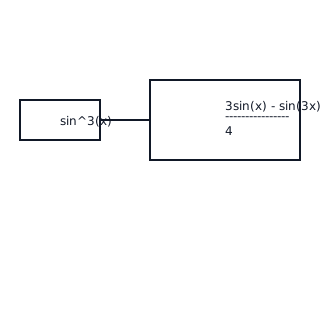
Diagram showing the conversion of a power term to a sum of linear trigonometric terms.
•

Even powers of sine and cosine (e.g., sin⁡4x\sin^4 x) require multiple applications of the half-angle or power-reduction formulas to eventually reduce the expression to a form where no powers of trigonometric functions remain.
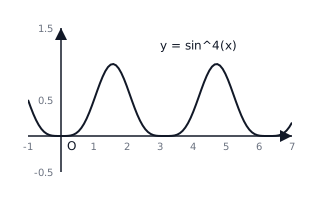
Graph of sin^4 x illustrating that it is a periodic function with a positive offset, which can be integrated once expanded.

📐Formulae

sin⁡2x=1−cos⁡2x2\sin^2 x = \frac{1 - \cos 2x}{2}

cos⁡2x=1+cos⁡2x2\cos^2 x = \frac{1 + \cos 2x}{2}

sin⁡3x=3sin⁡x−4sin⁡3x  ⟹  sin⁡3x=3sin⁡x−sin⁡3x4\sin 3x = 3\sin x - 4\sin^3 x \implies \sin^3 x = \frac{3\sin x - \sin 3x}{4}

cos⁡3x=4cos⁡3x−3cos⁡x  ⟹  cos⁡3x=3cos⁡x+cos⁡3x4\cos 3x = 4\cos^3 x - 3\cos x \implies \cos^3 x = \frac{3\cos x + \cos 3x}{4}

2sin⁡Acos⁡B=sin⁡(A+B)+sin⁡(A−B)2\sin A \cos B = \sin(A + B) + \sin(A - B)

2cos⁡Asin⁡B=sin⁡(A+B)−sin⁡(A−B)2\cos A \sin B = \sin(A + B) - \sin(A - B)

2cos⁡Acos⁡B=cos⁡(A+B)+cos⁡(A−B)2\cos A \cos B = \cos(A + B) + \cos(A - B)

2sin⁡Asin⁡B=cos⁡(A−B)−cos⁡(A+B)2\sin A \sin B = \cos(A - B) - \cos(A + B)

💡Examples

Problem 1:

Find ∫cos⁡2x dx\int \cos^2 x \, dx.

Solution:

We use the identity cos⁡2x=1+cos⁡2x2\cos^2 x = \frac{1 + \cos 2x}{2}. ∫cos⁡2x dx=∫1+cos⁡2x2 dx\int \cos^2 x \, dx = \int \frac{1 + \cos 2x}{2} \, dx =12∫(1+cos⁡2x) dx= \frac{1}{2} \int (1 + \cos 2x) \, dx =12[x+sin⁡2x2]+C= \frac{1}{2} \left[ x + \frac{\sin 2x}{2} \right] + C =x2+sin⁡2x4+C= \frac{x}{2} + \frac{\sin 2x}{4} + C

Explanation:

Direct integration of cos⁡2x\cos^2 x is not possible using basic rules, so we reduce the power from 2 to 1 using the double angle identity.

Problem 2:

Evaluate ∫sin⁡3xcos⁡4x dx\int \sin 3x \cos 4x \, dx.

Solution:

Use the identity 2sin⁡Acos⁡B=sin⁡(A+B)+sin⁡(A−B)2\sin A \cos B = \sin(A+B) + \sin(A-B). Here A=3xA = 3x and B=4xB = 4x. ∫sin⁡3xcos⁡4x dx=12∫2sin⁡3xcos⁡4x dx\int \sin 3x \cos 4x \, dx = \frac{1}{2} \int 2\sin 3x \cos 4x \, dx =12∫[sin⁡(3x+4x)+sin⁡(3x−4x)] dx= \frac{1}{2} \int [\sin(3x + 4x) + \sin(3x - 4x)] \, dx =12∫[sin⁡7x+sin⁡(−x)] dx= \frac{1}{2} \int [\sin 7x + \sin(-x)] \, dx Since sin⁡(−x)=−sin⁡x\sin(-x) = -\sin x: =12∫(sin⁡7x−sin⁡x) dx= \frac{1}{2} \int (\sin 7x - \sin x) \, dx =12[−cos⁡7x7−(−cos⁡x)]+C= \frac{1}{2} \left[ -\frac{\cos 7x}{7} - (-\cos x) \right] + C =cos⁡x2−cos⁡7x14+C= \frac{\cos x}{2} - \frac{\cos 7x}{14} + C

Explanation:

When we have a product of sine and cosine with different angles, the product-to-sum identity transforms the product into a sum of two linear trigonometric functions.

Problem 3:

Find ∫sin⁡3x dx\int \sin^3 x \, dx using trigonometric identities.

Solution:

We use the identity sin⁡3x=3sin⁡x−4sin⁡3x\sin 3x = 3\sin x - 4\sin^3 x, which gives sin⁡3x=3sin⁡x−sin⁡3x4\sin^3 x = \frac{3\sin x - \sin 3x}{4}. ∫sin⁡3x dx=∫3sin⁡x−sin⁡3x4 dx\int \sin^3 x \, dx = \int \frac{3\sin x - \sin 3x}{4} \, dx =14[3∫sin⁡x dx−∫sin⁡3x dx]= \frac{1}{4} \left[ 3 \int \sin x \, dx - \int \sin 3x \, dx \right] =14[3(−cos⁡x)−(−cos⁡3x3)]+C= \frac{1}{4} \left[ 3(-\cos x) - \left( -\frac{\cos 3x}{3} \right) \right] + C =−34cos⁡x+112cos⁡3x+C= -\frac{3}{4}\cos x + \frac{1}{12}\cos 3x + C

Explanation:

The triple angle identity is an efficient way to linearize powers of sine and cosine, making them immediately integrable.

Problem 4:

Evaluate ∫sin⁡4xsin⁡8x dx\int \sin 4x \sin 8x \, dx.

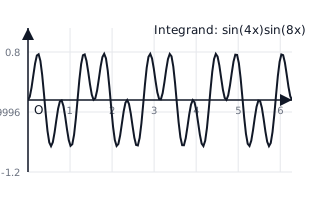
Graph showing the product of two sine waves of different frequencies.

Solution:

We use the identity 2sin⁡Asin⁡B=cos⁡(A−B)−cos⁡(A+B)2 \sin A \sin B = \cos(A - B) - \cos(A + B). Let A=8xA = 8x and B=4xB = 4x: ∫sin⁡4xsin⁡8x dx=12∫(2sin⁡8xsin⁡4x) dx\int \sin 4x \sin 8x \, dx = \frac{1}{2} \int (2 \sin 8x \sin 4x) \, dx ∫sin⁡4xsin⁡8x dx=12∫[cos⁡(8x−4x)−cos⁡(8x+4x)] dx\int \sin 4x \sin 8x \, dx = \frac{1}{2} \int [\cos(8x - 4x) - \cos(8x + 4x)] \, dx ∫sin⁡4xsin⁡8x dx=12∫(cos⁡4x−cos⁡12x) dx\int \sin 4x \sin 8x \, dx = \frac{1}{2} \int (\cos 4x - \cos 12x) \, dx Integrating term by term: 12[sin⁡4x4−sin⁡12x12]+C\frac{1}{2} \left[ \frac{\sin 4x}{4} - \frac{\sin 12x}{12} \right] + C =sin⁡4x8−sin⁡12x24+C= \frac{\sin 4x}{8} - \frac{\sin 12x}{24} + C

Explanation:

To integrate the product of two sine functions with different frequencies, we transform the product into a difference of cosines using product-to-sum identities. This makes the integration straightforward as we only need to handle basic cosine terms.

Problem 5:

Find ∫cos⁡4x dx\int \cos^4 x \, dx.

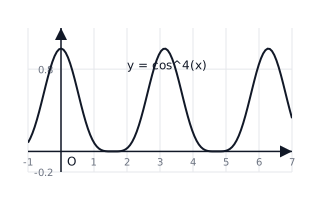
Graph of cos^4 x showing its periodicity and reduction in amplitude compared to cos x.

Solution:

We write cos⁡4x=(cos⁡2x)2\cos^4 x = (\cos^2 x)^2. Using cos⁡2x=1+cos⁡2x2\cos^2 x = \frac{1 + \cos 2x}{2}: cos⁡4x=(1+cos⁡2x2)2=14(1+2cos⁡2x+cos⁡22x)\cos^4 x = \left( \frac{1 + \cos 2x}{2} \right)^2 = \frac{1}{4} (1 + 2\cos 2x + \cos^2 2x) Now apply the identity to cos⁡22x\cos^2 2x: cos⁡22x=1+cos⁡4x2\cos^2 2x = \frac{1 + \cos 4x}{2} Substitute this back into the expression: cos⁡4x=14(1+2cos⁡2x+1+cos⁡4x2)\cos^4 x = \frac{1}{4} \left( 1 + 2\cos 2x + \frac{1 + \cos 4x}{2} \right) cos⁡4x=14(2+4cos⁡2x+1+cos⁡4x2)=18(3+4cos⁡2x+cos⁡4x)\cos^4 x = \frac{1}{4} \left( \frac{2 + 4\cos 2x + 1 + \cos 4x}{2} \right) = \frac{1}{8} (3 + 4\cos 2x + \cos 4x) Now integrate: ∫cos⁡4x dx=18∫(3+4cos⁡2x+cos⁡4x) dx\int \cos^4 x \, dx = \frac{1}{8} \int (3 + 4\cos 2x + \cos 4x) \, dx =18[3x+4sin⁡2x2+sin⁡4x4]+C= \frac{1}{8} \left[ 3x + \frac{4\sin 2x}{2} + \frac{\sin 4x}{4} \right] + C =3x8+sin⁡2x4+sin⁡4x32+C= \frac{3x}{8} + \frac{\sin 2x}{4} + \frac{\sin 4x}{32} + C

Explanation:

Integrating cos⁡4x\cos^4 x requires reducing the degree from 4 to 1. This is achieved by applying the power reduction formula twice. The resulting expression is a sum of constant and basic cosine terms which are easily integrated.