
Review the key concepts, formulae, and examples before starting your quiz.
🔑Concepts
The area function represents the signed area under the curve from a fixed lower limit to a variable upper limit . For a continuous function where , the area is bounded by the curve, the -axis, and the vertical lines and .
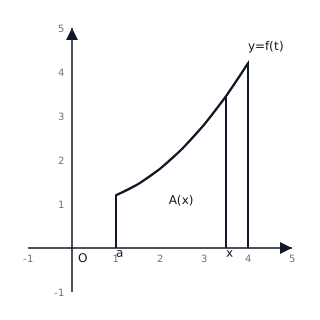
The First Fundamental Theorem of Calculus states that if is continuous on , then the area function is differentiable on , and its derivative is given by for all .
As the variable increases, the area function changes. The rate of change of this area with respect to is exactly the height of the function at that point.
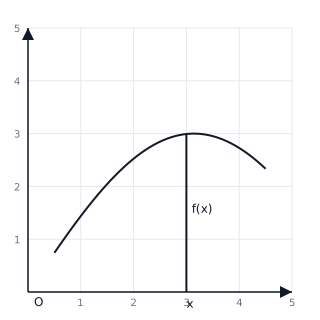
The area function is used to define the accumulation of a quantity. For example, if represents the velocity of an object, represents the displacement from time to time .
📐Formulae
💡Examples
Problem 1:
Find the derivative of the area function .
Solution:
Given . Using the First Fundamental Theorem of Integral Calculus:
Explanation:
According to the theorem, . Here, , so we replace with to find the derivative.
Problem 2:
If the area function is defined by , calculate the value of .
Solution:
Integrating the terms: Substituting the limits:
Explanation:
To find , we substitute into the upper limit of the integral and evaluate the definite integral using the power rule of integration.
Problem 3:
Verify the First Fundamental Theorem of Calculus for in the interval .
Solution:
First, find the area function : Now, find the derivative of : Since , the theorem is verified.
Explanation:
We explicitly calculated the area function by integrating and then differentiated the result to show it returns the original function .
Problem 4:
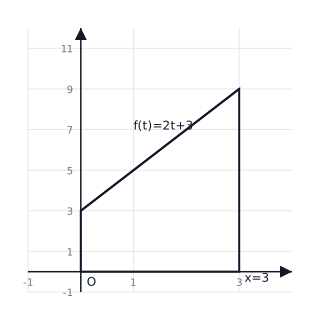
Given the function , find the area function and verify that .
Solution:
- Set up the integral: .
- Integrate with respect to : .
- Substitute the limits: .
- Differentiate with respect to : .
- Compare with : Since , we have verified .
Explanation:
The area under a linear function creates a trapezoidal region. The area function calculates this area for any .
Problem 5:
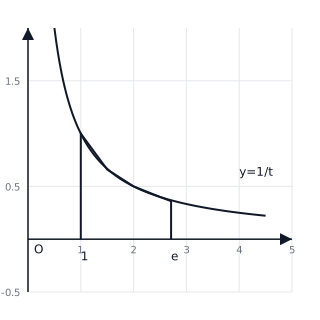
Evaluate the area function for and find its derivative at .
Solution:
- Evaluate the integral: .
- Find the derivative using the First Fundamental Theorem: .
- Calculate the value at : .
Explanation:
For the function , the area starting from is the natural logarithm function. The slope of this area function at any point is .