krit.club logo

Integrals - Integrals of Some Particular Functions

Grade 12CBSE

Review the key concepts, formulae, and examples before starting your quiz.

🔑Concepts

•

The integration of certain standard rational and irrational functions requires transforming the denominator into the form (x±k)2±a2(x \pm k)^2 \pm a^2 or a2−(x±k)2a^2 - (x \pm k)^2. This is achieved by the method of 'completing the square' for quadratic expressions of the form ax2+bx+cax^2 + bx + c. The goal is to reduce complex expressions into one of the six standard fundamental integral forms.
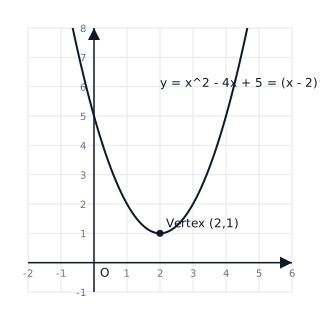
Graph showing a parabola transformed by completing the square to identify its vertex form, which is the basis for integrating quadratic denominators.
•

Integrals of the form ∫dxax2+bx+c\int \frac{dx}{ax^2 + bx + c} or ∫dxax2+bx+c\int \frac{dx}{\sqrt{ax^2 + bx + c}} are evaluated by taking the coefficient aa common from the quadratic term and completing the square for the remaining expression. Specifically, ax2+bx+c=a[(x+b2a)2+(ca−b24a2)]ax^2 + bx + c = a[(x + \frac{b}{2a})^2 + (\frac{c}{a} - \frac{b^2}{4a^2})]. The substitution x+b2a=tx + \frac{b}{2a} = t then converts it into a standard integral form.

Flowchart showing the steps to transform a quadratic denominator into a standard integral form.
•

For integrals of the type ∫px+qax2+bx+cdx\int \frac{px + q}{ax^2 + bx + c} dx or ∫px+qax2+bx+cdx\int \frac{px + q}{\sqrt{ax^2 + bx + c}} dx, the numerator px+qpx + q is expressed as a linear combination of the derivative of the denominator and a constant. We write px+q=Addx(ax2+bx+c)+Bpx + q = A\frac{d}{dx}(ax^2 + bx + c) + B, where AA and BB are determined by comparing coefficients of xx and constant terms on both sides.

Visual representation of the decomposition of a linear numerator in terms of the derivative of the quadratic denominator.
•

Logarithmic results occur when the integral involves 1x2−a2\frac{1}{x^2 - a^2}, 1a2−x2\frac{1}{a^2 - x^2}, or 1x2±a2\frac{1}{\sqrt{x^2 \pm a^2}}. These forms arise because the antiderivatives involve natural logarithms of absolute values to ensure the function is defined over its domain. The constant of integration CC must always be added to the final result.
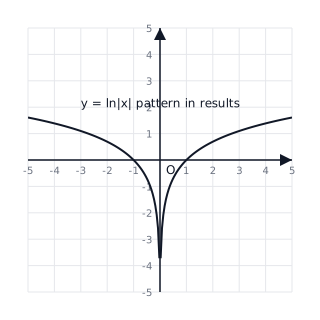
Graph of the natural log of the absolute value of x, representing the common functional form found in several particular integral solutions.

📐Formulae

∫dxx2−a2=12alog⁡∣x−ax+a∣+C\int \frac{dx}{x^2 - a^2} = \frac{1}{2a} \log \left| \frac{x - a}{x + a} \right| + C

∫dxa2−x2=12alog⁡∣a+xa−x∣+C\int \frac{dx}{a^2 - x^2} = \frac{1}{2a} \log \left| \frac{a + x}{a - x} \right| + C

∫dxx2+a2=1atan⁡−1xa+C\int \frac{dx}{x^2 + a^2} = \frac{1}{a} \tan^{-1} \frac{x}{a} + C

∫dxx2−a2=log⁡∣x+x2−a2∣+C\int \frac{dx}{\sqrt{x^2 - a^2}} = \log |x + \sqrt{x^2 - a^2}| + C

∫dxa2−x2=sin⁡−1xa+C\int \frac{dx}{\sqrt{a^2 - x^2}} = \sin^{-1} \frac{x}{a} + C

∫dxx2+a2=log⁡∣x+x2+a2∣+C\int \frac{dx}{\sqrt{x^2 + a^2}} = \log |x + \sqrt{x^2 + a^2}| + C

💡Examples

Problem 1:

Evaluate ∫dxx2−16\int \frac{dx}{x^2 - 16}

Solution:

The given integral is ∫dxx2−42\int \frac{dx}{x^2 - 4^2}. Comparing this with standard formula ∫dxx2−a2\int \frac{dx}{x^2 - a^2}, we have a=4a = 4. Using the formula: ∫dxx2−a2=12alog⁡∣x−ax+a∣+C\int \frac{dx}{x^2 - a^2} = \frac{1}{2a} \log \left| \frac{x - a}{x + a} \right| + C Substituting a=4a = 4: 12(4)log⁡∣x−4x+4∣+C=18log⁡∣x−4x+4∣+C\frac{1}{2(4)} \log \left| \frac{x - 4}{x + 4} \right| + C = \frac{1}{8} \log \left| \frac{x - 4}{x + 4} \right| + C

Explanation:

This is a direct application of the formula for 1/(x2−a2)1/(x^2 - a^2) where a2=16a^2 = 16.

Problem 2:

Find ∫dxx2+2x+5\int \frac{dx}{x^2 + 2x + 5}

Solution:

First, complete the square for the denominator x2+2x+5x^2 + 2x + 5: x2+2x+5=(x2+2x+1)+4=(x+1)2+22x^2 + 2x + 5 = (x^2 + 2x + 1) + 4 = (x + 1)^2 + 2^2 Now the integral becomes: ∫dx(x+1)2+22\int \frac{dx}{(x + 1)^2 + 2^2} Let u=x+1u = x + 1, then du=dxdu = dx. The integral is in the form ∫duu2+a2\int \frac{du}{u^2 + a^2} where a=2a = 2. Applying the formula: 12tan⁡−1(x+12)+C\frac{1}{2} \tan^{-1} \left( \frac{x + 1}{2} \right) + C

Explanation:

We use the technique of completing the square to transform the quadratic into (x+1)2+22(x+1)^2 + 2^2, then apply the tan⁡−1\tan^{-1} integral formula.

Problem 3:

Evaluate ∫dx9−25x2\int \frac{dx}{\sqrt{9 - 25x^2}}

Solution:

First, make the coefficient of x2x^2 unity by taking 2525 common: ∫dx25(925−x2)=15∫dx(35)2−x2\int \frac{dx}{\sqrt{25(\frac{9}{25} - x^2)}} = \frac{1}{5} \int \frac{dx}{\sqrt{(\frac{3}{5})^2 - x^2}} This is in the form ∫dxa2−x2\int \frac{dx}{\sqrt{a^2 - x^2}} with a=35a = \frac{3}{5}. Applying the formula sin⁡−1(xa)+C\sin^{-1}(\frac{x}{a}) + C: 15sin⁡−1(x3/5)+C=15sin⁡−1(5x3)+C\frac{1}{5} \sin^{-1} \left( \frac{x}{3/5} \right) + C = \frac{1}{5} \sin^{-1} \left( \frac{5x}{3} \right) + C

Explanation:

To use the standard formula, the coefficient of x2x^2 should ideally be 11. We factor out 2525 from the square root and then apply the sin⁡−1\sin^{-1} formula.

Problem 4:

Evaluate ∫dx2x−x2\int \frac{dx}{\sqrt{2x - x^2}}

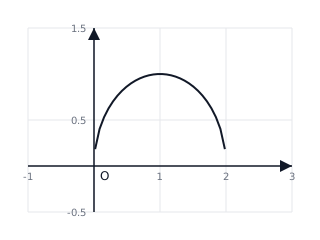
Graph showing the semi-circle resulting from the square root of a quadratic with a negative leading coefficient.

Solution:

  1. Complete the square for the expression inside the square root: 2x−x2=−(x2−2x)=−(x2−2x+1−1)2x - x^2 = -(x^2 - 2x) = -(x^2 - 2x + 1 - 1) 2x−x2=−((x−1)2−1)=1−(x−1)22x - x^2 = -( (x-1)^2 - 1 ) = 1 - (x-1)^2

  2. Rewrite the integral: ∫dx1−(x−1)2\int \frac{dx}{\sqrt{1 - (x-1)^2}}

  3. Use the formula ∫dxa2−x2=sin⁡−1xa+C\int \frac{dx}{\sqrt{a^2 - x^2}} = \sin^{-1} \frac{x}{a} + C where xx is replaced by (x−1)(x-1) and a=1a = 1: sin⁡−1(x−1)+C\sin^{-1} (x-1) + C

Explanation:

To solve an integral with a quadratic under a square root where the leading coefficient is negative, we complete the square to get the form a2−(x−h)2\sqrt{a^2 - (x-h)^2}, leading to an arcsine result.

Problem 5:

Evaluate ∫dx3x2+13x−10\int \frac{dx}{3x^2 + 13x - 10}
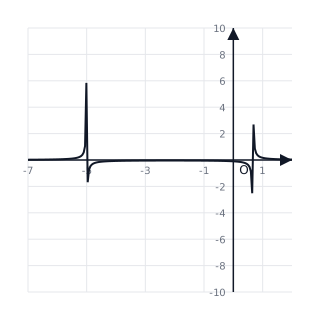
Graph of the rational function showing vertical asymptotes where the quadratic denominator equals zero.

Solution:

  1. Factor out the coefficient of x2x^2: 13∫dxx2+133x−103\frac{1}{3} \int \frac{dx}{x^2 + \frac{13}{3}x - \frac{10}{3}}

  2. Complete the square for x2+133xx^2 + \frac{13}{3}x: (x+136)2−(136)2−103(x + \frac{13}{6})^2 - (\frac{13}{6})^2 - \frac{10}{3} =(x+136)2−16936−12036= (x + \frac{13}{6})^2 - \frac{169}{36} - \frac{120}{36} =(x+136)2−28936=(x+136)2−(176)2= (x + \frac{13}{6})^2 - \frac{289}{36} = (x + \frac{13}{6})^2 - (\frac{17}{6})^2

  3. Apply the formula ∫dxx2−a2=12alog⁡∣x−ax+a∣+C\int \frac{dx}{x^2 - a^2} = \frac{1}{2a} \log |\frac{x-a}{x+a}| + C: 13⋅12(176)log⁡∣x+136−176x+136+176∣+C\frac{1}{3} \cdot \frac{1}{2(\frac{17}{6})} \log | \frac{x + \frac{13}{6} - \frac{17}{6}}{x + \frac{13}{6} + \frac{17}{6}} | + C 13⋅317log⁡∣x−46x+306∣+C\frac{1}{3} \cdot \frac{3}{17} \log | \frac{x - \frac{4}{6}}{x + \frac{30}{6}} | + C 117log⁡∣3x−23(x+5)∣+C\frac{1}{17} \log | \frac{3x - 2}{3(x + 5)} | + C

Explanation:

By completing the square on the quadratic denominator, we transform the integral into the standard ∫dxx2−a2\int \frac{dx}{x^2 - a^2} form, allowing for a logarithmic solution.