
Integrals - Integration of a variety of functions by substitution, by partial fractions and by parts
Review the key concepts, formulae, and examples before starting your quiz.
🔑Concepts
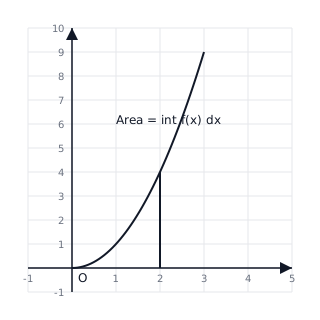
Integration by Substitution: This method simplifies an integral by changing the variable. If a function is of the form , we substitute , making the integral . Graphically, this corresponds to a transformation of the area under the curve to a simpler coordinate system.
Integration by Partial Fractions: Rational functions where the degree of is less than can be decomposed into simpler fractions. For example, . This splits a complex rational function into basic logarithmic integrals.

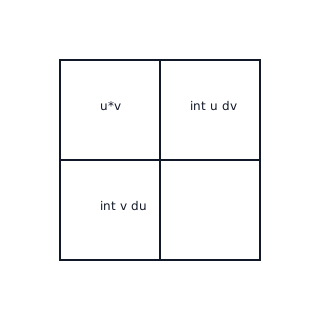
Integration by Parts: Based on the product rule of differentiation, . The ILATE rule (Inverse Trigonometric, Logarithmic, Algebraic, Trigonometric, Exponential) is used to prioritize the choice of the function .
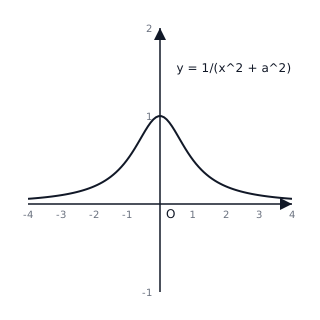
Special Integrals: These are standard results for functions involving square roots and quadratic denominators. Remembering forms like is essential for solving problems involving completing the square.
📐Formulae
💡Examples
Problem 1:
Evaluate using the method of substitution.
Solution:
Step 1: Let . Step 2: Differentiate both sides with respect to : , which gives . Step 3: Substitute and into the integral: . Step 4: Integrate the function: . Step 5: Substitute the value of back in terms of : .
Explanation:
This problem uses substitution because the derivative of the denominator () is present in the numerator. By changing the variable, we transform a rational function into a standard reciprocal integral.
Problem 2:
Evaluate using integration by parts.
Solution:
Step 1: Identify and using ILATE. Let (Algebraic) and (Trigonometric). Step 2: Calculate and . Step 3: Apply the integration by parts formula: . Step 4: Substitute the values: . Step 5: Integrate the remaining term: . Step 6: Simplify: .
Explanation:
Integration by parts is applied here because the integrand is a product of an algebraic function and a trigonometric function. Choosing allows the degree of the algebraic part to reduce to 1, making the second integral straightforward.
Problem 3:
Evaluate using partial fractions.
Solution:
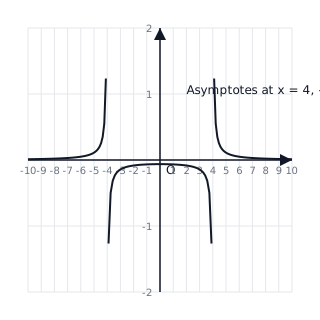
- Factor the denominator: .
- Decompose into partial fractions: .
- Solve for and : .
- Let . Let .
- Substitute back: .
- Simplify: .
Explanation:
This example demonstrates how a quadratic denominator is split into two linear factors to facilitate logarithmic integration.
Problem 4:
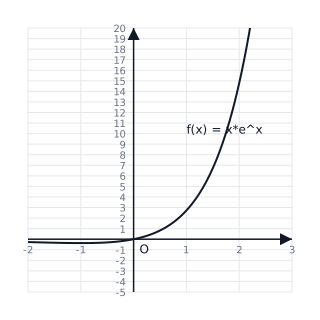
Evaluate using integration by parts.
Solution:
- Choose (algebraic) and (exponential) based on ILATE.
- Compute and .
- Apply the formula .
- .
- Evaluate the remaining integral: .
- Factor out : .
Explanation:
Integration by parts is used here to reduce the algebraic term to through differentiation, leaving a simple exponential integral.