🚀 50 free questions/month

Introduction to Three-Dimensional Geometry - Section Formula

Grade 11ICSE

🔑Concepts

•

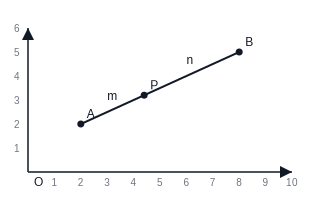
The Section Formula (Internal Division) determines the coordinates of a point PP that divides the line segment joining A(x1,y1,z1)A(x_1, y_1, z_1) and B(x2,y2,z2)B(x_2, y_2, z_2) in a given ratio m:nm : n. The point PP lies on the segment ABAB such that APPB=mn\frac{AP}{PB} = \frac{m}{n}.

A line segment AB divided internally by point P in ratio m:n
•

The External Division occurs when a point PP lies on the extension of the line segment ABAB such that AP:BP=m:nAP : BP = m : n. In this case, the formula uses a negative sign between the ratio terms in the numerator and denominator.
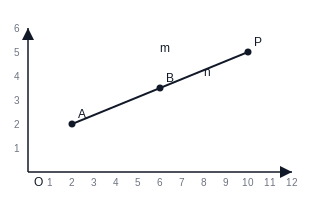
A line segment AB extended to point P for external division
•

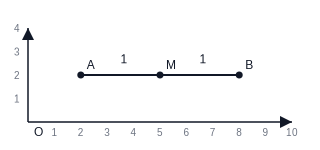
The Midpoint of a line segment is a special case of the section formula where the ratio m:nm : n is 1:11 : 1. It represents the average of the xx, yy, and zz coordinates of the endpoints.

Line segment AB with M as the midpoint
•

The Centroid of a Triangle (GG) is the point where the medians intersect. It divides each median in the ratio 2:12 : 1 from the vertex to the midpoint of the opposite side.
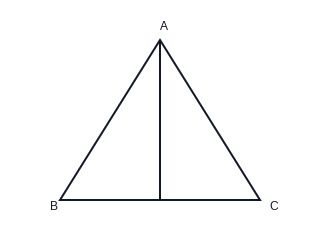
Centroid G of a triangle ABC

📐Formulae

Internal Section Formula: P(x,y,z)=(mx2+nx1m+n,my2+ny1m+n,mz2+nz1m+n)P(x, y, z) = \left( \frac{mx_2 + nx_1}{m+n}, \frac{my_2 + ny_1}{m+n}, \frac{mz_2 + nz_1}{m+n} \right)

External Section Formula: P(x,y,z)=(mx2−nx1m−n,my2−ny1m−n,mz2−nz1m−n)P(x, y, z) = \left( \frac{mx_2 - nx_1}{m-n}, \frac{my_2 - ny_1}{m-n}, \frac{mz_2 - nz_1}{m-n} \right)

Midpoint Formula: M(x,y,z)=(x1+x22,y1+y22,z1+z22)M(x, y, z) = \left( \frac{x_1 + x_2}{2}, \frac{y_1 + y_2}{2}, \frac{z_1 + z_2}{2} \right)

Centroid of a Triangle ABCABC: G(x,y,z)=(x1+x2+x33,y1+y2+y33,z1+z2+z33)G(x, y, z) = \left( \frac{x_1 + x_2 + x_3}{3}, \frac{y_1 + y_2 + y_3}{3}, \frac{z_1 + z_2 + z_3}{3} \right)

Centroid of a Tetrahedron: G(x,y,z)=(x1+x2+x3+x44,y1+y2+y3+y44,z1+z2+z3+y44)G(x, y, z) = \left( \frac{x_1 + x_2 + x_3 + x_4}{4}, \frac{y_1 + y_2 + y_3 + y_4}{4}, \frac{z_1 + z_2 + z_3 + y_4}{4} \right)

💡Examples

Problem 1:

Find the coordinates of the point which divides the line segment joining the points A(1,−2,3)A(1, -2, 3) and B(3,4,−5)B(3, 4, -5) in the ratio 2:32:3 internally.

Solution:

  1. Identify coordinates and ratio: (x1,y1,z1)=(1,−2,3)(x_1, y_1, z_1) = (1, -2, 3), (x2,y2,z2)=(3,4,−5)(x_2, y_2, z_2) = (3, 4, -5), m=2m = 2, n=3n = 3.
  2. Apply the internal section formula for xx: x=2(3)+3(1)2+3=6+35=95x = \frac{2(3) + 3(1)}{2+3} = \frac{6+3}{5} = \frac{9}{5}.
  3. Apply the formula for yy: y=2(4)+3(−2)2+3=8−65=25y = \frac{2(4) + 3(-2)}{2+3} = \frac{8-6}{5} = \frac{2}{5}.
  4. Apply the formula for zz: z=2(−5)+3(3)2+3=−10+95=−15z = \frac{2(-5) + 3(3)}{2+3} = \frac{-10+9}{5} = \frac{-1}{5}.
  5. The required point is (95,25,−15)\left( \frac{9}{5}, \frac{2}{5}, \frac{-1}{5} \right).

Explanation:

This problem uses the internal section formula because the point is specified to divide the segment internally. We plug the given endpoints and ratio directly into the coordinates formula.

Problem 2:

Find the ratio in which the YZYZ-plane divides the line segment joining A(−2,4,7)A(-2, 4, 7) and B(3,−5,8)B(3, -5, 8).

Solution:

  1. Let the YZYZ-plane divide the segment ABAB in the ratio k:1k:1 at point PP.
  2. Any point on the YZYZ-plane has an xx-coordinate equal to 00. Therefore, xp=0x_p = 0.
  3. Using the section formula for the xx-coordinate: x=kx2+1x1k+1=0x = \frac{kx_2 + 1x_1}{k+1} = 0.
  4. Substitute the values: k(3)+1(−2)k+1=0\frac{k(3) + 1(-2)}{k+1} = 0.
  5. Solve for kk: 3k−2=0  ⟹  3k=2  ⟹  k=233k - 2 = 0 \implies 3k = 2 \implies k = \frac{2}{3}.
  6. Since kk is positive, the ratio is 2:32:3 internally.

Explanation:

When a plane divides a segment, we use the property of that specific plane (for YZYZ-plane, x=0x=0; for XZXZ-plane, y=0y=0; for XYXY-plane, z=0z=0). Setting the relevant coordinate to zero allows us to solve for the unknown ratio kk.

Problem 3:

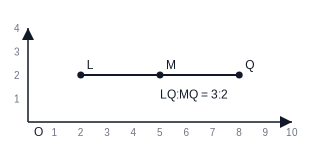
Determine the coordinates of the point QQ which divides the line segment joining L(2,4,5)L(2, 4, 5) and M(3,5,−4)M(3, 5, -4) externally in the ratio 3:23:2.

Point Q dividing LM externally in ratio 3:2

Solution:

Given: A(x1,y1,z1)=(2,4,5)A(x_1, y_1, z_1) = (2, 4, 5), B(x2,y2,z2)=(3,5,−4)B(x_2, y_2, z_2) = (3, 5, -4), and ratio m:n=3:2m:n = 3:2. Using the external section formula: x=mx2−nx1m−n=3(3)−2(2)3−2=9−41=5x = \frac{m x_2 - n x_1}{m - n} = \frac{3(3) - 2(2)}{3 - 2} = \frac{9 - 4}{1} = 5 y=my2−ny1m−n=3(5)−2(4)3−2=15−81=7y = \frac{m y_2 - n y_1}{m - n} = \frac{3(5) - 2(4)}{3 - 2} = \frac{15 - 8}{1} = 7 z=mz2−nz1m−n=3(−4)−2(5)3−2=−12−101=−22z = \frac{m z_2 - n z_1}{m - n} = \frac{3(-4) - 2(5)}{3 - 2} = \frac{-12 - 10}{1} = -22 Therefore, the coordinates of QQ are (5,7,−22)(5, 7, -22).

Explanation:

To divide a segment externally, the ratio m:nm:n is applied with a subtraction in the formula. Point QQ lies on the line passing through LL and MM, but outside the segment LMLM, closer to MM because m>nm > n.

Problem 4:

Find the ratio in which the XZXZ-plane divides the line segment joining the points P(−3,4,−8)P(-3, 4, -8) and Q(5,−6,4)Q(5, -6, 4). Also, find the coordinates of the point of intersection.
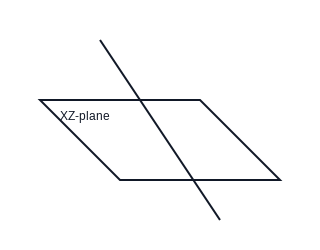
Line PQ intersecting the XZ-plane at point R

Solution:

Let the XZXZ-plane divide PQPQ in the ratio k:1k : 1 at point R(x,y,z)R(x, y, z). In the XZXZ-plane, the yy-coordinate is always 00. Using the section formula for the yy-coordinate: y=ky2+1y1k+1=0y = \frac{k y_2 + 1 y_1}{k + 1} = 0 k(−6)+1(4)k+1=0\frac{k(-6) + 1(4)}{k + 1} = 0 −6k+4=0  ⟹  6k=4  ⟹  k=23-6k + 4 = 0 \implies 6k = 4 \implies k = \frac{2}{3} The ratio is 2:32:3 internally. Now, find xx and zz: x=23(5)+1(−3)23+1=103−353=1/35/3=15x = \frac{\frac{2}{3}(5) + 1(-3)}{\frac{2}{3} + 1} = \frac{\frac{10}{3} - 3}{\frac{5}{3}} = \frac{1/3}{5/3} = \frac{1}{5} z=23(4)+1(−8)23+1=83−853=−16/35/3=−165z = \frac{\frac{2}{3}(4) + 1(-8)}{\frac{2}{3} + 1} = \frac{\frac{8}{3} - 8}{\frac{5}{3}} = \frac{-16/3}{5/3} = -\frac{16}{5} The point of intersection is (15,0,−165)(\frac{1}{5}, 0, -\frac{16}{5}).

Explanation:

Since the XZXZ-plane is defined by y=0y=0, we set the yy-coordinate of the dividing point to zero to find the ratio kk. Once kk is found, we substitute it back to find the remaining coordinates.

Finished reading?

Practice Section Formula with a worksheet. Answers included.