
Introduction to Three-Dimensional Geometry - Coordinate Axes and Coordinate Planes in 3D
Review the key concepts, formulae, and examples before starting your quiz.
🔑Concepts
The 3D coordinate system consists of three mutually perpendicular lines passing through a fixed point called the origin . These lines are the -axis, -axis, and -axis.
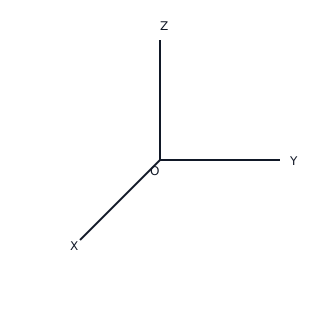
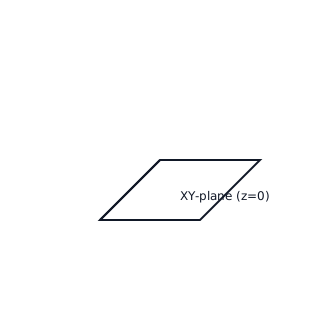
Three coordinate planes are formed by pairs of axes: the -plane (contains and axes, ), the -plane (contains and axes, ), and the -plane (contains and axes, ).
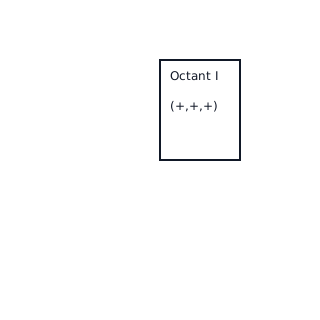
The coordinate planes divide the space into eight regions called octants. The sign of coordinates determines the octant. For example, in the first octant, all coordinates are positive.
Any point in space is represented as , where and are the perpendicular distances from the , , and planes respectively.
📐Formulae
Equation of the -plane:
Equation of the -plane:
Equation of the -plane:
Coordinates of a point on the -axis:
Coordinates of a point on the -axis:
Coordinates of a point on the -axis:
Distance of point from the origin:
Distance between two points and :
💡Examples
Problem 1:
Determine the octants in which the following points lie: and .
Solution:
- For point : Here is positive (), is negative (), and is positive (). Looking at the sign convention, the pattern corresponds to Octant IV.
- For point : Here is negative (), is negative (), and is negative (). The pattern corresponds to Octant VII.
Explanation:
To identify the octant, we look at the signs of the coordinates. Octants I-IV have and Octants V-VIII have .
Problem 2:
Find the distance of the point from (i) the -plane and (ii) the Origin.
Solution:
- Distance from the -plane: The perpendicular distance of any point from the -plane is given by . Here, , so the distance is units.
- Distance from the Origin : Using the distance formula , we get: units.
Explanation:
The distance from a coordinate plane is the absolute value of the 'missing' coordinate. The distance from the origin uses the 3D version of the Pythagorean theorem.
Problem 3:
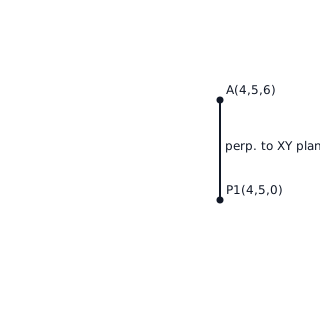
Find the coordinates of the point which is the projection of on the -plane, -plane, and -plane.
Solution:
- For the -plane, the -coordinate becomes zero. So, projection is .
- For the -plane, the -coordinate becomes zero. So, projection is .
- For the -plane, the -coordinate becomes zero. So, projection is .
Explanation:
The projection of a point onto a coordinate plane is found by setting the coordinate corresponding to the missing axis of that plane to zero.
Problem 4:
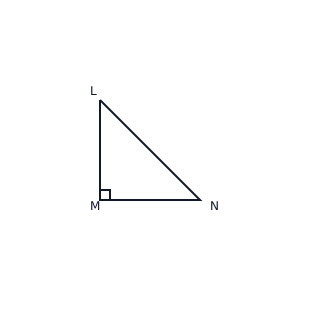
Show that the points , and form a right-angled triangle.
Solution:
Using distance formula : Since , the triangle is right-angled at .
Explanation:
We calculate the squares of the lengths of the three sides using the 3D distance formula and verify if the Pythagorean theorem holds true.