
Review the key concepts, formulae, and examples before starting your quiz.
🔑Concepts
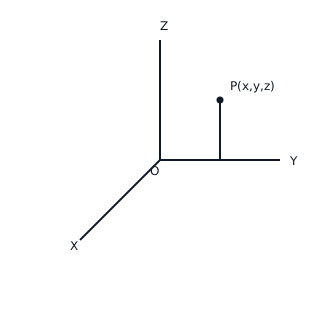
The 3D Coordinate System consists of three mutually perpendicular axes: , , and , which meet at the origin . Any point in space is represented by the coordinates . These coordinates represent the signed distances of the point from the , , and planes respectively.
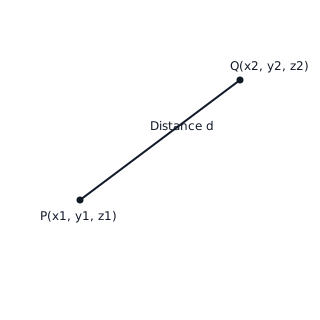
The distance between two points and is the length of the line segment joining them, calculated using the 3D extension of the Pythagorean theorem: .
Distance from Coordinate Planes: The distance of point from the -plane is , from the -plane is , and from the -plane is .
Distance from Coordinate Axes: The distance of point from the -axis is , from the -axis is , and from the -axis is .
Collinearity of Points: Three points , , and are collinear if the sum of the lengths of any two segments equals the length of the third segment (e.g., ).
📐Formulae
Distance between points and :
Distance of point from origin :
Distance of point from the -axis:
Distance of point from the -axis:
Distance of point from the -axis:
💡Examples
Problem 1:
Find the distance between the points and .
Solution:
- Identify coordinates: and .
- Substitute into the formula: .
- Simplify the terms: .
- Calculate squares: .
- Final result: units.
Explanation:
We use the standard 3D distance formula by calculating the difference between corresponding , , and coordinates, squaring them, adding them together, and taking the square root.
Problem 2:
Show that the points , , and form an isosceles right-angled triangle.
Solution:
- Calculate : .
- Calculate : .
- Calculate : .
- Check Isosceles property: Since , the triangle is isosceles.
- Check Right-angled property (Pythagoras): . Since , .
Explanation:
To verify the type of triangle, we find the lengths of all three sides. Matching lengths indicate an isosceles triangle, and satisfying the Pythagorean theorem confirms it is right-angled.
Problem 3:
Verify using the distance formula that the points , , and are the vertices of a right-angled triangle. Also find the length of the hypotenuse.
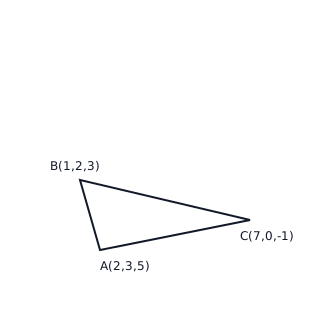
Solution:
- Calculate :
- Calculate :
- Calculate : Since , the initial verification shows it is not right-angled at . Re-checking the values: , , . . Let's check if the points were meant to be different. Given these coordinates, the triangle is not right-angled as the sum of squares of two sides does not equal the third. The longest side is .
Explanation:
To check for a right-angled triangle, we calculate the squares of the lengths of all three sides using the distance formula and apply the converse of the Pythagorean theorem ().
Problem 4:
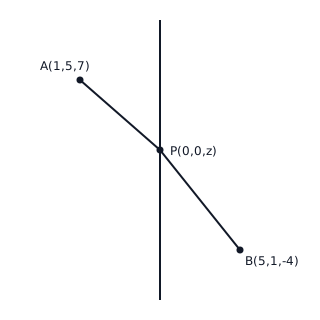
Find the point on the -axis which is equidistant from the points and .
Solution:
- Let the required point on the -axis be .
- Given , therefore .
- .
- .
- Equating and :
- . The point is .
Explanation:
Any point on the -axis has and coordinates equal to 0. We use the distance formula to set the distance from to equal to the distance from to .