krit.club logo

Introduction to Three-Dimensional Geometry - Coordinates of a Point

Grade 11ICSE

Review the key concepts, formulae, and examples before starting your quiz.

🔑Concepts

•

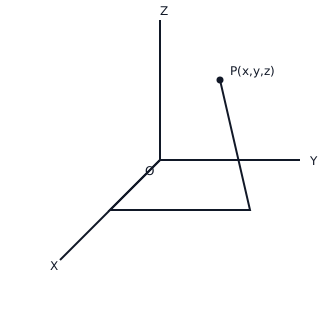
The 3D Cartesian coordinate system is formed by three mutually perpendicular axes: the XX-axis, YY-axis, and ZZ-axis, intersecting at the origin O(0,0,0)O(0, 0, 0). These axes define three coordinate planes: the XYXY-plane (where z=0z = 0), the YZYZ-plane (where x=0x = 0), and the ZXZX-plane (where y=0y = 0).

3D Coordinate System showing X, Y, and Z axes intersecting at Origin O with a point P.
•

The three coordinate planes divide the entire space into eight regions called octants. The sign of the coordinates (x,y,z)(x, y, z) determines the octant in which a point lies. For example, in the first octant, all coordinates are positive (+,+,+)(+, +, +).

•

The distance of a point P(x,y,z)P(x, y, z) from the coordinate planes is given by the absolute values of its coordinates: distance from XYXY-plane is ∣z∣|z|, from YZYZ-plane is ∣x∣|x|, and from ZXZX-plane is ∣y∣|y|.

•

The coordinates of any point on the XX-axis are of the form (x,0,0)(x, 0, 0), on the YY-axis (0,y,0)(0, y, 0), and on the ZZ-axis (0,0,z)(0, 0, z).

📐Formulae

Distance between two points P(x1,y1,z1)P(x_1, y_1, z_1) and Q(x2,y2,z2)Q(x_2, y_2, z_2): d=(x2−x1)2+(y2−y1)2+(z2−z1)2d = \sqrt{(x_2 - x_1)^2 + (y_2 - y_1)^2 + (z_2 - z_1)^2}

Distance from Origin O(0,0,0)O(0, 0, 0) to point P(x,y,z)P(x, y, z): OP=x2+y2+z2OP = \sqrt{x^2 + y^2 + z^2}

Internal Section Formula: R=(mx2+nx1m+n,my2+ny1m+n,mz2+nz1m+n)R = (\frac{mx_2 + nx_1}{m+n}, \frac{my_2 + ny_1}{m+n}, \frac{mz_2 + nz_1}{m+n})

External Section Formula: R=(mx2−nx1m−n,my2−ny1m−n,mz2−nz1m−n)R = (\frac{mx_2 - nx_1}{m-n}, \frac{my_2 - ny_1}{m-n}, \frac{mz_2 - nz_1}{m-n})

Midpoint Formula: M=(x1+x22,y1+y22,z1+z22)M = (\frac{x_1 + x_2}{2}, \frac{y_1 + y_2}{2}, \frac{z_1 + z_2}{2})

Centroid of a Triangle: G=(x1+x2+x33,y1+y2+y33,z1+z2+z33)G = (\frac{x_1 + x_2 + x_3}{3}, \frac{y_1 + y_2 + y_3}{3}, \frac{z_1 + z_2 + z_3}{3})

💡Examples

Problem 1:

Find the distance between the points A(3,−2,5)A(3, -2, 5) and B(−1,4,−3)B(-1, 4, -3).

Solution:

  1. Identify the coordinates: (x1,y1,z1)=(3,−2,5)(x_1, y_1, z_1) = (3, -2, 5) and (x2,y2,z2)=(−1,4,−3)(x_2, y_2, z_2) = (-1, 4, -3).
  2. Apply the distance formula: d=(x2−x1)2+(y2−y1)2+(z2−z1)2d = \sqrt{(x_2 - x_1)^2 + (y_2 - y_1)^2 + (z_2 - z_1)^2}.
  3. Substitute the values: d=(−1−3)2+(4−(−2))2+(−3−5)2d = \sqrt{(-1 - 3)^2 + (4 - (-2))^2 + (-3 - 5)^2}.
  4. Simplify: d=(−4)2+(6)2+(−8)2d = \sqrt{(-4)^2 + (6)^2 + (-8)^2}.
  5. d=16+36+64=116d = \sqrt{16 + 36 + 64} = \sqrt{116}.
  6. Final value: d=229d = 2\sqrt{29} units.

Explanation:

The distance formula calculates the straight-line spatial distance between two points by finding the square root of the sum of the squares of the differences between their respective coordinates.

Problem 2:

Find the coordinates of the point RR which divides the line segment joining P(1,−2,3)P(1, -2, 3) and Q(3,4,−5)Q(3, 4, -5) in the ratio 2:32:3 internally.

Solution:

  1. Coordinates: P(1,−2,3)P(1, -2, 3), Q(3,4,−5)Q(3, 4, -5) and ratio m:n=2:3m:n = 2:3.
  2. Use Internal Section Formula: x=mx2+nx1m+nx = \frac{mx_2 + nx_1}{m+n}, y=my2+ny1m+ny = \frac{my_2 + ny_1}{m+n}, z=mz2+nz1m+nz = \frac{mz_2 + nz_1}{m+n}.
  3. For xx: x=2(3)+3(1)2+3=6+35=95x = \frac{2(3) + 3(1)}{2+3} = \frac{6+3}{5} = \frac{9}{5}.
  4. For yy: y=2(4)+3(−2)2+3=8−65=25y = \frac{2(4) + 3(-2)}{2+3} = \frac{8-6}{5} = \frac{2}{5}.
  5. For zz: z=2(−5)+3(3)2+3=−10+95=−15z = \frac{2(-5) + 3(3)}{2+3} = \frac{-10+9}{5} = -\frac{1}{5}.
  6. The point is R(95,25,−15)R(\frac{9}{5}, \frac{2}{5}, -\frac{1}{5}).

Explanation:

The section formula determines the coordinates of a point that partitions a line segment according to a specific ratio. Since it is internal division, we add the products in the numerator and the terms in the denominator.

Problem 3:

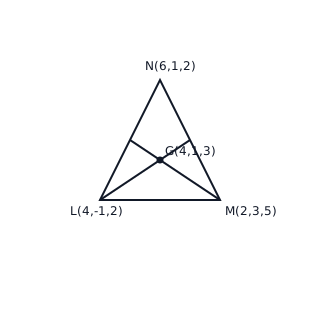
Determine the coordinates of the centroid of a triangle whose vertices are L(4,−1,2)L(4, -1, 2), M(2,3,5)M(2, 3, 5), and N(6,1,2)N(6, 1, 2).

Triangle LMN with centroid G illustrated.

Solution:

The coordinates of the centroid G(x,y,z)G(x, y, z) are given by: x=x1+x2+x33=4+2+63=123=4x = \frac{x_1 + x_2 + x_3}{3} = \frac{4 + 2 + 6}{3} = \frac{12}{3} = 4 y=y1+y2+y33=−1+3+13=33=1y = \frac{y_1 + y_2 + y_3}{3} = \frac{-1 + 3 + 1}{3} = \frac{3}{3} = 1 z=z1+z2+z33=2+5+23=93=3z = \frac{z_1 + z_2 + z_3}{3} = \frac{2 + 5 + 2}{3} = \frac{9}{3} = 3 Thus, the centroid is G(4,1,3)G(4, 1, 3).

Explanation:

The centroid of a triangle in 3D space is the arithmetic mean of the coordinates of its three vertices.

Problem 4:

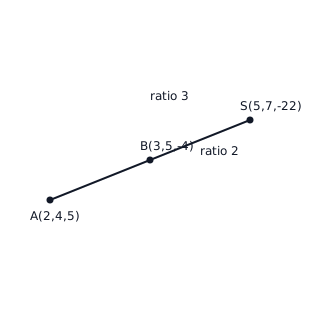
Find the coordinates of the point SS that divides the segment joining A(2,4,5)A(2, 4, 5) and B(3,5,−4)B(3, 5, -4) externally in the ratio 3:23:2.

Line segment AB extended to point S showing external division.

Solution:

Using the External Section Formula with m=3,n=2m=3, n=2: x=3(3)−2(2)3−2=9−41=5x = \frac{3(3) - 2(2)}{3 - 2} = \frac{9 - 4}{1} = 5 y=3(5)−2(4)3−2=15−81=7y = \frac{3(5) - 2(4)}{3 - 2} = \frac{15 - 8}{1} = 7 z=3(−4)−2(5)3−2=−12−101=−22z = \frac{3(-4) - 2(5)}{3 - 2} = \frac{-12 - 10}{1} = -22 The coordinates of point SS are (5,7,−22)(5, 7, -22).

Explanation:

External division occurs when the point SS lies on the extension of the line segment ABAB.