krit.club logo

Limits and Derivatives - Limits of Trigonometric Functions

Grade 11CBSE

Review the key concepts, formulae, and examples before starting your quiz.

🔑Concepts

•

The fundamental trigonometric limit states that lim⁡x→0sin⁡xx=1\lim_{x \to 0} \frac{\sin x}{x} = 1. This implies that for very small values of xx (measured in radians), sin⁡x≈x\sin x \approx x. Geometrically, as the angle xx approaches zero, the length of the arc and the length of the vertical segment (sine) become nearly identical.
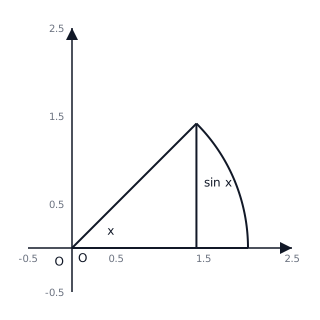
Unit circle sector showing angle x and vertical line representing sin x.
•

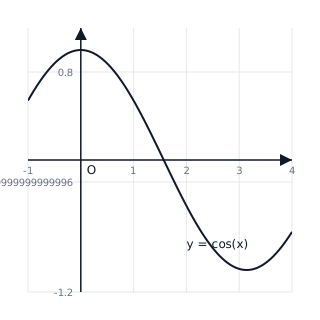
The limit lim⁡x→01−cos⁡xx=0\lim_{x \to 0} \frac{1 - \cos x}{x} = 0 can be visualized by observing the rate of change of the horizontal distance (cosine) as the angle approaches zero. Since the cosine curve has a horizontal tangent at x=0x = 0, its distance from 1 decreases much slower than xx decreases.

Graph of y = cos(x) showing a flat peak at x=0.
•

Sandwich Theorem for Trigonometric Limits: For 0<x<π20 < x < \frac{\pi}{2}, we have the inequality cos⁡x<sin⁡xx<1\cos x < \frac{\sin x}{x} < 1. As xx approaches 0, both cos⁡x\cos x and 1 approach 1, forcing the middle term to 1.
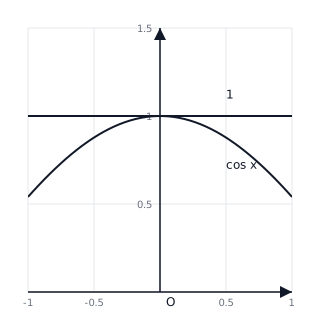
Comparison of functions 1 and cos x near x=0.
•

Standard Substitution: When x→ax \to a and the expression involves trigonometric functions, we often substitute h=x−ah = x - a so that as x→ax \to a, h→0h \to 0. This allows the use of standard limit formulae.

📐Formulae

lim⁡x→0sin⁡x=0\lim_{x \to 0} \sin x = 0

lim⁡x→0cos⁡x=1\lim_{x \to 0} \cos x = 1

lim⁡x→0sin⁡xx=1\lim_{x \to 0} \frac{\sin x}{x} = 1 (where xx is in radians)

lim⁡x→0tan⁡xx=1\lim_{x \to 0} \frac{\tan x}{x} = 1

lim⁡x→01−cos⁡xx=0\lim_{x \to 0} \frac{1 - \cos x}{x} = 0

lim⁡x→01−cos⁡xx2=12\lim_{x \to 0} \frac{1 - \cos x}{x^2} = \frac{1}{2}

💡Examples

Problem 1:

Evaluate lim⁡x→0sin⁡5x3x\lim_{x \to 0} \frac{\sin 5x}{3x}

Solution:

  1. We know the standard limit lim⁡θ→0sin⁡θθ=1\lim_{\theta \to 0} \frac{\sin \theta}{\theta} = 1.
  2. To use this, the angle in the sine function must match the denominator. Here the angle is 5x5x, but the denominator is 3x3x.
  3. Multiply and divide the expression by 55: lim⁡x→0sin⁡5x3x=lim⁡x→0(sin⁡5x5x⋅53)\lim_{x \to 0} \frac{\sin 5x}{3x} = \lim_{x \to 0} \left( \frac{\sin 5x}{5x} \cdot \frac{5}{3} \right)
  4. Pull the constant out of the limit: 53⋅lim⁡x→0sin⁡5x5x\frac{5}{3} \cdot \lim_{x \to 0} \frac{\sin 5x}{5x}
  5. Let y=5xy = 5x. As x→0x \to 0, yy also approaches 00. The limit becomes: 53⋅lim⁡y→0sin⁡yy=53⋅1=53\frac{5}{3} \cdot \lim_{y \to 0} \frac{\sin y}{y} = \frac{5}{3} \cdot 1 = \frac{5}{3}

Explanation:

This solution uses the strategy of coefficient adjustment to match the argument of the sine function with its denominator, allowing the application of the fundamental limit theorem.

Problem 2:

Evaluate lim⁡x→01−cos⁡4xx2\lim_{x \to 0} \frac{1 - \cos 4x}{x^2}

Solution:

  1. Use the identity 1−cos⁡θ=2sin⁡2(θ2)1 - \cos \theta = 2\sin^2(\frac{\theta}{2}). Here θ=4x\theta = 4x, so θ2=2x\frac{\theta}{2} = 2x.
  2. Substitute the identity into the limit: lim⁡x→02sin⁡2(2x)x2\lim_{x \to 0} \frac{2\sin^2(2x)}{x^2}
  3. Rearrange the expression to group the squared terms: 2⋅lim⁡x→0(sin⁡2xx)22 \cdot \lim_{x \to 0} \left( \frac{\sin 2x}{x} \right)^2
  4. To use lim⁡θ→0sin⁡θθ=1\lim_{\theta \to 0} \frac{\sin \theta}{\theta} = 1, we need 2x2x in the denominator. Multiply and divide inside the square by 22: 2⋅lim⁡x→0(2⋅sin⁡2x2x)2=2⋅(2)2⋅lim⁡x→0(sin⁡2x2x)22 \cdot \lim_{x \to 0} \left( \frac{2 \cdot \sin 2x}{2x} \right)^2 = 2 \cdot (2)^2 \cdot \lim_{x \to 0} \left( \frac{\sin 2x}{2x} \right)^2
  5. Evaluate the limit: 2⋅4⋅(1)2=82 \cdot 4 \cdot (1)^2 = 8

Explanation:

This approach uses a trigonometric identity to convert a cosine expression into a sine expression, which then permits the use of the standard sine limit by squaring the terms.

Problem 3:

Evaluate lim⁡x→0sin⁡3xsin⁡2x\lim_{x \to 0} \frac{\sin 3x}{\sin 2x}
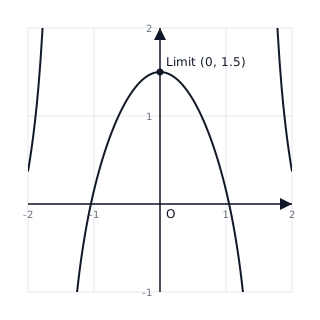
Graph of sin(3x)/sin(2x) approaching 1.5 at x=0.

Solution:

We divide the numerator and denominator by xx: lim⁡x→0sin⁡3xxsin⁡2xx\lim_{x \to 0} \frac{\frac{\sin 3x}{x}}{\frac{\sin 2x}{x}} To use the standard limit lim⁡θ→0sin⁡θθ=1\lim_{\theta \to 0} \frac{\sin \theta}{\theta} = 1, we adjust the coefficients: lim⁡x→03⋅sin⁡3x3x2⋅sin⁡2x2x\lim_{x \to 0} \frac{3 \cdot \frac{\sin 3x}{3x}}{2 \cdot \frac{\sin 2x}{2x}} Applying the limit property: 3⋅12⋅1=32\frac{3 \cdot 1}{2 \cdot 1} = \frac{3}{2}

Explanation:

This example uses the ratio property of limits and the transformation of the argument to match the denominator.

Problem 4:

Evaluate lim⁡x→0tan⁡x−sin⁡xx3\lim_{x \to 0} \frac{\tan x - \sin x}{x^3}
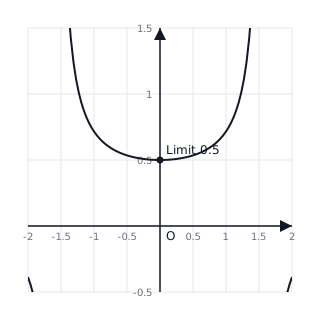
Graph of (tan x - sin x)/x^3 approaching 0.5 at x=0.

Solution:

Rewrite tan⁡x\tan x as sin⁡xcos⁡x\frac{\sin x}{\cos x}: lim⁡x→0sin⁡xcos⁡x−sin⁡xx3\lim_{x \to 0} \frac{\frac{\sin x}{\cos x} - \sin x}{x^3} lim⁡x→0sin⁡x(1−cos⁡x)x3cos⁡x\lim_{x \to 0} \frac{\sin x (1 - \cos x)}{x^3 \cos x} Separate the terms: lim⁡x→0(sin⁡xx)⋅(1−cos⁡xx2)⋅(1cos⁡x)\lim_{x \to 0} \left( \frac{\sin x}{x} \right) \cdot \left( \frac{1 - \cos x}{x^2} \right) \cdot \left( \frac{1}{\cos x} \right) Substitute the standard limits: 1⋅12⋅11=121 \cdot \frac{1}{2} \cdot \frac{1}{1} = \frac{1}{2}

Explanation:

This solution involves trigonometric identity manipulation and decomposing the expression into known standard limits.