
Review the key concepts, formulae, and examples before starting your quiz.
🔑Concepts
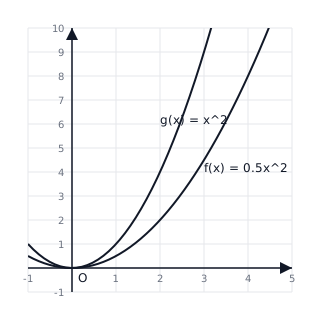
The derivative of a constant times a function is equal to the constant times the derivative of the function: . Geometrically, multiplying a function by a constant stretches the graph vertically, which increases the slope of the tangent line at every point by that same factor .
The Sum and Difference Rules state that the derivative of a sum or difference of two functions is the sum or difference of their individual derivatives: . This allows for term-by-term differentiation of polynomials.
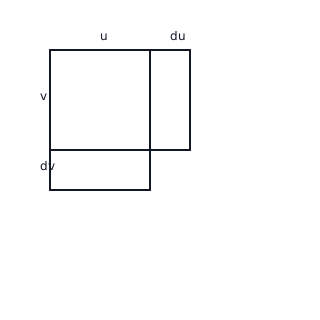
The Product Rule (Leibniz Rule) handles the derivative of two functions multiplied together: . It is not simply the product of the derivatives.
The Quotient Rule is used for functions in the form of a fraction: . Always ensure the denominator .

📐Formulae
(where is a constant)
💡Examples
Problem 1:
Find the derivative of the function with respect to .
Solution:
Step 1: Identify that the function is a sum of terms. We apply the Sum Rule and Constant Multiple Rule. Step 2: Differentiate each term individually. (since the derivative of a constant is zero). Step 3: Combine the results. .
Explanation:
This problem uses the basic Power Rule and the linearity of the derivative (sum rule). Each power of is reduced by 1, and the coefficient is multiplied by the original exponent.
Problem 2:
Differentiate using the Product Rule.
Solution:
Step 1: Identify the two functions. Let and . Step 2: Find the derivatives of and . Step 3: Apply the Product Rule formula: . Step 4: Simplify the expression. .
Explanation:
To differentiate a product of two different types of functions (algebraic and trigonometric), the Product Rule is essential. We calculate the derivative of each part separately and then combine them according to the formula.
Problem 3:
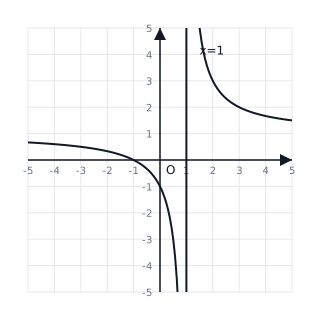
Find the derivative of the function with respect to where .
Solution:
Let and . Then and . Using the Quotient Rule:
Explanation:
To differentiate a rational function, we identify the numerator and denominator , find their respective derivatives, and apply the Quotient Rule formula.
Problem 4:
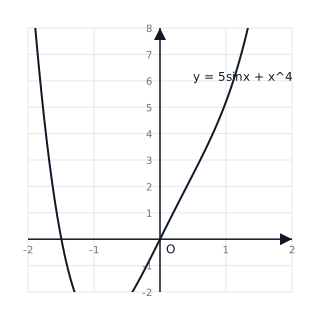
Differentiate with respect to .
Solution:
Apply the Sum Rule and the Constant Multiple Rule:
Explanation:
The derivative of a sum is the sum of the derivatives. We use the known derivative of and the power rule for .