krit.club logo

Limits and Derivatives - Derivative of polynomials and trigonometric functions

Grade 11CBSE

Review the key concepts, formulae, and examples before starting your quiz.

🔑Concepts

•

The derivative of a polynomial P(x)=anxn+an−1xn−1+⋯+a0P(x) = a_n x^n + a_{n-1} x^{n-1} + \dots + a_0 is found using the power rule and the linearity of the derivative operator. For any term axna x^n, the derivative is a⋅nxn−1a \cdot n x^{n-1}. Constant terms have a derivative of zero.
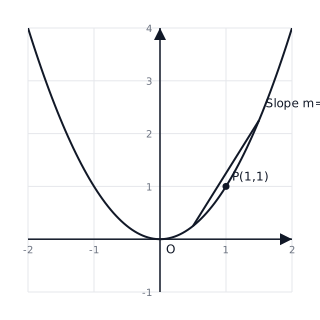
Graph of y=x^2 and its tangent at x=1 showing the derivative value as the slope.
•

The derivative of sin⁡x\sin x and cos⁡x\cos x follows a cyclic pattern. Geometrically, the derivative of a trigonometric function at a point represents the instantaneous rate of change (slope) of the wave at that point.
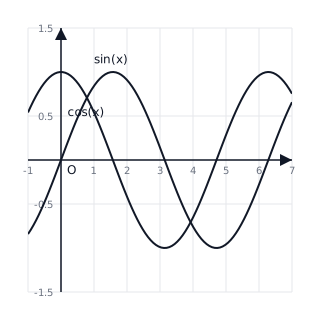
Graphs of sin(x) and its derivative cos(x) overlaid to show phase relationship.
•

The Product Rule allows us to differentiate the product of a polynomial and a trigonometric function: ddx[f(x)g(x)]=f(x)g′(x)+g(x)f′(x)\frac{d}{dx}[f(x)g(x)] = f(x)g'(x) + g(x)f'(x).

•

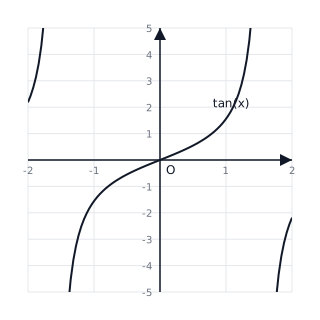
The Quotient Rule is used for functions in the form u(x)v(x)\frac{u(x)}{v(x)}, commonly appearing when differentiating functions like tan⁡x\tan x (viewed as sin⁡xcos⁡x\frac{\sin x}{\cos x}).

Graph of the tangent function which is a quotient of sine and cosine.

📐Formulae

ddx(xn)=nxn−1\frac{d}{dx}(x^n) = n x^{n-1}

ddx(sin⁡x)=cos⁡x\frac{d}{dx}(\sin x) = \cos x

ddx(cos⁡x)=−sin⁡x\frac{d}{dx}(\cos x) = -\sin x

ddx(tan⁡x)=sec⁡2x\frac{d}{dx}(\tan x) = \sec^2 x

ddx(sec⁡x)=sec⁡xtan⁡x\frac{d}{dx}(\sec x) = \sec x \tan x

ddx(cot⁡x)=−csc⁡2x\frac{d}{dx}(\cot x) = -\csc^2 x

ddx(csc⁡x)=−csc⁡xcot⁡x\frac{d}{dx}(\csc x) = -\csc x \cot x

ddx[u(x)⋅v(x)]=u(x)v′(x)+v(x)u′(x)\frac{d}{dx}[u(x) \cdot v(x)] = u(x) v'(x) + v(x) u'(x)

ddx[u(x)v(x)]=v(x)u′(x)−u(x)v′(x)[v(x)]2\frac{d}{dx}\left[\frac{u(x)}{v(x)}\right] = \frac{v(x) u'(x) - u(x) v'(x)}{[v(x)]^2}

💡Examples

Problem 1:

Find the derivative of f(x)=4x3−7x2+5x−9f(x) = 4x^3 - 7x^2 + 5x - 9.

Solution:

f′(x)=ddx(4x3)−ddx(7x2)+ddx(5x)−ddx(9)f'(x) = \frac{d}{dx}(4x^3) - \frac{d}{dx}(7x^2) + \frac{d}{dx}(5x) - \frac{d}{dx}(9) f′(x)=4(3x3−1)−7(2x2−1)+5(1x1−1)−0f'(x) = 4(3x^{3-1}) - 7(2x^{2-1}) + 5(1x^{1-1}) - 0 f′(x)=12x2−14x+5f'(x) = 12x^2 - 14x + 5

Explanation:

Apply the power rule ddx(xn)=nxn−1\frac{d}{dx}(x^n) = nx^{n-1} to each term individually. The derivative of the constant −9-9 is 00.

Problem 2:

Differentiate y=x2sin⁡xy = x^2 \sin x with respect to xx.

Solution:

Using the Product Rule with u=x2u = x^2 and v=sin⁡xv = \sin x: dydx=x2ddx(sin⁡x)+sin⁡xddx(x2)\frac{dy}{dx} = x^2 \frac{d}{dx}(\sin x) + \sin x \frac{d}{dx}(x^2) dydx=x2(cos⁡x)+sin⁡x(2x)\frac{dy}{dx} = x^2(\cos x) + \sin x(2x) dydx=x2cos⁡x+2xsin⁡x\frac{dy}{dx} = x^2 \cos x + 2x \sin x

Explanation:

Since the function is a product of a polynomial x2x^2 and a trigonometric function sin⁡x\sin x, we use the formula ddx(uv)=uv′+vu′\frac{d}{dx}(uv) = uv' + vu'.

Problem 3:

Find the derivative of y=cos⁡x1+sin⁡xy = \frac{\cos x}{1 + \sin x}.

Solution:

Using the Quotient Rule where u=cos⁡xu = \cos x and v=1+sin⁡xv = 1 + \sin x: dydx=(1+sin⁡x)ddx(cos⁡x)−(cos⁡x)ddx(1+sin⁡x)(1+sin⁡x)2\frac{dy}{dx} = \frac{(1 + \sin x) \frac{d}{dx}(\cos x) - (\cos x) \frac{d}{dx}(1 + \sin x)}{(1 + \sin x)^2} dydx=(1+sin⁡x)(−sin⁡x)−(cos⁡x)(cos⁡x)(1+sin⁡x)2\frac{dy}{dx} = \frac{(1 + \sin x)(-\sin x) - (\cos x)(\cos x)}{(1 + \sin x)^2} dydx=−sin⁡x−sin⁡2x−cos⁡2x(1+sin⁡x)2\frac{dy}{dx} = \frac{-\sin x - \sin^2 x - \cos^2 x}{(1 + \sin x)^2} dydx=−sin⁡x−(sin⁡2x+cos⁡2x)(1+sin⁡x)2\frac{dy}{dx} = \frac{-\sin x - (\sin^2 x + \cos^2 x)}{(1 + \sin x)^2} Since sin⁡2x+cos⁡2x=1\sin^2 x + \cos^2 x = 1: dydx=−sin⁡x−1(1+sin⁡x)2=−(1+sin⁡x)(1+sin⁡x)2=−11+sin⁡x\frac{dy}{dx} = \frac{-\sin x - 1}{(1 + \sin x)^2} = \frac{-(1 + \sin x)}{(1 + \sin x)^2} = \frac{-1}{1 + \sin x}

Explanation:

Apply the quotient rule and then simplify using the trigonometric identity sin⁡2x+cos⁡2x=1\sin^2 x + \cos^2 x = 1.

Problem 4:

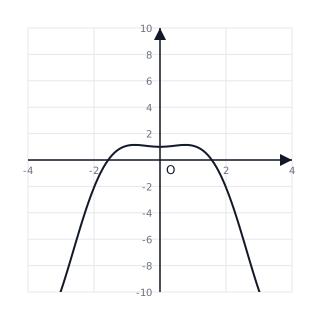
Differentiate f(x)=(x2+1)cos⁡xf(x) = (x^2 + 1)\cos x with respect to xx.

Graph of the function (x^2+1)cos(x).

Solution:

Let u(x)=x2+1u(x) = x^2 + 1 and v(x)=cos⁡xv(x) = \cos x. Using the product rule: f′(x)=u(x)v′(x)+v(x)u′(x)f'(x) = u(x) v'(x) + v(x) u'(x) f′(x)=(x2+1)ddx(cos⁡x)+cos⁡xddx(x2+1)f'(x) = (x^2 + 1) \frac{d}{dx}(\cos x) + \cos x \frac{d}{dx}(x^2 + 1) Since ddx(cos⁡x)=−sin⁡x\frac{d}{dx}(\cos x) = -\sin x and ddx(x2+1)=2x\frac{d}{dx}(x^2 + 1) = 2x f′(x)=(x2+1)(−sin⁡x)+(cos⁡x)(2x)f'(x) = (x^2 + 1)(-\sin x) + (\cos x)(2x) f′(x)=2xcos⁡x−(x2+1)sin⁡xf'(x) = 2x \cos x - (x^2 + 1) \sin x

Explanation:

We apply the product rule because the function is a product of a polynomial (x2+1)(x^2+1) and a trigonometric function (cos⁡x)(\cos x).

Problem 5:

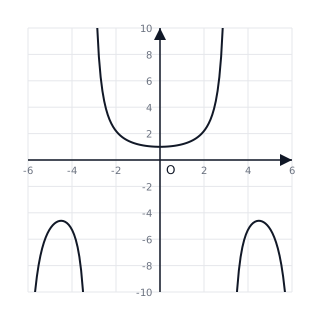
Find the derivative of y=xsin⁡xy = \frac{x}{\sin x}.

Graph of x/sin(x) showing vertical asymptotes where sin(x)=0.

Solution:

Using the quotient rule ddx[uv]=vu′−uv′v2\frac{d}{dx}[\frac{u}{v}] = \frac{v u' - u v'}{v^2}: Let u=xu = x and v=sin⁡xv = \sin x. Then u′=1u' = 1 and v′=cos⁡xv' = \cos x. y′=(sin⁡x)(1)−(x)(cos⁡x)(sin⁡x)2y' = \frac{(\sin x)(1) - (x)(\cos x)}{(\sin x)^2} y′=sin⁡x−xcos⁡xsin⁡2xy' = \frac{\sin x - x \cos x}{\sin^2 x}

Explanation:

The quotient rule is applied with the numerator as a first-degree polynomial and the denominator as a trigonometric function.