
Review the key concepts, formulae, and examples before starting your quiz.
🔑Concepts
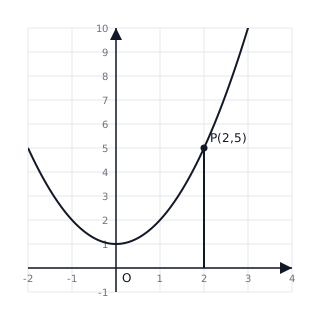
A polynomial function is continuous everywhere. Therefore, the limit as is simply the value of the function at that point: . This is known as direct substitution.
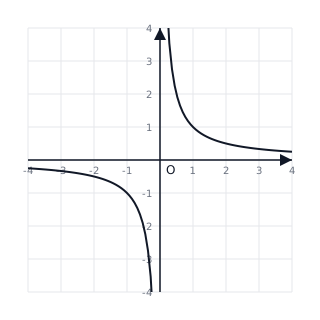
A rational function is of the form , where and are polynomials. If , the limit is found by direct substitution: .
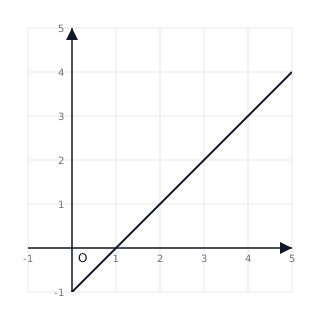
If direct substitution results in an indeterminate form like , we must simplify the expression. For rational functions, this usually involves factoring the numerator and denominator to cancel the common factor . For example, if , the limit exists at even if the function is undefined there.
Algebra of limits: Limits distribute over addition, subtraction, multiplication, and division (provided the denominator limit is non-zero). This allows us to evaluate complex rational expressions by breaking them into simpler polynomial limits.
📐Formulae
seeds
💡Examples
Problem 1:
Evaluate .
Solution:
Explanation:
Since the function is a polynomial, we use the direct substitution method.
Problem 2:
Find the limit: .
Solution:
Explanation:
Direct substitution gives . We factorize the numerator as , cancel the common factor , and then substitute .
Problem 3:
Evaluate .
Solution:
Explanation:
We divide both the numerator and denominator by to apply the standard formula .
Problem 4:
Evaluate the limit: .
Solution:
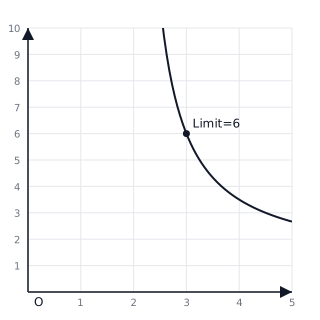
Direct substitution gives , which is indeterminate. Factorize numerator and denominator: Numerator: Denominator: So, Cancel the common factor for : Now substitute : .
Explanation:
Since substitution results in , there is a common factor in both the numerator and denominator. Removing this 'hole' allows us to find the limit value.
Problem 5:
Find the value of .
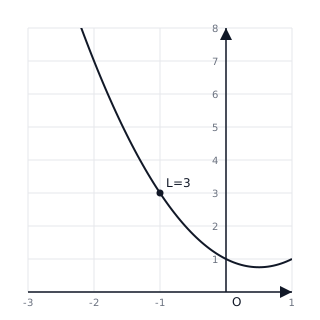
Solution:
Direct substitution gives . Use the algebraic identity : So, Cancel : Substitute : .
Explanation:
The limit represents the value the function approaches as gets closer to . By factoring the sum of cubes, we eliminate the term causing the division by zero.