
Coordinate Geometry - Use section formula for internal division to find coordinates of partition points
Review the key concepts, formulae, and examples before starting your quiz.
🔑Concepts
The Section Formula allows us to find the coordinates of a point that divides a line segment joining two points and into a specific ratio internally.
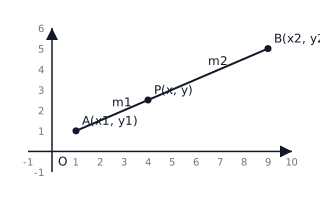
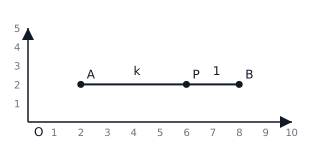
When the ratio is not known, it is often easier to assume the ratio as . By substituting and in the section formula, we solve for using either the or coordinate of the dividing point.
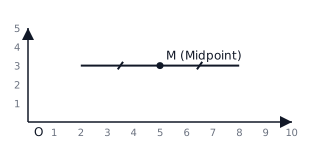
A special case of the section formula occurs when . This defines the midpoint , which is the average of the coordinates: .
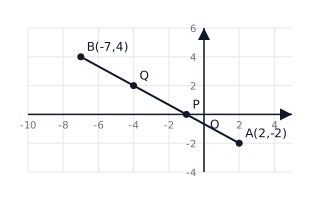
Trisection of a line segment means dividing it into three equal parts. This requires finding two points, and . Point divides the segment in ratio , and point divides it in ratio .
📐Formulae
Section Formula (Internal):
Midpoint Formula:
Ratio Formula:
Centroid of a Triangle:
💡Examples
Problem 1:
Find the coordinates of the point which divides the line segment joining the points and in the ratio internally.
Solution:
- Identify the given values: , , , and .
- Apply the Section Formula for the x-coordinate:
- Apply the Section Formula for the y-coordinate:
- The coordinates of point are .
Explanation:
We use the internal section formula by substituting the endpoints and the given ratio to find the specific coordinates of the point located on segment .
Problem 2:
In what ratio does the point divide the line segment joining the points and ?
Solution:
- Let the ratio be .
- Use the x-coordinate formula: .
- Substitute the values .
- Cross-multiply: .
- Rearrange terms: .
- Solve for : .
- The ratio is .
Explanation:
To find an unknown ratio, we assume it is , set up an equation using one of the coordinates (either x or y), and solve for . Since is positive, the division is internal.
Problem 3:
Find the coordinates of the points of trisection of the line segment joining the points and .
Solution:
Let and be the points of trisection. divides in ratio . Using Section Formula for : So, is . is the midpoint of or divides in . Using : So, is .
Explanation:
Trisection divides the segment into three equal lengths. We calculate the coordinates of the first point using ratio and the second using .
Problem 4:
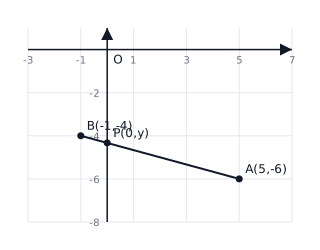
Find the ratio in which the y-axis divides the line segment joining the points and . Also, find the point of intersection.
Solution:
Let the y-axis divide the segment at point in the ratio . Since lies on the y-axis, its x-coordinate is . Using Section Formula for x: So the ratio is . Now, find using : The point of intersection is .
Explanation:
On the y-axis, the x-coordinate is always zero. We use this property to find the unknown ratio first, then use to find the y-coordinate.