
Coordinate Geometry - Apply distance formula to compute and compare distances between points
Review the key concepts, formulae, and examples before starting your quiz.
🔑Concepts
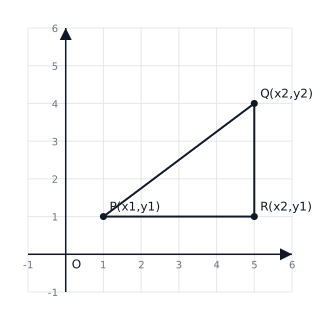
The Distance Formula is derived from the Pythagoras Theorem. For any two points and in the Cartesian plane, the horizontal distance is and the vertical distance is . The distance is the hypotenuse of the right-angled triangle formed by these segments.
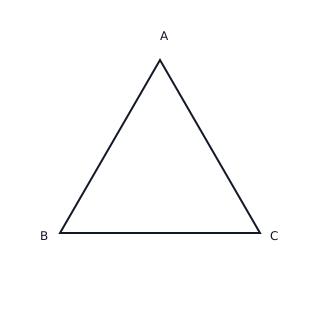
To verify if three points and form an equilateral triangle, use the distance formula to compute and . If , the triangle is equilateral.
A point is equidistant from two points and if . This condition is often used to find a missing coordinate or the relation between and for points on the perpendicular bisector of .
To check if a quadrilateral with given vertices is a square, show that all four sides are equal () AND both diagonals are equal ().
📐Formulae
Distance between two points and :
Distance of a point from the Origin :
Condition for Collinearity of points : (or any other combination of segments totaling the third)
💡Examples
Problem 1:
Find the distance between the points and .
Solution:
- Identify the coordinates: and .
- Substitute values into the distance formula: .
- Calculate the differences: and .
- Square the differences: and .
- Add the squares: .
- Take the square root: units.
Explanation:
We apply the distance formula directly by calculating the horizontal and vertical displacements between the two points and then using the Pythagorean approach to find the total distance.
Problem 2:
Determine if the points , , and are collinear.
Solution:
- Calculate : .
- Calculate : .
- Calculate : .
- Check if the sum of two distances equals the third: .
- Since , the points are not collinear.
Explanation:
To check for collinearity, we find the lengths of all possible segments between the three points. If the sum of the two shorter segments equals the longest segment, the points lie on a single line.
Problem 3:
Find a point on the -axis which is equidistant from and .
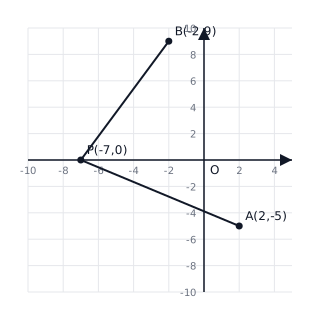
Solution:
Let the point on the -axis be . Since is equidistant from and , . Squaring both sides: The point is .
Explanation:
Any point on the -axis has a -coordinate of 0. We equate the distances and using the distance formula and solve for .
Problem 4:
Check whether the points , and are the vertices of an isosceles triangle.
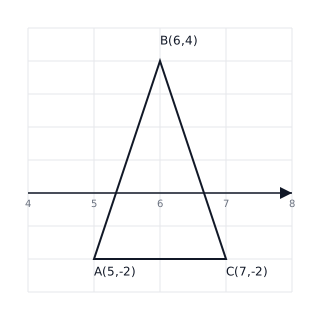
Solution:
We calculate the lengths of the three sides: Since , the triangle has two equal sides.
Explanation:
A triangle is isosceles if at least two of its sides are of equal length. By calculating all three side lengths, we find .