krit.club logo

Coordinate Geometry - Revise coordinate-plane concepts and represent geometric data on Cartesian plane

Grade 10CBSE

Review the key concepts, formulae, and examples before starting your quiz.

🔑Concepts

•

The Cartesian Plane consists of two perpendicular number lines: the horizontal x-axis and the vertical y-axis. Their intersection is the origin O(0,0)O(0, 0). Any point PP is represented as an ordered pair (x,y)(x, y), where xx is the abscissa (distance from y-axis) and yy is the ordinate (distance from x-axis).
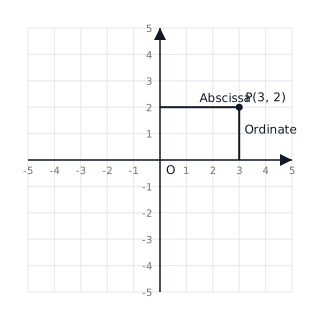
Cartesian plane showing a point P(3, 2) with its x and y distances.
•

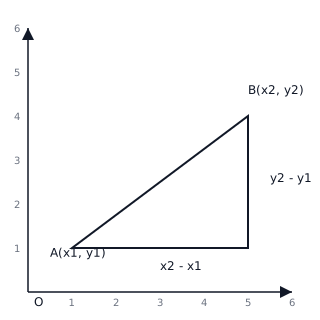
The Distance Formula is derived using the Pythagorean theorem. For any two points A(x1,y1)A(x_1, y_1) and B(x2,y2)B(x_2, y_2), the distance ABAB is the hypotenuse of a right-angled triangle with base (x2−x1)(x_2 - x_1) and height (y2−y1)(y_2 - y_1).

Right triangle showing the derivation of the distance formula.
•

The Midpoint Formula determines the center of a line segment. It is essentially the average of the x-coordinates and the y-coordinates of the endpoints.
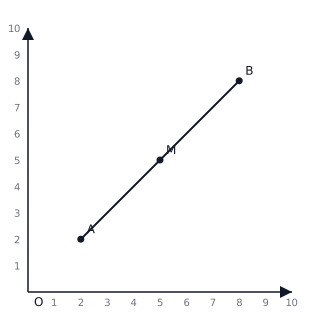
Line segment AB with its midpoint M.
•

Collinearity: Three points AA, BB, and CC are collinear if they lie on the same straight line. This can be verified if AB+BC=ACAB + BC = AC (using distance formula).

📐Formulae

Distance d=(x2−x1)2+(y2−y1)2\text{Distance } d = \sqrt{(x_2 - x_1)^2 + (y_2 - y_1)^2}

Distance from Origin (0,0)=x2+y2\text{Distance from Origin } (0,0) = \sqrt{x^2 + y^2}

Section Formula (Internal): P(x,y)=(m1x2+m2x1m1+m2,m1y2+m2y1m1+m2)\text{Section Formula (Internal): } P(x, y) = \left( \frac{m_1x_2 + m_2x_1}{m_1 + m_2}, \frac{m_1y_2 + m_2y_1}{m_1 + m_2} \right)

Midpoint Formula: M=(x1+x22,y1+y22)\text{Midpoint Formula: } M = \left( \frac{x_1 + x_2}{2}, \frac{y_1 + y_2}{2} \right)

Centroid of a Triangle: G=(x1+x2+x33,y1+y2+y33)\text{Centroid of a Triangle: } G = \left( \frac{x_1 + x_2 + x_3}{3}, \frac{y_1 + y_2 + y_3}{3} \right)

💡Examples

Problem 1:

Find the distance between the points A(2,−3)A(2, -3) and B(10,3)B(10, 3).

Solution:

d=(10−2)2+(3−(−3))2d = \sqrt{(10 - 2)^2 + (3 - (-3))^2} d=(8)2+(6)2d = \sqrt{(8)^2 + (6)^2} d=64+36=100=10 unitsd = \sqrt{64 + 36} = \sqrt{100} = 10 \text{ units}

Explanation:

Apply the distance formula d=(x2−x1)2+(y2−y1)2d = \sqrt{(x_2-x_1)^2 + (y_2-y_1)^2} by substituting the coordinates of AA and BB.

Problem 2:

Find the coordinates of the point which divides the line segment joining (−1,7)(-1, 7) and (4,−3)(4, -3) in the ratio 2:32 : 3 internally.

Solution:

Here, (x1,y1)=(−1,7)(x_1, y_1) = (-1, 7), (x2,y2)=(4,−3)(x_2, y_2) = (4, -3), m1=2m_1 = 2, and m2=3m_2 = 3. x=2(4)+3(−1)2+3=8−35=55=1x = \frac{2(4) + 3(-1)}{2 + 3} = \frac{8 - 3}{5} = \frac{5}{5} = 1 y=2(−3)+3(7)2+3=−6+215=155=3y = \frac{2(-3) + 3(7)}{2 + 3} = \frac{-6 + 21}{5} = \frac{15}{5} = 3 The point is (1,3)(1, 3).

Explanation:

Use the Section Formula x=m1x2+m2x1m1+m2x = \frac{m_1x_2 + m_2x_1}{m_1 + m_2} and y=m1y2+m2y1m1+m2y = \frac{m_1y_2 + m_2y_1}{m_1 + m_2} to find the coordinates.

Problem 3:

If the points A(6,1)A(6, 1), B(8,2)B(8, 2), C(9,4)C(9, 4), and D(p,3)D(p, 3) are the vertices of a parallelogram, taken in order, find the value of pp.

Solution:

Diagonals of a parallelogram bisect each other. Therefore, Midpoint of ACAC = Midpoint of BDBD. Midpoint of AC=(6+92,1+42)=(152,52)\text{Midpoint of } AC = \left( \frac{6+9}{2}, \frac{1+4}{2} \right) = \left( \frac{15}{2}, \frac{5}{2} \right) Midpoint of BD=(8+p2,2+32)=(8+p2,52)\text{Midpoint of } BD = \left( \frac{8+p}{2}, \frac{2+3}{2} \right) = \left( \frac{8+p}{2}, \frac{5}{2} \right) Equating xx-coordinates: 152=8+p2\frac{15}{2} = \frac{8+p}{2} 15=8+p  ⟹  p=715 = 8 + p \implies p = 7

Explanation:

Since diagonals of a parallelogram bisect each other, their midpoints must coincide. We use the midpoint formula for both diagonals and solve for pp.

Problem 4:

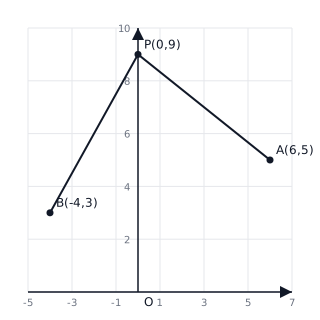
Find a point on the y-axis which is equidistant from the points A(6,5)A(6, 5) and B(−4,3)B(-4, 3).

Point P on y-axis equidistant from A and B.

Solution:

  1. Let the point on the y-axis be P(0,y)P(0, y).
  2. Since PP is equidistant from AA and BB, PA=PBPA = PB.
  3. PA2=PB2PA^2 = PB^2
  4. (6−0)2+(5−y)2=(−4−0)2+(3−y)2(6 - 0)^2 + (5 - y)^2 = (-4 - 0)^2 + (3 - y)^2
  5. 36+25+y2−10y=16+9+y2−6y36 + 25 + y^2 - 10y = 16 + 9 + y^2 - 6y
  6. 61−10y=25−6y61 - 10y = 25 - 6y
  7. 36=4y  ⟹  y=936 = 4y \implies y = 9
  8. The point is (0,9)(0, 9).

Explanation:

Any point on the y-axis has an x-coordinate of 0. We use the distance squared to avoid square roots and solve for the unknown y-coordinate.

Problem 5:

Determine the ratio in which the line segment joining A(1,−5)A(1, -5) and B(−4,5)B(-4, 5) is divided by the x-axis. Also find the coordinates of the point of division.
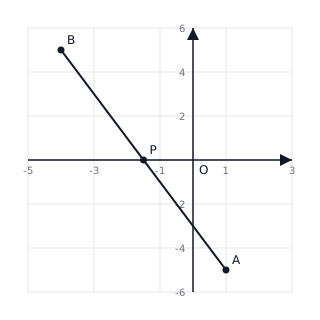
Line segment AB intersected by the x-axis at point P.

Solution:

  1. Let the ratio be k:1k : 1 and the point on the x-axis be P(x,0)P(x, 0).
  2. Using Section Formula for the y-coordinate: 0=k(5)+1(−5)k+10 = \frac{k(5) + 1(-5)}{k + 1}
  3. 5k−5=0  ⟹  k=15k - 5 = 0 \implies k = 1. The ratio is 1:11 : 1.
  4. Now find the x-coordinate: x=1(−4)+1(1)1+1=−32=−1.5x = \frac{1(-4) + 1(1)}{1 + 1} = \frac{-3}{2} = -1.5
  5. The point of division is (−1.5,0)(-1.5, 0).

Explanation:

When a line is divided by the x-axis, the y-coordinate of the intersection point is always zero. This allows us to solve for the ratio kk first.

Revise coordinate-plane concepts and represent geometric data on Cartesian plane Class 10 Notes &…