krit.club logo

Coordinate Geometry - Introduction

Grade 10CBSE

Review the key concepts, formulae, and examples before starting your quiz.

πŸ”‘Concepts

β€’

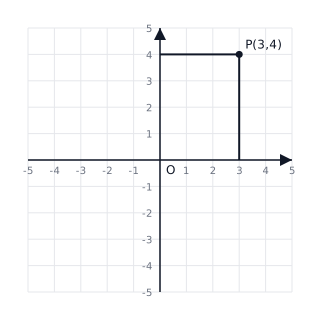
The Cartesian Coordinate System: A point P(x,y)P(x, y) is located in a plane using two perpendicular axes. The horizontal axis is the x-axis and the vertical axis is the y-axis. The point of intersection is the origin O(0,0)O(0, 0).

Cartesian coordinate plane showing point P at (3,4) with perpendicular drops to the axes.
β€’

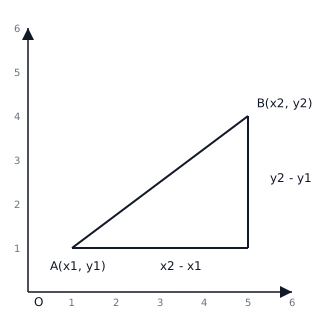
Distance Formula: The distance between any two points A(x1,y1)A(x_1, y_1) and B(x2,y2)B(x_2, y_2) is the length of the line segment ABAB, calculated using the Pythagorean theorem logic: AB=(x2βˆ’x1)2+(y2βˆ’y1)2AB = \sqrt{(x_2 - x_1)^2 + (y_2 - y_1)^2}.

Right angled triangle showing the horizontal and vertical distance between two points A and B.
β€’

Section Formula (Internal Division): If a point P(x,y)P(x, y) divides the line segment joining A(x1,y1)A(x_1, y_1) and B(x2,y2)B(x_2, y_2) in the ratio m1:m2m_1 : m_2 internally, its coordinates are given by the weighted average of the endpoints' coordinates.

β€’

Midpoint Theorem: The midpoint of a line segment is a special case of the section formula where the ratio is 1:11 : 1. It is the arithmetic mean of the x-coordinates and y-coordinates of the endpoints.

β€’

Centroid of a Triangle: The centroid GG is the point of concurrency of the medians of a triangle. It divides each median in the ratio 2:12 : 1 from the vertex.

πŸ“Formulae

d=(x2βˆ’x1)2+(y2βˆ’y1)2d = \sqrt{(x_2 - x_1)^2 + (y_2 - y_1)^2}

DistanceΒ fromΒ originΒ (0,0)Β toΒ (x,y)=x2+y2\text{Distance from origin } (0,0) \text{ to } (x, y) = \sqrt{x^2 + y^2}

P(x,y)=(m1x2+m2x1m1+m2,m1y2+m2y1m1+m2)P(x, y) = \left( \frac{m_1x_2 + m_2x_1}{m_1 + m_2}, \frac{m_1y_2 + m_2y_1}{m_1 + m_2} \right)

MidpointΒ M=(x1+x22,y1+y22)\text{Midpoint } M = \left( \frac{x_1 + x_2}{2}, \frac{y_1 + y_2}{2} \right)

CentroidΒ G=(x1+x2+x33,y1+y2+y33)\text{Centroid } G = \left( \frac{x_1 + x_2 + x_3}{3}, \frac{y_1 + y_2 + y_3}{3} \right)

πŸ’‘Examples

Problem 1:

Find the distance between the points A(2,3)A(2, 3) and B(4,1)B(4, 1).

Solution:

Let (x1,y1)=(2,3)(x_1, y_1) = (2, 3) and (x2,y2)=(4,1)(x_2, y_2) = (4, 1). Using the distance formula: AB=(4βˆ’2)2+(1βˆ’3)2AB = \sqrt{(4 - 2)^2 + (1 - 3)^2} AB=(2)2+(βˆ’2)2AB = \sqrt{(2)^2 + (-2)^2} AB=4+4AB = \sqrt{4 + 4} AB=8=22Β unitsAB = \sqrt{8} = 2\sqrt{2} \text{ units}

Explanation:

Substitute the given coordinates into the Distance Formula d=(x2βˆ’x1)2+(y2βˆ’y1)2d = \sqrt{(x_2 - x_1)^2 + (y_2 - y_1)^2} and simplify the square root.

Problem 2:

Find the coordinates of the point which divides the line segment joining (4,βˆ’3)(4, -3) and (8,5)(8, 5) in the ratio 3:13 : 1 internally.

Solution:

Given x1=4,y1=βˆ’3,x2=8,y2=5x_1 = 4, y_1 = -3, x_2 = 8, y_2 = 5 and m1=3,m2=1m_1 = 3, m_2 = 1. Using the section formula: x=3(8)+1(4)3+1=24+44=284=7x = \frac{3(8) + 1(4)}{3 + 1} = \frac{24 + 4}{4} = \frac{28}{4} = 7 y=3(5)+1(βˆ’3)3+1=15βˆ’34=124=3y = \frac{3(5) + 1(-3)}{3 + 1} = \frac{15 - 3}{4} = \frac{12}{4} = 3 The point is (7,3)(7, 3).

Explanation:

The section formula provides the xx and yy coordinates by weighting the endpoint coordinates with the given ratio.

Problem 3:

Find the midpoint of the line segment joining P(βˆ’5,7)P(-5, 7) and Q(βˆ’1,3)Q(-1, 3).

Solution:

Using the midpoint formula: M=(βˆ’5+(βˆ’1)2,7+32)M = \left( \frac{-5 + (-1)}{2}, \frac{7 + 3}{2} \right) M=(βˆ’62,102)M = \left( \frac{-6}{2}, \frac{10}{2} \right) M=(βˆ’3,5)M = (-3, 5)

Explanation:

The midpoint is found by taking the average of the xx-coordinates and the average of the yy-coordinates.

Problem 4:

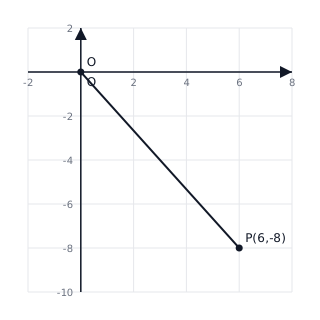
Find the distance of the point P(6,βˆ’8)P(6, -8) from the origin O(0,0)O(0, 0).

Line segment connecting the origin O(0,0) to point P(6,-8) in the fourth quadrant.

Solution:

Let the given point be P(x,y)=(6,βˆ’8)P(x, y) = (6, -8). The distance from origin is given by: d=x2+y2d = \sqrt{x^2 + y^2} Substituting the values: d=(6)2+(βˆ’8)2d = \sqrt{(6)^2 + (-8)^2} d=36+64d = \sqrt{36 + 64} d=100d = \sqrt{100} d=10Β unitsd = 10 \text{ units}

Explanation:

To find the distance from the origin, we square both coordinates, add them, and then take the square root. This is a direct application of the distance formula where one point is (0,0)(0,0).

Problem 5:

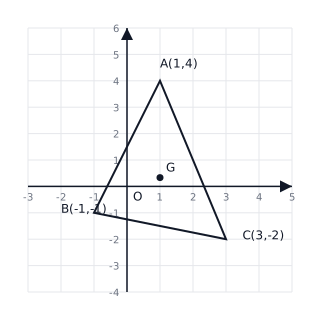
Determine the coordinates of the centroid of β–³ABC\triangle ABC whose vertices are A(1,4)A(1, 4), B(βˆ’1,βˆ’1)B(-1, -1) and C(3,βˆ’2)C(3, -2).

Triangle ABC with vertices at (1,4), (-1,-1), and (3,-2) showing the approximate location of the centroid G.

Solution:

Let the vertices be (x1,y1)=(1,4)(x_1, y_1) = (1, 4), (x2,y2)=(βˆ’1,βˆ’1)(x_2, y_2) = (-1, -1), and (x3,y3)=(3,βˆ’2)(x_3, y_3) = (3, -2). The coordinates of centroid G(x,y)G(x, y) are: x=x1+x2+x33=1+(βˆ’1)+33=33=1x = \frac{x_1 + x_2 + x_3}{3} = \frac{1 + (-1) + 3}{3} = \frac{3}{3} = 1 y=y1+y2+y33=4+(βˆ’1)+(βˆ’2)3=13y = \frac{y_1 + y_2 + y_3}{3} = \frac{4 + (-1) + (-2)}{3} = \frac{1}{3} So, the centroid is G(1,13)G(1, \frac{1}{3}).

Explanation:

The centroid of a triangle is found by averaging the x-coordinates and y-coordinates of its three vertices.