
Review the key concepts, formulae, and examples before starting your quiz.
🔑Concepts
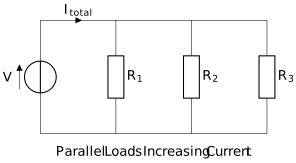
Overloading occurs when too many high-power electrical appliances (like heaters and air conditioners) are connected to a single socket or circuit, causing the total current to exceed the safety limit of the wires, leading to overheating.
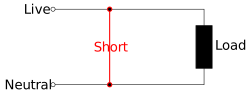
A short circuit happens when the live wire and neutral wire come into direct contact due to damaged insulation. This provides a path of nearly zero resistance (), causing current to surge to dangerous levels.
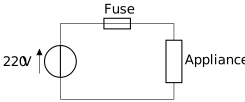
A fuse is a safety device containing a thin wire with a low melting point. It is connected in series with the live wire. If the current exceeds the fuse rating, the wire melts (), breaking the circuit.
Earthing (Grounding) involves connecting the metallic body of an appliance to the earth via a low-resistance wire. If a fault causes the live wire to touch the metallic casing, the current flows safely to the ground instead of through a person.

📐Formulae
💡Examples
Problem 1:
An electric oven with a power rating of is operated in a domestic circuit that has a voltage of . If the circuit is protected by a fuse, will the fuse blow when the oven is switched on?
Solution:
Given and . Using the formula : Since , the fuse will melt and break the circuit.
Explanation:
The current required by the oven is higher than the fuse rating. This is a case of potential overloading, and the fuse acts as a safety measure to prevent damage.
Problem 2:
Calculate the resistance of a circuit during a short circuit if the voltage is and the current surges to .
Solution:
Using Ohm's Law , we can rearrange it to find :
Explanation:
During a short circuit, the resistance becomes very low (in this case, ), which allows a very high current to flow through the wires.
Problem 3:
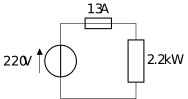
A electric kettle is used on a supply. Determine the current flowing through the kettle and select an appropriate fuse from the following ratings: , , or .
Solution:
- Convert power to Watts:
- Use the formula for current:
- The fuse rating must be slightly higher than the operating current. Therefore, a fuse is required.
Explanation:
A fuse would blow immediately under normal operation as . A fuse allows the normal current but will blow if a fault occurs.
Problem 4:
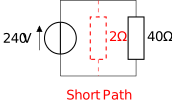
An electric iron has an internal resistance of . A fault creates a short circuit path with a resistance of only . Calculate the current surge in the circuit if the supply is .
Solution:
- Under normal conditions:
- Under fault conditions (short circuit):
- The current increases from to .
Explanation:
The drastic decrease in resistance causes a massive surge in current. Since heating effect , the heat generated increases by a factor of , which can melt wires and cause a fire.