
Review the key concepts, formulae, and examples before starting your quiz.
🔑Concepts
A simple Voltaic cell, also known as a Galvanic cell, converts chemical energy into electrical energy through redox reactions occurring between two different metals in an electrolyte.
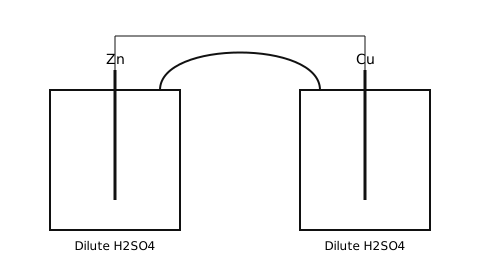
The electrode with higher reactivity (usually Zinc) acts as the negative terminal (Anode) where oxidation occurs: .
The electrode with lower reactivity (usually Copper) acts as the positive terminal (Cathode). Hydrogen ions () from the electrolyte move towards it to gain electrons: .
Electric current flows in the external circuit from the Copper electrode (positive) to the Zinc electrode (negative), while electrons flow from Zinc to Copper.
The chemical action eventually creates local action and polarization, which are defects that reduce the efficiency of the cell over time.
📐Formulae
💡Examples
Problem 1:
Calculate the heat produced in a wire of resistance when a current of flows through it for seconds.
Solution:
Explanation:
We use Joule's Law of Heating. By substituting the given values of current (), resistance (), and time (), we find the total heat energy produced in Joules.
Problem 2:
In a simple Voltaic cell, if the potential difference () is and the current () flowing through an external bulb is , what is the resistance () of the bulb?
Solution:
Explanation:
Using Ohm's Law, we rearrange the formula to solve for resistance by dividing the voltage by the current.
Problem 3:
Determine the total charge flow if a Voltaic cell provides a current of for seconds.
Solution:
Explanation:
Electric charge () is the product of the electric current () and the time () for which it flows. The unit is Coulombs ().
Problem 4:
A student sets up a voltaic cell using Zinc and Copper plates. If the cell produces a constant current of to light a small LED for , calculate the total heat energy dissipated in the circuit if the internal resistance of the setup is .
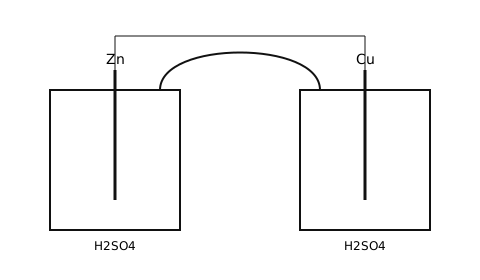
Solution:
Given: Current () = Time () = Resistance () =
Using the formula for heating effect:
Explanation:
The chemical energy in the cell is converted to electrical energy, and as current flows through the resistance, it generates heat according to Joule's law of heating.
Problem 5:
In a laboratory experiment with a Voltaic cell, a voltmeter measures a potential difference of . If a resistor of is connected across the terminals, determine the current () flowing through the circuit.
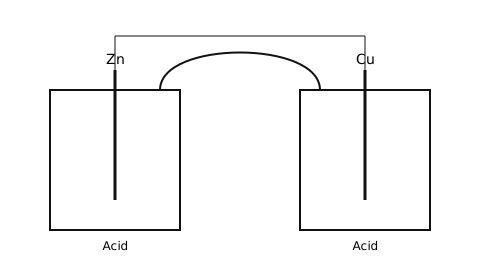
Solution:
Given: Potential Difference () = Resistance () =
According to Ohm's Law:
Explanation:
The potential difference maintained by the chemical reaction in the cell drives the flow of charge through the external resistance.