
Review the key concepts, formulae, and examples before starting your quiz.
🔑Concepts
A dry cell is a primary chemical cell that converts chemical energy into electrical energy. It is called 'dry' because its electrolyte is in the form of a moist paste rather than a liquid, making it portable and leak-proof.
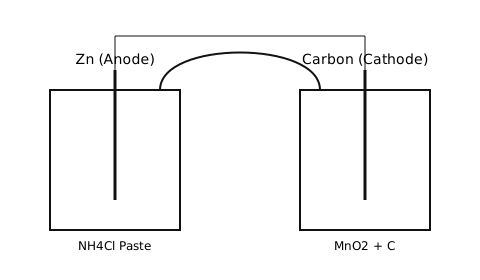
The components of a dry cell include a Zinc container (negative terminal), a Carbon rod (positive terminal), and a mixture of Ammonium Chloride () paste which acts as the electrolyte.
When multiple dry cells are connected in series, the positive terminal of one cell is connected to the negative terminal of the next. The total voltage is the sum of individual voltages:
The heating effect in a circuit powered by a dry cell occurs because the electrical energy is converted into thermal energy as current passes through a resistance over time , given by .
📐Formulae
💡Examples
Problem 1:
A current of flows through an electric heater with a resistance of for . Calculate the total heat produced in Joules.
Solution:
Explanation:
By applying Joule's Law of Heating, we square the current, multiply it by the resistance, and then by the time duration to find the energy dissipated as heat.
Problem 2:
Calculate the total voltage required to push a current of through a circuit with a total resistance of .
Solution:
Explanation:
Using Ohm's Law, the potential difference () is the product of the current () and the resistance ().
Problem 3:
Represent the subtraction of two resistance values and to find the difference in resistance.
Solution:
Explanation:
The difference in resistance between the two components is .
Problem 4:
A dry cell with a potential difference of is connected to a bulb with a resistance of . Find the current flowing through the bulb.
Solution:
Given: Voltage Resistance
Using Ohm's Law:
The current flowing through the bulb is .
Explanation:
The current is calculated by dividing the electromotive force (voltage) of the dry cell by the total resistance of the circuit.
Problem 5:
Two dry cells of each are connected in series to a resistor. If the total resistance is and the current flows for , calculate the heat produced. Use vertical multiplication for the final energy calculation.
Solution:
Total Voltage Current
Heat produced
Total heat produced is .
Explanation:
First, the total voltage of the battery is found by summing the cell voltages. Then, the current is determined. Finally, Joule's law of heating is applied to find the energy in Joules.