krit.club logo

Vectors and Transformations - Vector Notation and Magnitude

Grade 9IGCSE

Review the key concepts, formulae, and examples before starting your quiz.

🔑Concepts

•

A vector is a quantity that has both magnitude (size) and direction. In column notation (xy)\begin{pmatrix} x \\ y \end{pmatrix}, xx represents the horizontal displacement (right is positive) and yy represents the vertical displacement (up is positive).
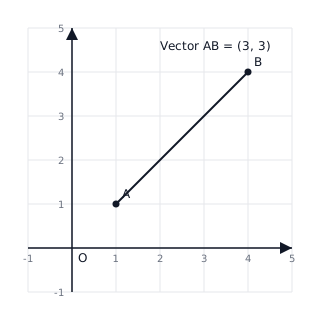
A vector AB shown on a coordinate grid starting at (1,1) and ending at (4,4).
•

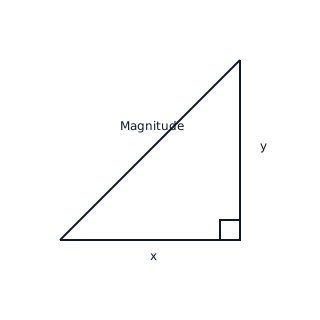
The magnitude of a vector a=(xy)\mathbf{a} = \begin{pmatrix} x \\ y \end{pmatrix}, denoted by ∣a∣|\mathbf{a}|, is the length of the vector. It is calculated using Pythagoras' Theorem: ∣a∣=x2+y2|\mathbf{a}| = \sqrt{x^2 + y^2}.

A right-angled triangle representing the components x and y of a vector with the hypotenuse as the magnitude.
•

Parallel vectors have the same direction but may have different magnitudes. A vector kak\mathbf{a} is parallel to a\mathbf{a}. If k>0k > 0, they are in the same direction; if k<0k < 0, they are in opposite directions.

•

A position vector OP⃗\vec{OP} is a vector that starts at the origin O(0,0)O(0,0) and ends at point P(x,y)P(x,y). Its column vector is simply (xy)\begin{pmatrix} x \\ y \end{pmatrix}.

📐Formulae

Magnitude of vector v=(xy)\mathbf{v} = \begin{pmatrix} x \\ y \end{pmatrix}: ∣v∣=x2+y2|\mathbf{v}| = \sqrt{x^2 + y^2}

Displacement vector between A(x1,y1)A(x_1, y_1) and B(x2,y2):AB⃗=(x2−x1y2−y1)B(x_2, y_2): \vec{AB} = \begin{pmatrix} x_2 - x_1 \\ y_2 - y_1 \end{pmatrix}

Scalar Multiplication: k(xy)k \begin{pmatrix} x \\ y \end{pmatrix} = (kxky)\begin{pmatrix} kx \\ ky \end{pmatrix}

Negative Vector: −(xy)-\begin{pmatrix} x \\ y \end{pmatrix} = (−x−y)\begin{pmatrix} -x \\ -y \end{pmatrix}

💡Examples

Problem 1:

Given the vector u=(5−12)\mathbf{u} = \begin{pmatrix} 5 \\ -12 \end{pmatrix}, calculate the magnitude ∣u∣|\mathbf{u}|.

Solution:

∣u∣=52+(−12)2=25+144=169=13|\mathbf{u}| = \sqrt{5^2 + (-12)^2} = \sqrt{25 + 144} = \sqrt{169} = 13.

Explanation:

To find the magnitude, use the formula derived from Pythagoras' Theorem: square both components, add them together, and take the square root of the result.

Problem 2:

Point AA has coordinates (1,2)(1, 2) and point BB has coordinates (4,6)(4, 6). Find the column vector AB⃗\vec{AB} and its magnitude.

Solution:

AB⃗=(4−16−2)\vec{AB} = \begin{pmatrix} 4 - 1 \\ 6 - 2 \end{pmatrix} = (34)\begin{pmatrix} 3 \\ 4 \end{pmatrix}. Magnitude ∣AB⃗∣=32+42=9+16=5|\vec{AB}| = \sqrt{3^2 + 4^2} = \sqrt{9 + 16} = 5.

Explanation:

First, find the displacement vector by subtracting the coordinates of the starting point AA from the end point BB. Then, apply the magnitude formula to find the length of the line segment ABAB.

Problem 3:

If a=(2−3)\mathbf{a} = \begin{pmatrix} 2 \\ -3 \end{pmatrix}, find the vector 3a3\mathbf{a}.

Solution:

3a=3(2−3)3\mathbf{a} = 3 \begin{pmatrix} 2 \\ -3 \end{pmatrix} = (3×23×−3)\begin{pmatrix} 3 \times 2 \\ 3 \times -3 \end{pmatrix} = (6−9)\begin{pmatrix} 6 \\ -9 \end{pmatrix}.

Explanation:

Multiply both the xx and yy components of the vector by the scalar constant (3 in this case).

Problem 4:

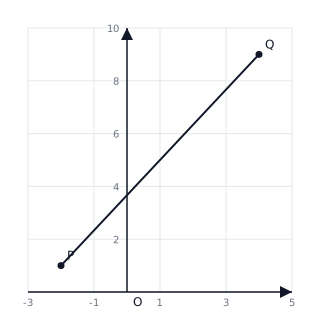
Calculate the magnitude of the vector PQ⃗\vec{PQ} where PP is (−2,1)( -2, 1) and QQ is (4,9)(4, 9).

A vector PQ on a coordinate plane from (-2, 1) to (4, 9).

Solution:

PQ⃗=(4−(−2)9−1)=(68)\vec{PQ} = \begin{pmatrix} 4 - (-2) \\ 9 - 1 \end{pmatrix} = \begin{pmatrix} 6 \\ 8 \end{pmatrix} ∣PQ⃗∣=62+82|\vec{PQ}| = \sqrt{6^2 + 8^2} ∣PQ⃗∣=36+64=100=10|\vec{PQ}| = \sqrt{36 + 64} = \sqrt{100} = 10

Explanation:

First, find the column vector by subtracting the coordinates of the starting point from the end point. Then, apply the magnitude formula using Pythagoras' Theorem.

Problem 5:

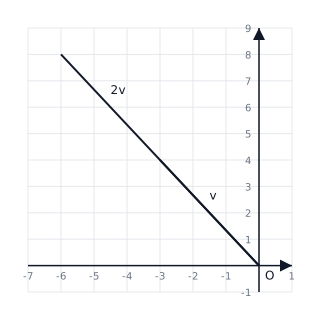
Given v=(−34)\mathbf{v} = \begin{pmatrix} -3 \\ 4 \end{pmatrix}, find the vector 2v2\mathbf{v} and illustrate it on a grid.

Comparison of vector v (-3, 4) and its scalar multiple 2v (-6, 8) starting from the origin.

Solution:

2v=2(−34)=(2×−32×4)=(−68)2\mathbf{v} = 2 \begin{pmatrix} -3 \\ 4 \end{pmatrix} = \begin{pmatrix} 2 \times -3 \\ 2 \times 4 \end{pmatrix} = \begin{pmatrix} -6 \\ 8 \end{pmatrix}

Explanation:

Scalar multiplication involves multiplying both the xx and yy components of the vector by the constant k=2k=2. This results in a vector that is twice as long and parallel to the original.