
Review the key concepts, formulae, and examples before starting your quiz.
🔑Concepts
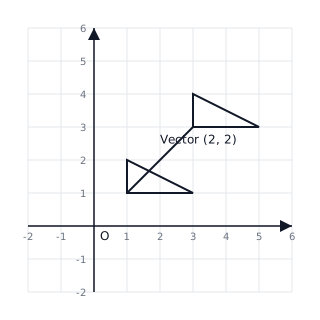
A translation moves an object from one position to another without changing its shape, size, or orientation. It is defined by a column vector , where represents the horizontal shift and represents the vertical shift.
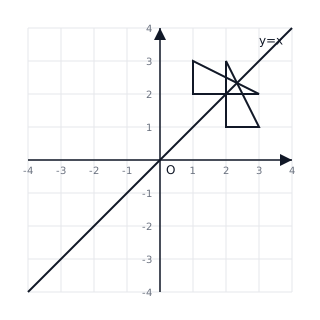
A reflection flips an object over a line of reflection. Every point on the image is the same distance from the mirror line as the corresponding point on the original object. Common mirror lines include the -axis (), the -axis (), and the lines and .
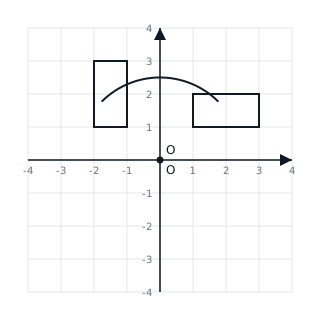
A rotation turns an object about a fixed point called the center of rotation. To fully describe a rotation, you must specify the angle (e.g., or ), the direction (clockwise or anticlockwise), and the center of rotation (e.g., origin ).
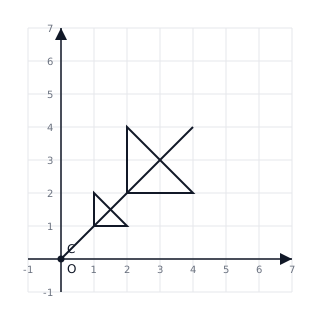
Enlargement changes the size of an object by a scale factor from a center of enlargement. If , the image is larger; if , the image is smaller. If is negative, the image is inverted on the opposite side of the center.
📐Formulae
Vector Addition:
Scalar Multiplication:
Magnitude of a vector :
Enlargement Area Scale Factor:
Reflection in :
Reflection in :
💡Examples
Problem 1:
Translate the point by the vector . Find the coordinates of the image .
Solution:
Explanation:
To translate a point, add the -component of the vector to the -coordinate and the -component of the vector to the -coordinate.
Problem 2:
A triangle with vertices , , and is reflected in the line . What are the new coordinates?
Solution:
Explanation:
When reflecting in the line , the and coordinates of each point are swapped.
Problem 3:
A square is enlarged by a scale factor of from the center . If the original area is , what is the area of the enlarged square?
Solution:
Explanation:
The area of an enlarged shape increases by the square of the scale factor ().
Problem 4:
Rotate the point anticlockwise about the origin .
Solution:
Explanation:
For a anticlockwise rotation about the origin, the mapping is .
Problem 5:
A triangle has vertices at , , and . It is enlarged by a scale factor of with the origin as the center of enlargement. Determine the new coordinates of the vertices.
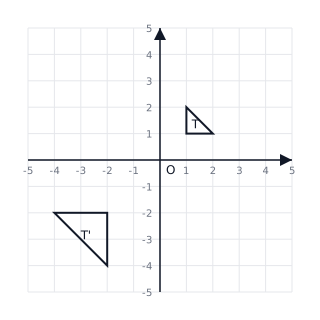
Solution:
The rule for enlargement from the origin is .
Explanation:
Since the scale factor is negative, the image is twice as large as the original, but it is inverted and located on the opposite side of the center of enlargement (the origin).
Problem 6:
Reflect the rectangle with vertices , , , and in the line . Find the coordinates of the reflected image.
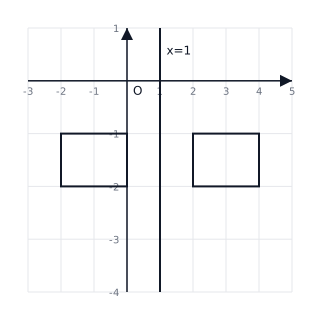
Solution:
The mirror line is the vertical line . The distance from each -coordinate to is mirrored on the other side: is unit right of , so is unit left at . Coordinates: . is units right of , so is units left at . Coordinates: . is units right of , so is units left at . Coordinates: . is unit right of , so is unit left at . Coordinates: .
Explanation:
In a reflection across a vertical line , the -coordinates remain the same, and the -coordinate changes from to . Here, .