krit.club logo

Vectors and Transformations - Vector Addition and Subtraction

Grade 9IGCSE

Review the key concepts, formulae, and examples before starting your quiz.

🔑Concepts

•

A vector can be represented as a column vector (xy)\begin{pmatrix} x \\ y \end{pmatrix}, where xx indicates horizontal movement and yy indicates vertical movement. Adding two vectors involves joining them 'tip-to-tail'. The resultant vector is the direct path from the start of the first vector to the end of the second.
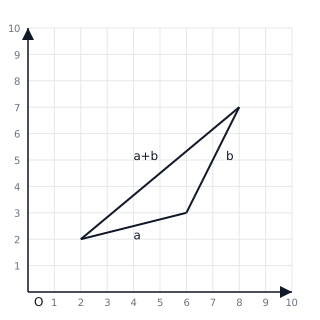
Tip-to-tail addition of two vectors showing the resultant vector.
•

Vector subtraction a−b\mathbf{a} - \mathbf{b} is equivalent to adding the negative of vector b\mathbf{b}. Geometrically, −b-\mathbf{b} has the same magnitude as b\mathbf{b} but points in the exact opposite direction.
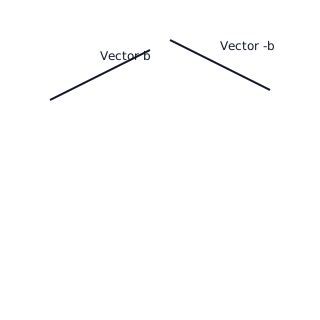
Diagram showing vector b and its opposite vector -b.
•

The position vector of a point P(x,y)P(x, y) is the vector OP⃗=(xy)\vec{OP} = \begin{pmatrix} x \\ y \end{pmatrix}, relative to the origin O(0,0)O(0,0). For any two points AA and BB, the displacement vector AB⃗\vec{AB} is calculated by subtracting the position vector of the start point from the end point: AB⃗=OB⃗−OA⃗\vec{AB} = \vec{OB} - \vec{OA}.

•

Parallel vectors have the same direction but may have different magnitudes. Two vectors are parallel if one is a scalar multiple of the other, such as a=kb\mathbf{a} = k\mathbf{b}.

📐Formulae

Addition: (x1y1)+(x2y2)=(x1+x2y1+y2)\begin{pmatrix} x_1 \\ y_1 \end{pmatrix} + \begin{pmatrix} x_2 \\ y_2 \end{pmatrix} = \begin{pmatrix} x_1 + x_2 \\ y_1 + y_2 \end{pmatrix}

Subtraction: (x1y1)−(x2y2)=(x1−x2y1−y2)\begin{pmatrix} x_1 \\ y_1 \end{pmatrix} - \begin{pmatrix} x_2 \\ y_2 \end{pmatrix} = \begin{pmatrix} x_1 - x_2 \\ y_1 - y_2 \end{pmatrix}

Scalar Multiplication: k(xy)=(kxky)k \begin{pmatrix} x \\ y \end{pmatrix} = \begin{pmatrix} kx \\ ky \end{pmatrix}

Magnitude (Length): ∣a∣=x2+y2|\mathbf{a}| = \sqrt{x^2 + y^2}

Displacement between points: AB⃗=OB⃗−OA⃗\vec{AB} = \vec{OB} - \vec{OA} (where OO is the origin)

💡Examples

Problem 1:

Given vectors a=(3−2)\mathbf{a} = \begin{pmatrix} 3 \\ -2 \end{pmatrix} and b=(15)\mathbf{b} = \begin{pmatrix} 1 \\ 5 \end{pmatrix}, calculate 2a+b2\mathbf{a} + \mathbf{b}.

Solution:

2a+b=2(3−2)+(15)=(6−4)+(15)=(71)2\mathbf{a} + \mathbf{b} = 2\begin{pmatrix} 3 \\ -2 \end{pmatrix} + \begin{pmatrix} 1 \\ 5 \end{pmatrix} = \begin{pmatrix} 6 \\ -4 \end{pmatrix} + \begin{pmatrix} 1 \\ 5 \end{pmatrix} = \begin{pmatrix} 7 \\ 1 \end{pmatrix}

Explanation:

First, multiply vector a\mathbf{a} by the scalar 2 by multiplying both components. Then, add the resulting xx-components and yy-components separately.

Problem 2:

In triangle OABOAB, OA⃗=a\vec{OA} = \mathbf{a} and OB⃗=b\vec{OB} = \mathbf{b}. Find the vector AB⃗\vec{AB} in terms of a\mathbf{a} and b\mathbf{b}.

Solution:

AB⃗=AO⃗+OB⃗=−a+b\vec{AB} = \vec{AO} + \vec{OB} = -\mathbf{a} + \mathbf{b} (or b−a\mathbf{b} - \mathbf{a})

Explanation:

To get from AA to BB, you can travel from AA back to the origin OO (which is −a-\mathbf{a}) and then from the origin to BB (which is b\mathbf{b}).

Problem 3:

If c=(−43)\mathbf{c} = \begin{pmatrix} -4 \\ 3 \end{pmatrix}, find the magnitude ∣c∣|\mathbf{c}|.

Solution:

∣c∣=(−4)2+32=16+9=25=5|\mathbf{c}| = \sqrt{(-4)^2 + 3^2} = \sqrt{16 + 9} = \sqrt{25} = 5

Explanation:

The magnitude is found using Pythagoras' theorem on the xx and yy components of the column vector.

Problem 4:

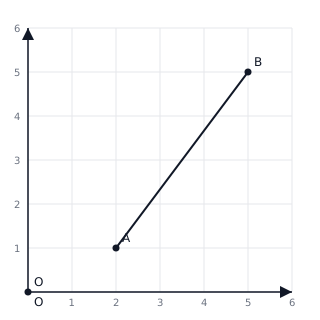
Given the position vectors OA⃗=(21)\vec{OA} = \begin{pmatrix} 2 \\ 1 \end{pmatrix} and OB⃗=(55)\vec{OB} = \begin{pmatrix} 5 \\ 5 \end{pmatrix}, find the column vector representing the displacement AB⃗\vec{AB}.

Graph showing points A and B and the vector AB connecting them.

Solution:

AB⃗=OB⃗−OA⃗\vec{AB} = \vec{OB} - \vec{OA} AB⃗=(55)−(21)\vec{AB} = \begin{pmatrix} 5 \\ 5 \end{pmatrix} - \begin{pmatrix} 2 \\ 1 \end{pmatrix} AB⃗=(5−25−1)=(34)\vec{AB} = \begin{pmatrix} 5 - 2 \\ 5 - 1 \end{pmatrix} = \begin{pmatrix} 3 \\ 4 \end{pmatrix}

Explanation:

To find the vector from point AA to point BB, we subtract the coordinates (position vector) of AA from the coordinates of BB. This results in the horizontal and vertical distance required to travel from AA to BB.

Problem 5:

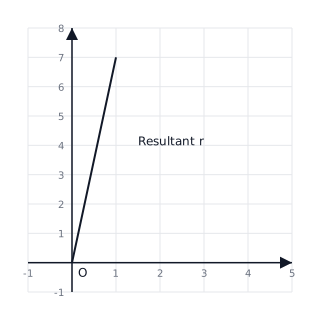
Calculate the resultant vector r=u+v−w\mathbf{r} = \mathbf{u} + \mathbf{v} - \mathbf{w} where u=(42)\mathbf{u} = \begin{pmatrix} 4 \\ 2 \end{pmatrix}, v=(−13)\mathbf{v} = \begin{pmatrix} -1 \\ 3 \end{pmatrix}, and w=(2−2)\mathbf{w} = \begin{pmatrix} 2 \\ -2 \end{pmatrix}.

Coordinate plane showing the final resultant vector r starting from the origin.

Solution:

r=(42)+(−13)−(2−2)\mathbf{r} = \begin{pmatrix} 4 \\ 2 \end{pmatrix} + \begin{pmatrix} -1 \\ 3 \end{pmatrix} - \begin{pmatrix} 2 \\ -2 \end{pmatrix} r=(4+(−1)−22+3−(−2))\mathbf{r} = \begin{pmatrix} 4 + (-1) - 2 \\ 2 + 3 - (-2) \end{pmatrix} r=(17)\mathbf{r} = \begin{pmatrix} 1 \\ 7 \end{pmatrix}

Explanation:

We combine the xx-components and yy-components separately. Remember that subtracting a negative number is equivalent to adding a positive (5−(−2)=75 - (-2) = 7).