
Review the key concepts, formulae, and examples before starting your quiz.
🔑Concepts
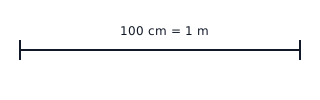
Linear units measure length, distance, or perimeter. Common metric units include millimeters (), centimeters (), meters (), and kilometers (). Conversion depends on factors of , , or .
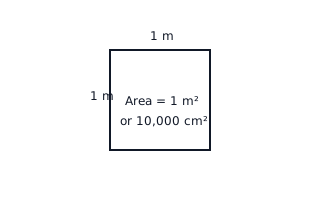
Area units measure surface coverage. Because area is two-dimensional, the conversion factor is the square of the linear conversion factor. For example, since , then .
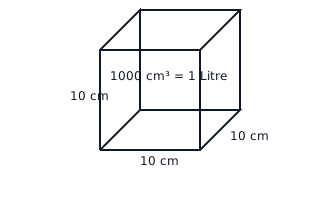
Volume units measure the space occupied by a 3D object. The conversion factor is the cube of the linear conversion factor. For example, . Capacity often uses litres (), where .
Mass and Density: Mass is usually measured in grams () or kilograms (). Density relates mass and volume: . Common units for density are or .
📐Formulae
💡Examples
Problem 1:
Calculate the area of a rectangle with length and width in .
Solution:
First, convert the length to centimeters: Now calculate the area:
Explanation:
Before performing calculations, ensure all units are consistent. Here, meters were converted to centimeters before multiplying.
Problem 2:
A water tank has a volume of . How many liters of water does it hold?
Solution:
Convert cubic meters to cubic centimeters: Since :
Explanation:
We first use the volume conversion factor to find , then divide by to convert to liters.
Problem 3:
Convert a speed of to .
Solution:
Convert kilometers to meters: Convert hours to seconds: Calculate speed:
Explanation:
Compound units are converted by changing the numerator and denominator separately.
Problem 4:
Find the total mass in grams of three items weighing , , and .
Solution:
Convert all masses to grams: Add the values: Total mass =
Explanation:
Convert kilograms to grams by multiplying by and then sum the values.
Problem 5:
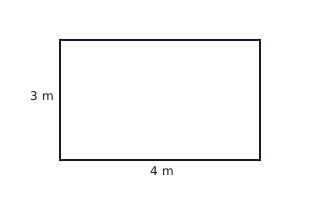
A rectangular floor measures by . Calculate the area of the floor in .
Solution:
Explanation:
First, calculate the area in square meters. Since , the area conversion factor is . Multiply the area in by to get the result in .
Problem 6:
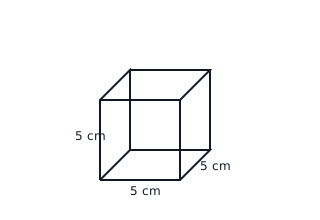
A solid metal cube has a side length of . If the density of the metal is , find the mass of the cube in kilograms ().
Solution:
Explanation:
First, find the volume of the cube using . Then, use the density formula rearranged for mass (). Finally, convert the mass from grams to kilograms by dividing by .