
Review the key concepts, formulae, and examples before starting your quiz.
🔑Concepts
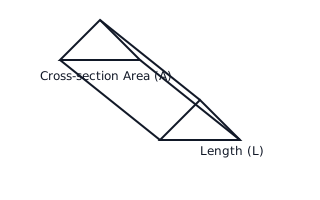
A Prism is a 3D solid with a constant cross-section. Its volume is calculated by multiplying the area of this cross-section by the length or height of the prism. Common examples include cuboids and triangular prisms.
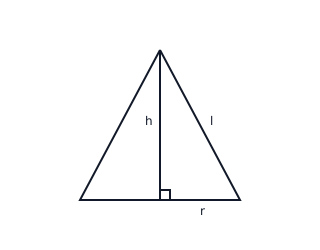
For a Right-Circular Cone, the relationship between the vertical height , the radius , and the slant height is defined by the Pythagorean theorem: . This is essential for finding the Curved Surface Area (CSA) when only vertical height is given.
A Pyramid has a base that can be any polygon, and its lateral faces are triangles meeting at a common vertex called the apex. The volume is exactly one-third of the volume of a prism with the same base and height: .
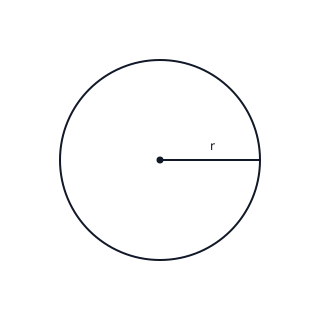
A Sphere is perfectly symmetrical. All points on its surface are at an equal distance from the center. Its surface area is , which is exactly four times the area of its great circle.
📐Formulae
Cuboid: ,
Cylinder: , ,
Prism:
Sphere: ,
Cone: , (where is slant height)
Pyramid:
Hemisphere: , ,
💡Examples
Problem 1:
A cylinder has a radius of cm and a height of cm. Calculate its Total Surface Area. (Take )
Solution:
cm²
Explanation:
To find the Total Surface Area of a cylinder, you must add the area of the two circular bases () to the area of the curved side ().
Problem 2:
A right-circular cone has a radius of cm and a vertical height of cm. Find its Volume.
Solution:
cm³
Explanation:
The volume of a cone is exactly one-third the volume of a cylinder with the same radius and height. Plug the radius () and height () into the formula.
Problem 3:
A metal sphere with a radius of cm is melted down and recast into a solid cylinder with a radius of cm. Find the height of the cylinder.
Solution:
Volume of Sphere = . Volume of Cylinder = . Set volumes equal: cm.
Explanation:
In recasting problems, the volume remains constant. Calculate the volume of the original shape (sphere) and set it equal to the formula for the volume of the new shape (cylinder) to solve for the missing dimension.
Problem 4:
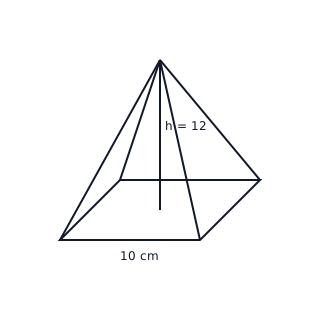
A square-based pyramid has a base side length of cm and a vertical height of cm. Calculate the Total Surface Area of the pyramid.
Solution:
- Find the slant height () of the triangular faces using the right-angled triangle formed by the vertical height and half the base length:
- Calculate the area of the square base:
- Calculate the area of the four triangular faces:
- Total Surface Area (TSA):
Explanation:
To find the surface area, we must sum the area of the square base and the area of the four identical triangular side faces. The height of these triangles is the 'slant height' of the pyramid, found using Pythagoras.
Problem 5:
A composite solid consists of a hemisphere of radius cm joined to the top of a cylinder of radius cm and height cm. Calculate the total volume of the solid in terms of .
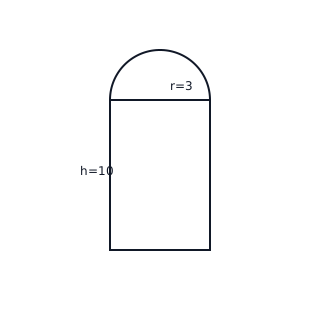
Solution:
- Calculate the volume of the cylinder:
- Calculate the volume of the hemisphere:
- Total Volume:
Explanation:
For composite solids, calculate the volume of each individual simple solid and then sum them together. Ensure the radius is consistent for both parts.