krit.club logo

Mensuration - Perimeter and Area of 2D Shapes

Grade 9IGCSE

Review the key concepts, formulae, and examples before starting your quiz.

🔑Concepts

•

The perimeter of a 2D shape is the total distance around its boundary. For a polygon, it is the sum of all side lengths. For a circle, this distance is called the circumference, calculated using C=2πrC = 2\pi r or C=πdC = \pi d.

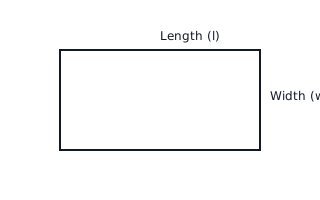
Diagram of a rectangle showing length and width for perimeter calculation.
•

The area of a triangle is found using the perpendicular height (hh) and the base (bb). The formula is A=12bhA = \frac{1}{2}bh. Note that for obtuse triangles, the height may fall outside the base.
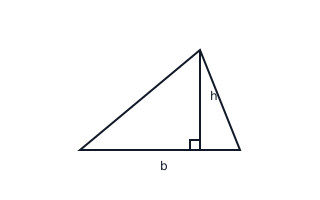
Triangle with base and perpendicular height indicated.
•

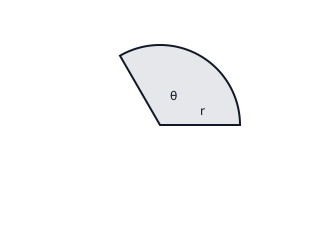
A sector is a portion of a circle enclosed by two radii and an arc. The area of a sector depends on the central angle θ\theta and is calculated as θ360×πr2\frac{\theta}{360} \times \pi r^2.

A circular sector with radius r and central angle theta.
•

Composite shapes are made by combining two or more basic shapes. To find the total area, divide the figure into simpler shapes like rectangles and triangles, calculate their individual areas, and then add them together.

📐Formulae

Rectangle Area=l×w\text{Rectangle Area} = l \times w

Triangle Area=12×b×h\text{Triangle Area} = \frac{1}{2} \times b \times h

Parallelogram Area=b×h\text{Parallelogram Area} = b \times h

Trapezium Area=12(a+b)h\text{Trapezium Area} = \frac{1}{2}(a + b)h

Circle Circumference=2πr or πd\text{Circle Circumference} = 2\pi r \text{ or } \pi d

Circle Area=πr2\text{Circle Area} = \pi r^2

Arc Length=θ360×2πr\text{Arc Length} = \frac{\theta}{360} \times 2\pi r

Sector Area=θ360×πr2\text{Sector Area} = \frac{\theta}{360} \times \pi r^2

💡Examples

Problem 1:

Calculate the area of a trapezium where the parallel sides are 8 cm and 12 cm, and the perpendicular height is 5 cm.

Solution:

Area = 12(8+12)×5=12(20)×5=10×5=50 cm2\frac{1}{2}(8 + 12) \times 5 = \frac{1}{2}(20) \times 5 = 10 \times 5 = 50 \text{ cm}^2

Explanation:

Apply the trapezium area formula A=12(a+b)hA = \frac{1}{2}(a+b)h, where aa and bb are the parallel sides and hh is the height.

Problem 2:

A sector of a circle has a radius of 6 cm and a central angle of 60°. Find the length of the arc. (Use π=3.142\pi = 3.142)

Solution:

Arc Length = 60360×2×3.142×6=16×37.704=6.284 cm\frac{60}{360} \times 2 \times 3.142 \times 6 = \frac{1}{6} \times 37.704 = 6.284 \text{ cm}

Explanation:

Use the arc length formula θ360×2πr\frac{\theta}{360} \times 2\pi r. Substitute θ=60\theta = 60 and r=6r = 6.

Problem 3:

Find the perimeter of a semi-circle with a radius of 7 cm. (Take π=227\pi = \frac{22}{7})

Solution:

Perimeter = (πr)+d=(227×7)+(2×7)=22+14=36 cm(\pi r) + d = (\frac{22}{7} \times 7) + (2 \times 7) = 22 + 14 = 36 \text{ cm}

Explanation:

The perimeter of a semi-circle consists of the curved arc (half of 2πr2\pi r) plus the straight diameter (2r2r).

Problem 4:

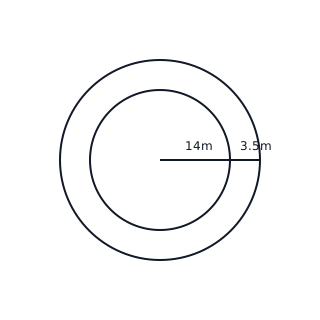
A circular garden has a radius of 14 m14\text{ m}. A circular path of width 3.5 m3.5\text{ m} is built around the outside of the garden. Find the area of the path. (Take π=227\pi = \frac{22}{7})

Concentric circles representing a garden and a surrounding path.

Solution:

Radius of garden (inner circle), r=14 m\text{Radius of garden (inner circle), } r = 14\text{ m} Radius of garden + path (outer circle), R=14+3.5=17.5 m\text{Radius of garden + path (outer circle), } R = 14 + 3.5 = 17.5\text{ m} Area of path=Area of outer circle−Area of inner circle\text{Area of path} = \text{Area of outer circle} - \text{Area of inner circle} Area=πR2−πr2=π(R2−r2)\text{Area} = \pi R^2 - \pi r^2 = \pi(R^2 - r^2) Area=227(17.52−142)\text{Area} = \frac{22}{7}(17.5^2 - 14^2) Area=227(306.25−196)=227(110.25)\text{Area} = \frac{22}{7}(306.25 - 196) = \frac{22}{7}(110.25) Area=22×15.75=346.5 m2\text{Area} = 22 \times 15.75 = 346.5\text{ m}^2

Explanation:

To find the area of the path (the annulus), we subtract the area of the smaller inner circle from the area of the larger outer circle. The outer radius is the sum of the inner radius and the path width.

Problem 5:

Calculate the area of a parallelogram where the base is 15 cm15\text{ cm} and the perpendicular height is 9 cm9\text{ cm}. If the other side length is 11 cm11\text{ cm}, find the perimeter of the parallelogram.
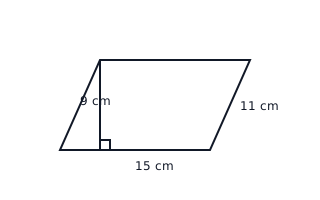
Parallelogram with base 15 cm, height 9 cm, and side 11 cm.

Solution:

Area=base×height\text{Area} = \text{base} \times \text{height} Area=15×9=135 cm2\text{Area} = 15 \times 9 = 135\text{ cm}^2 Perimeter=2(a+b)\text{Perimeter} = 2(a + b) Perimeter=2(15+11)=2(26)=52 cm\text{Perimeter} = 2(15 + 11) = 2(26) = 52\text{ cm}

Explanation:

Area of a parallelogram is the product of its base and perpendicular height. The perimeter is the sum of all four sides (twice the sum of adjacent sides).