
Review the key concepts, formulae, and examples before starting your quiz.
🔑Concepts
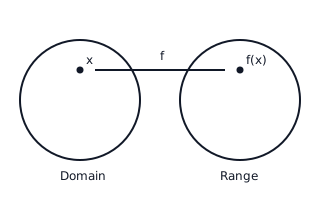
A function is a mapping from a set of inputs (domain) to a set of outputs (range). For every input , there is exactly one output . This can be visualized using a mapping diagram.
Composite functions involve applying one function to the result of another. For example, means you first calculate and then use that result as the input for .
The inverse function 'undoes' the operation of . Graphically, is the reflection of in the line .
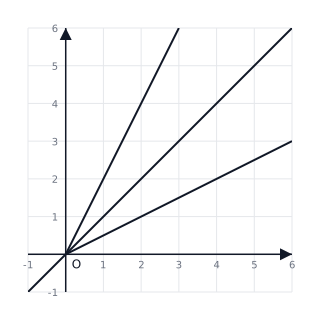
The domain of becomes the range of , and the range of becomes the domain of .
📐Formulae
(Basic function notation)
(Composite function formula)
(Identity property of inverse functions)
To find : 1. Let , 2. Swap and , 3. Rearrange to make the subject.
💡Examples
Problem 1:
Given , find .
Solution:
Explanation:
Substitute the value 4 into the expression wherever appears and simplify.
Problem 2:
If and , find the expression for .
Solution:
Explanation:
To find , substitute the entire expression for into the position of .
Problem 3:
Find the inverse function for .
Solution:
- Let . 2. Swap variables: . 3. Solve for : . Therefore, .
Explanation:
The inverse function is found by reversing the operations. We swap and and isolate to find the new rule.
Problem 4:
Given , find when .
Solution:
Explanation:
Set the algebraic expression for the function equal to the given value and solve the resulting linear equation for .
Problem 5:
Given the functions and , calculate the value of .

Solution:
- Find :
- Use the result in : Therefore, .
Explanation:
To solve a composite function, start from the inner function and work outwards. Evaluate first, then substitute that value into .
Problem 6:
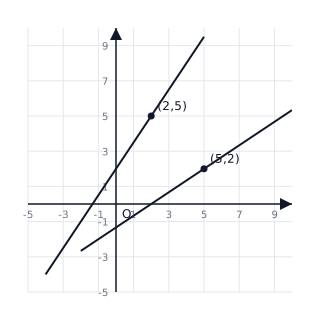
Find the inverse function for and state its value when .
Solution:
- Let
- Swap and :
- Solve for : So, .
- Evaluate for :
Explanation:
The inverse function is found by swapping the variables and rearranging the equation to isolate the new . This represents the reverse operation.