
Review the key concepts, formulae, and examples before starting your quiz.
🔑Concepts
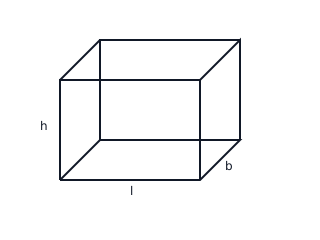
The cuboid is a three-dimensional solid with six rectangular faces. Its dimensions are length (), breadth (), and height (). The diagonal of a cuboid is the longest line segment connecting two opposite vertices, calculated as .
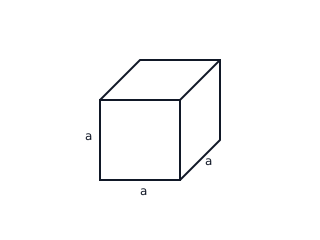
A cube is a special type of cuboid where all edges are equal in length (side ). The volume is the cube of the side, and the total surface area is exactly times the area of one square face.
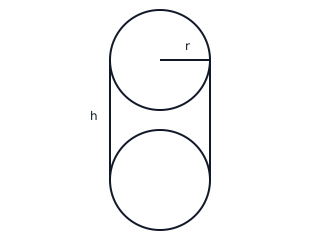
A right circular cylinder has two parallel circular bases and a curved surface. The distance between the centers of the bases is the height (), and the radius of the circular base is . The Curved Surface Area (CSA) corresponds to the area of the rectangle formed if the cylinder is unrolled.
Cross-section concepts: For solids like prisms and cylinders, the Volume can be generalized as . For a cylinder, the cross-section is a circle with area .
📐Formulae
Volume of a Cuboid:
Total Surface Area (TSA) of a Cuboid:
Lateral Surface Area (LSA) of a Cuboid:
Diagonal of a Cuboid:
Volume of a Cube:
Total Surface Area (TSA) of a Cube:
Lateral Surface Area (LSA) of a Cube:
Diagonal of a Cube:
Volume of a Cylinder:
Curved Surface Area (CSA) of a Cylinder:
Total Surface Area (TSA) of a Cylinder:
💡Examples
Problem 1:
A rectangular water tank is long, wide, and high. Find its capacity in liters and the total surface area of its outer walls and base (excluding the top).
Solution:
- Volume () = .
- Since liters, Capacity = liters.
- Area of 4 walls (LSA) = .
- Area of the base = .
- Total area required = Area of walls + Area of base = .
Explanation:
To find the capacity, we first calculate the volume in cubic meters and then convert it to liters. For the surface area, we calculate the lateral surface area for the four walls and add only the area of the bottom rectangular face, as the top is excluded.
Problem 2:
A solid metallic cylinder has a radius of and a height of . Calculate its Curved Surface Area (CSA) and its Volume. (Take )
Solution:
- Given: , .
- Curved Surface Area (CSA) =
- .
- Volume () =
- .
Explanation:
We apply the direct formulas for a cylinder. The radius cancels out with the denominator of , simplifying the multiplication for both the curved surface area and the total volume.
Problem 3:
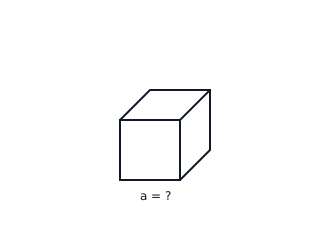
A cube has a total surface area of . Find the length of its edge and its volume.
Solution:
Given, Total Surface Area (TSA) Now, Volume of the cube
Explanation:
Since the cube has 6 identical square faces, we find the area of one face first, then the side length. The volume is the side length raised to the power of three.
Problem 4:
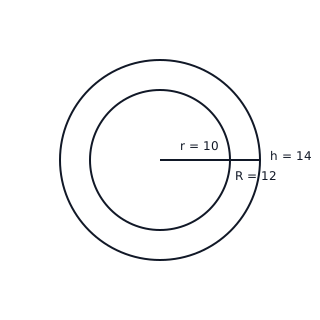
A hollow cylindrical pipe is made of metal and has an external radius of and an internal radius of . If the height of the pipe is , calculate the volume of metal used in making the pipe. (Take )
Solution:
Volume of metal = External Volume - Internal Volume
Explanation:
To find the volume of the material in a hollow cylinder, we subtract the volume of the inner cavity from the total external volume. The formula is , where is the outer radius and is the inner radius.