
Review the key concepts, formulae, and examples before starting your quiz.
🔑Concepts
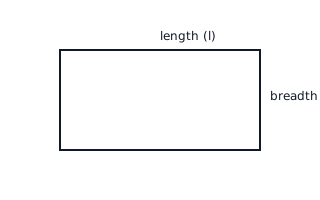
The perimeter of a plane figure is the total length of its boundary. For a triangle with sides , , and , the perimeter is . For a rectangle with length and breadth , it is .
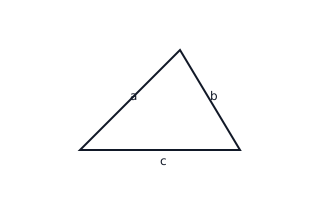
Heron's Formula is used to find the area of a triangle when the lengths of all three sides are known. First, calculate the semi-perimeter , then the Area .
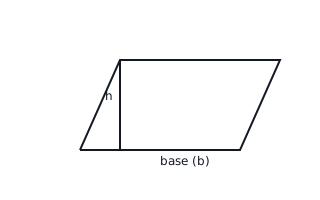
A Parallelogram's area is the product of its base and its corresponding height (altitude). . A Rhombus, being a special parallelogram, also has its area defined by its diagonals: .
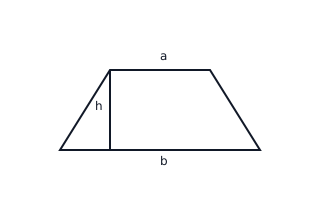
A Trapezium is a quadrilateral with one pair of parallel sides. Its area is given by half the sum of the parallel sides multiplied by the perpendicular distance between them: .
📐Formulae
Perimeter of a Triangle:
Area of a Triangle (General):
Semi-perimeter ():
Heron's Formula:
Area of an Equilateral Triangle:
Area of a Rectangle:
Perimeter of a Rectangle:
Area of a Square: or (where is the diagonal)
Area of a Parallelogram:
Area of a Rhombus:
Area of a Trapezium:
💡Examples
Problem 1:
Find the area of a triangle whose sides are , , and .
Solution:
- Find the semi-perimeter :
- Apply Heron's Formula:
Explanation:
Since all three sides of the triangle are given and it is a scalene triangle, Heron's formula is the most direct method to find the area.
Problem 2:
The area of a rhombus is and one of its diagonals is . Find the length of the other diagonal and the length of its side.
Solution:
- Find the second diagonal ():
- Find the side () using the property that diagonals bisect at right angles:
Explanation:
We use the area formula for a rhombus to find the missing diagonal. Then, we use the Pythagorean theorem on one of the four internal right-angled triangles formed by the diagonals to find the side length.
Problem 3:
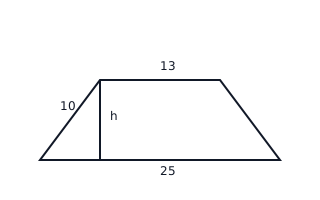
Find the area of a trapezium where the parallel sides are and , and the non-parallel sides are each.
Solution:
- Let the parallel sides be and .
- The non-parallel sides are equal, so it is an isosceles trapezium. Draw perpendiculars from the ends of the shorter side to the longer side.
- The length of the base of the triangle formed on each side is .
- Using Pythagoras theorem for the height :
- Area of Trapezium:
Explanation:
To find the area, we first find the height by utilizing the properties of an isosceles trapezium and applying the Pythagoras theorem on the right-angled triangle formed by the height and the non-parallel side.
Problem 4:
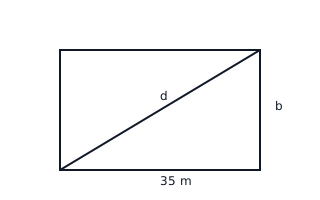
The perimeter of a rectangular field is and its length is . Find the area of the field and the length of its diagonal.
Solution:
- Given Perimeter and Length .
- Formula for Perimeter:
- Area of the rectangle:
- Length of the diagonal :
Explanation:
First, find the breadth using the perimeter formula. Then, use the breadth to calculate the area and the Pythagorean diagonal of the rectangle.