
Review the key concepts, formulae, and examples before starting your quiz.
🔑Concepts
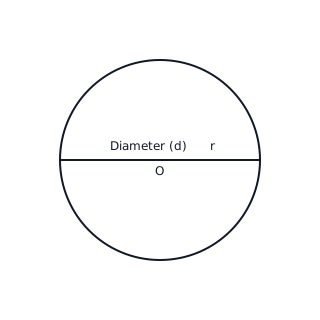
The basic parts of a circle include the radius (), the distance from the center to the edge; the diameter (), which is and passes through the center; and the circumference (), which is the perimeter of the circle.
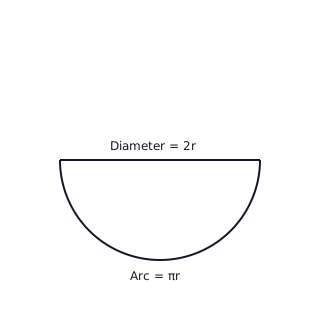
A semi-circle is exactly half of a circle. Its area is half the area of a circle, but its perimeter includes the curved arc length () plus the straight diameter ().
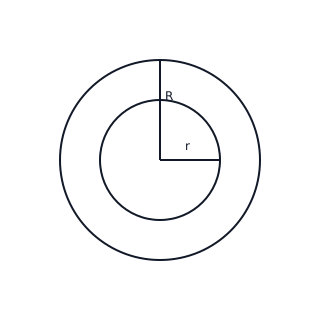
A circular ring (or annulus) is the region between two concentric circles. The area of the ring is calculated by subtracting the area of the inner circle from the area of the outer circle: .
The distance covered by a rotating wheel in one complete revolution is equal to its circumference (). To find the total distance, multiply the circumference by the number of rotations.
📐Formulae
💡Examples
Problem 1:
Find the circumference and the area of a circle whose radius is cm. (Take )
Solution:
Step 1: Identify the given values. Given, radius cm.
Step 2: Calculate the circumference using the formula . cm.
Step 3: Calculate the area using the formula . cm.
Explanation:
This problem demonstrates the direct application of basic circle formulas. We substitute the known radius into the standard equations for circumference and area to find the results.
Problem 2:
The circumference of a circle is cm. Find its area.
Solution:
Step 1: Use the circumference to find the radius . cm.
Step 2: Use the radius to find the area. cm.
Explanation:
In this problem, the radius is not given directly. We must first use the given circumference to solve for the unknown radius. Once the radius is found, we can then proceed to calculate the area.
Problem 3:
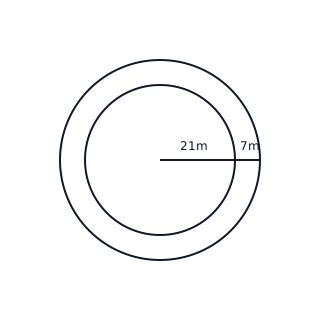
A circular path of width m is built around a circular park of radius m. Find the area of the path.
Solution:
- Let the radius of the inner park be m.
- The width of the path is m, so the outer radius m.
- The area of the path is the area of the ring:
- Using identity :
Explanation:
To find the area of a path around a circle, we calculate the difference between the areas of the larger outer circle and the smaller inner circle.
Problem 4:
Find the perimeter of a semi-circular plate whose diameter is cm. (Take )
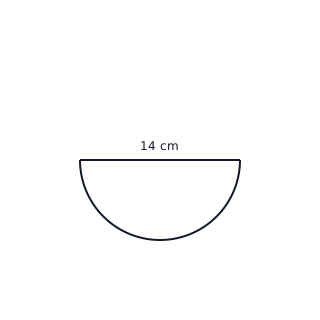
Solution:
- Given diameter cm, so radius cm.
- Perimeter of a semi-circle is given by the sum of the arc length and the diameter:
- Substitute the values:
Explanation:
The perimeter of a semi-circle consists of the curved boundary (half the circumference) plus the straight base (the diameter).