
Review the key concepts, formulae, and examples before starting your quiz.
🔑Concepts
A perpendicular drawn from the center of a circle to a chord bisects the chord. Conversely, the line joining the center to the midpoint of a chord is perpendicular to the chord.
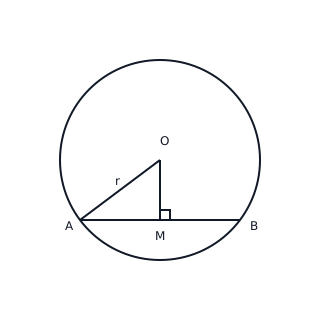
Equal chords of a circle (or of congruent circles) are equidistant from the center. This means if , then the perpendicular distances from the center to these chords are equal.
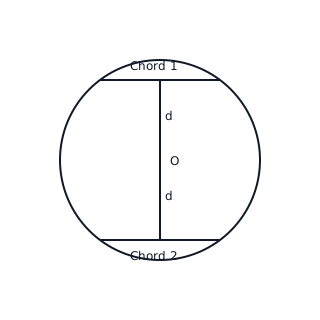
Chords equidistant from the center of a circle are equal in length. This is the converse of the theorem stating that equal chords are equidistant from the center.
The perpendicular bisector of a chord always passes through the center of the circle. This property is used to find the center of a circle when only an arc is given.
📐Formulae
💡Examples
Problem 1:
A chord of length is drawn in a circle of radius . Find the distance of the chord from the center of the circle.
Solution:
Given: Radius , Length of chord . Let be the perpendicular from center to chord . By the theorem, is the midpoint of , so: . In right-angled , using Pythagoras theorem: .
Explanation:
The perpendicular from the center bisects the chord into two segments. We then apply the Pythagoras theorem to the triangle formed by the radius, the distance from the center, and half the chord.
Problem 2:
In a circle of radius , a chord is at a distance of from the center. Find the length of the chord.
Solution:
Given: Radius , Distance . Let the chord be and the perpendicular from the center be . In right-angled : . Since the perpendicular from the center bisects the chord: .
Explanation:
We first find half the length of the chord using the Pythagoras theorem in the right triangle formed by the radius and the distance from the center, then double it to find the full chord length.
Problem 3:
Two chords and of a circle are parallel and have lengths and respectively. If the radius is and the chords are on the same side of the center, find the distance between them.
Solution:
Let be the center and . Let and . Since , . In : . Since , . In : . The distance between the chords is (as they are on the same side): .
Explanation:
Calculate the distance of each chord from the center individually using the Pythagoras theorem. Since they are on the same side of the center, subtract the smaller distance from the larger distance.
Problem 4:
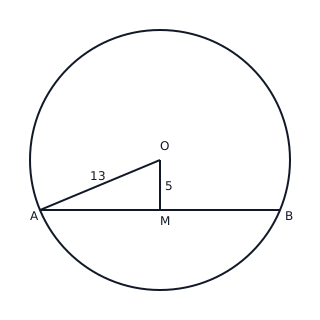
In a circle of radius , a chord is drawn at a distance of from the center. Find the length of the chord.
Solution:
Let the circle have center and the chord be . Let be the perpendicular from to . Given (radius) and (distance). In right-angled : Since the perpendicular from the center bisects the chord: Thus, the length of the chord is .
Explanation:
We use the Pythagorean theorem in the right triangle formed by the radius, the distance from the center, and half the chord length. Multiplying the result by 2 gives the full chord length.
Problem 5:
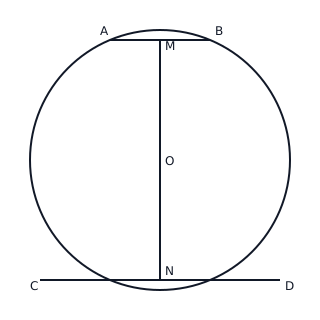
Two chords and of a circle are and long respectively and are parallel to each other. If they are on opposite sides of the center and the distance between them is , find the radius of the circle.
Solution:
Let be the radius and be the center. Let and . Let , then . In , : In , : Equating (1) and (2): Substitute into (1):
Explanation:
By expressing the radius squared in terms of the distance from the center for both chords, we create an equation to solve for the unknown distance , then find the radius.