krit.club logo

I'm Up and Down, and Round and Round - Angles Subtended by an Arc

Grade 9CBSE

Review the key concepts, formulae, and examples before starting your quiz.

🔑Concepts

•

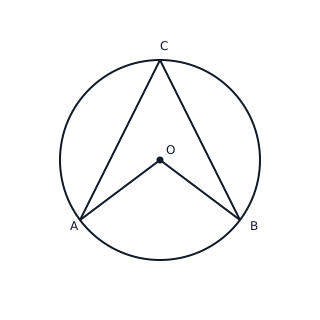
The angle subtended by an arc at the centre of a circle is double the angle subtended by it at any point on the remaining part of the circle. This means if arc ABAB subtends ∠AOB\angle AOB at centre OO and ∠ACB\angle ACB at the circumference, then ∠AOB=2∠ACB\angle AOB = 2\angle ACB.

Diagram showing angle at centre O (AOB) and angle at circumference C (ACB).
•

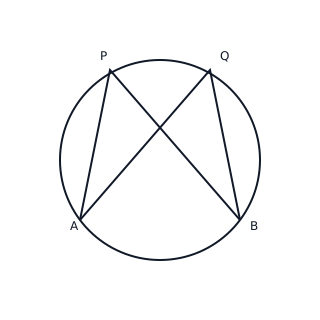
Angles in the same segment of a circle are equal. If two angles ∠APB\angle APB and ∠AQB\angle AQB are subtended by the same arc ABAB in the same segment, then ∠APB=∠AQB\angle APB = \angle AQB.

Angles P and Q subtended by arc AB are equal.
•

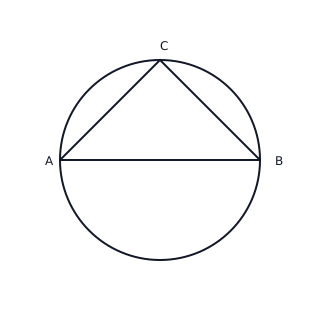
The angle in a semi-circle is always a right angle (90∘90^{\circ}). This is a special case of the central angle theorem where the arc is a semi-circle (central angle is 180∘180^{\circ}).

Triangle ABC in a circle where AB is diameter and angle C is 90 degrees.
•

For a cyclic quadrilateral, the sum of either pair of opposite angles is 180∘180^{\circ}. Conversely, if the sum of a pair of opposite angles of a quadrilateral is 180∘180^{\circ}, the quadrilateral is cyclic.

📐Formulae

∠at centre=2×∠at circumference\angle \text{at centre} = 2 \times \angle \text{at circumference}

∠BAC=∠BDC (Angles in the same segment)\angle BAC = \angle BDC \text{ (Angles in the same segment)}

In a semi-circle, ∠ACB=90∘\text{In a semi-circle, } \angle ACB = 90^{\circ}

In cyclic quadrilateral ABCD:∠A+∠C=180∘,∠B+∠D=180∘\text{In cyclic quadrilateral } ABCD: \angle A + \angle C = 180^{\circ}, \angle B + \angle D = 180^{\circ}

💡Examples

Problem 1:

In the given figure, OO is the centre of the circle. If ∠AOB=110∘\angle AOB = 110^{\circ}, find ∠ACB\angle ACB where CC is a point on the major arc.

Solution:

Given ∠AOB=110∘\angle AOB = 110^{\circ}. By the degree measure theorem, the angle subtended by an arc at the centre is double the angle subtended by it at any point on the remaining part of the circle. Therefore: ∠AOB=2∠ACB\angle AOB = 2 \angle ACB 110∘=2∠ACB110^{\circ} = 2 \angle ACB ∠ACB=110∘2=55∘\angle ACB = \frac{110^{\circ}}{2} = 55^{\circ}

Explanation:

Applied the Central Angle Theorem which states the relationship between the angle at the centre and the angle at the circumference.

Problem 2:

In a circle, ABAB is the diameter and CC is any point on the circle. If ∠ABC=30∘\angle ABC = 30^{\circ}, find ∠BAC\angle BAC.

Solution:

Since ABAB is the diameter, the angle subtended by it in the semi-circle is 90∘90^{\circ}. Therefore, ∠ACB=90∘\angle ACB = 90^{\circ}. In △ABC\triangle ABC: ∠BAC+∠ACB+∠ABC=180∘\angle BAC + \angle ACB + \angle ABC = 180^{\circ} ∠BAC+90∘+30∘=180∘\angle BAC + 90^{\circ} + 30^{\circ} = 180^{\circ} ∠BAC+120∘=180∘\angle BAC + 120^{\circ} = 180^{\circ} ∠BAC=60∘\angle BAC = 60^{\circ}

Explanation:

First used the property that an angle in a semi-circle is 90∘90^{\circ}, then applied the angle sum property of a triangle.

Problem 3:

If PQRSPQRS is a cyclic quadrilateral and ∠P=3x−5∘\angle P = 3x - 5^{\circ} and ∠R=x+25∘\angle R = x + 25^{\circ}, find the value of xx.

Solution:

In a cyclic quadrilateral, the sum of opposite angles is 180∘180^{\circ}. Since PP and RR are opposite angles: ∠P+∠R=180∘\angle P + \angle R = 180^{\circ} (3x−5)+(x+25)=180(3x - 5) + (x + 25) = 180 4x+20=1804x + 20 = 180 4x=1604x = 160 x=40x = 40

Explanation:

Used the property of cyclic quadrilaterals where the sum of opposite angles equals 180∘180^{\circ} to set up a linear equation.

Problem 4:

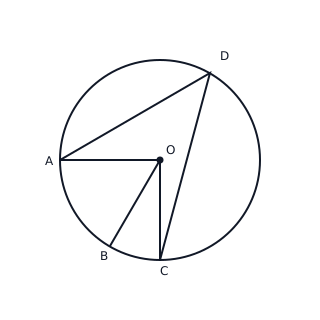
In the given figure, OO is the centre of the circle. Points AA, BB, and CC lie on the circle such that ∠BOC=30∘\angle BOC = 30^{\circ} and ∠AOB=60∘\angle AOB = 60^{\circ}. If DD is a point on the circle other than the arc ABCABC, find ∠ADC\angle ADC.

Circle with center O, points A, B, C on one side and D on the other.

Solution:

Total angle at the centre subtended by arc ABC=∠AOC\text{Total angle at the centre subtended by arc } ABC = \angle AOC ∠AOC=∠AOB+∠BOC=60∘+30∘=90∘\angle AOC = \angle AOB + \angle BOC = 60^{\circ} + 30^{\circ} = 90^{\circ} Since angle at centre is double the angle at circumference:\text{Since angle at centre is double the angle at circumference:} ∠AOC=2×∠ADC\angle AOC = 2 \times \angle ADC 90∘=2×∠ADC90^{\circ} = 2 \times \angle ADC ∠ADC=90∘2=45∘\angle ADC = \frac{90^{\circ}}{2} = 45^{\circ}

Explanation:

We first find the total angle subtended by the arc ABCABC at the centre OO by adding the adjacent angles. Then, we apply the theorem that the angle subtended by an arc at the centre is twice the angle subtended at any other point on the circle.

Problem 5:

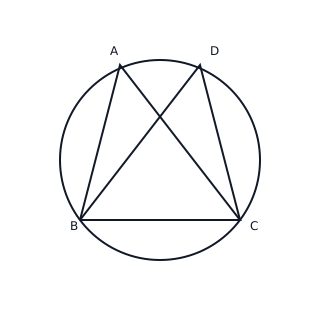
In the figure, ∠ABC=69∘\angle ABC = 69^{\circ} and ∠ACB=31∘\angle ACB = 31^{\circ}. Find ∠BDC\angle BDC.

Circle showing two triangles ABC and DBC sharing the same base BC.

Solution:

In △ABC:\text{In } \triangle ABC: ∠BAC+∠ABC+∠ACB=180∘\angle BAC + \angle ABC + \angle ACB = 180^{\circ} ∠BAC+69∘+31∘=180∘\angle BAC + 69^{\circ} + 31^{\circ} = 180^{\circ} ∠BAC+100∘=180∘\angle BAC + 100^{\circ} = 180^{\circ} ∠BAC=180∘−100∘=80∘\angle BAC = 180^{\circ} - 100^{\circ} = 80^{\circ} Since angles in the same segment are equal:\text{Since angles in the same segment are equal:} ∠BDC=∠BAC=80∘\angle BDC = \angle BAC = 80^{\circ}

Explanation:

We use the angle sum property of a triangle to find the angle at point AA inside △ABC\triangle ABC. Since points AA and DD are in the same segment relative to chord BCBC, the angles subtended by the arc BCBC at these points must be equal.