
Review the key concepts, formulae, and examples before starting your quiz.
🔑Concepts
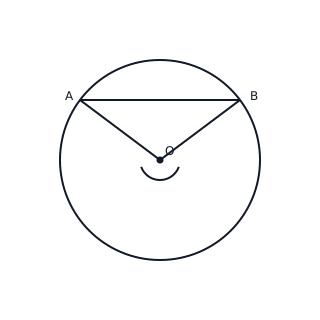
A chord subtends an angle at the center of a circle. Equal chords of a circle subtend equal angles at the center.
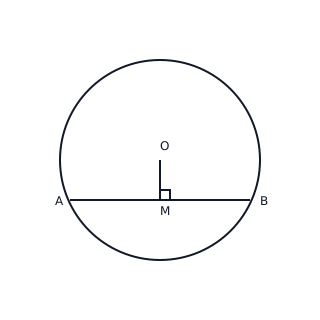
The perpendicular from the center of a circle to a chord bisects the chord. Conversely, the line drawn through the center of a circle to bisect a chord is perpendicular to the chord.
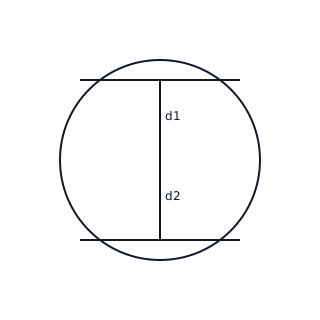
Equal chords of a circle (or of congruent circles) are equidistant from the center.
The angle subtended by an arc at the center is double the angle subtended by it at any point on the remaining part of the circle.
📐Formulae
💡Examples
Problem 1:
A chord of length is drawn in a circle of radius . Find the distance of the chord from the center of the circle.
Solution:
Given: Radius , Chord length . Let the distance from the center be . The perpendicular from the center bisects the chord, so the half-length of the chord is: Using the Pythagoras theorem in the right-angled triangle formed by the radius, the distance, and the half-chord:
Explanation:
We use the property that the perpendicular from the center to a chord bisects it, creating a right-angled triangle where the radius is the hypotenuse.
Problem 2:
In a circle with center , two chords and are such that . If , find the value of .
Solution:
According to the theorem, equal chords of a circle subtend equal angles at the center. Given that chord . Therefore, . Since , then .
Explanation:
This directly applies the theorem stating that equal chords subtend equal angles at the center of the circle.
Problem 3:
Find the length of a chord which is at a distance of from the center of a circle of radius .
Solution:
Given: and . We need to find the length of the chord . From the relation :
Explanation:
By calculating the half-chord length using Pythagoras theorem and then doubling it, we find the full length of the chord.
Problem 4:
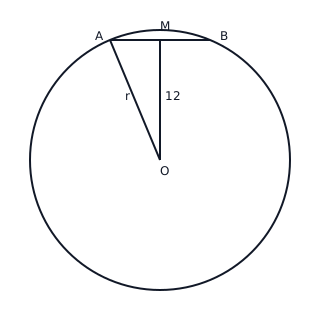
Two chords and of a circle are each. If the distance of chord from the center is , what is the radius of the circle?
Solution:
Let be the midpoint of chord . Since , . In , using Pythagoras theorem: .
Explanation:
Equal chords are equidistant from the center, so is also at . We use the property that a perpendicular from the center bisects the chord to form a right-angled triangle with the radius.
Problem 5:
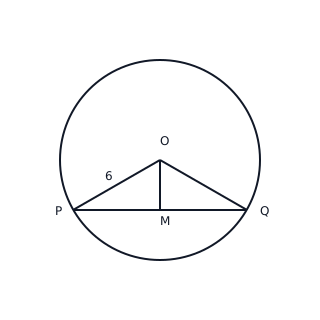
In a circle with center , chord subtends an angle of at the center. If the radius is , find the length of the chord .
Solution:
Draw . Since bisects , . In , .
Explanation:
The perpendicular from the center to a chord bisects the angle at the center. By using trigonometry in the resulting right-angled triangle, we find half the chord length.