
Review the key concepts, formulae, and examples before starting your quiz.
🔑Concepts
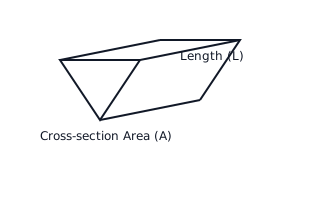
A prism is a 3D shape with a constant cross-section throughout its length. The volume is always calculated by multiplying the area of this cross-section by the length or height of the prism.
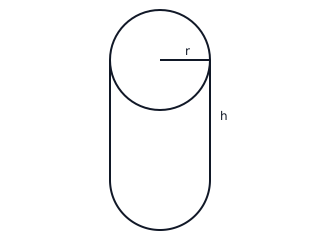
A cylinder is a special type of prism where the cross-section is a circle. The volume is given by .
The Total Surface Area (TSA) of a prism is the sum of the areas of all its faces. This includes two identical base areas and the lateral area (perimeter of base length).
The curved surface of a cylinder, when 'unrolled', forms a rectangle where the length is the circumference of the circle () and the width is the height ().
📐Formulae
💡Examples
Problem 1:
A triangular prism has a right-angled triangular base with sides 3 cm, 4 cm, and 5 cm. The length of the prism is 10 cm. Calculate its Volume.
Solution:
Explanation:
- Find the area of the triangular cross-section: . 2. Multiply by the length: .
Problem 2:
Calculate the total surface area of a cylinder with a radius of 7 cm and a height of 10 cm. (Use )
Solution:
Explanation:
- Area of two circular bases: . 2. Curved surface area: . 3. Total Surface Area = .
Problem 3:
A rectangular water tank (cuboid) measures 2m by 1.5m by 1m. How many liters of water can it hold?
Solution:
Explanation:
- Calculate volume in : . 2. Convert to liters: Since liters, liters.
Problem 4:
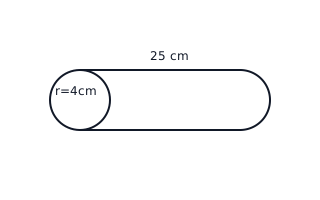
A cylindrical pipe has an internal radius of and a length of . Calculate the volume of water the pipe can hold in terms of .
Solution:
Explanation:
To find the volume, identify the radius and the height (length) . Substitute these values into the cylinder volume formula.
Problem 5:
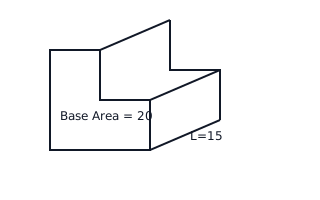
Find the total surface area of a L-shaped prism with a constant cross-sectional area of , a base perimeter of , and a length of .
Solution:
Explanation:
The total surface area of any prism is the sum of the areas of the two identical bases and the area of the rectangular sides (lateral area). The lateral area is the perimeter of the base multiplied by the prism's length.